

🗝️ The Upgrade | Weekly by Anne Marie Brown
17. The Upgrade | Weekly – Macro and Micro Economics Driving Shifts in the Luxury Travel Market
Travelers,
I’ve spent the last few weeks putting my MBA hat back on and reading a bunch of wonky economics articles. I’ve been searching for what is driving my client behavior, which has shifted dramatically from five years ago. I’ve been in the luxury travel industry for over 18 years now, and I’m trying to understand why this year feels so different.
After a week in the French Riviera and watching many of the places like Le Geurite just print money, I read Nadine’s The Stanza article on the economics of Euro Summer and wondered how the larger economic trends – macro and micro – are shifting luxury travel behavior.
The US stock market has been on a tear, minting new millionaires by the thousands. Where are these travelers going? How are the luxury markets absorbing their travel?
Wealth concentration, a bifurcated hospitality market, global politics, an $84 trillion wealth transfer, fuel volatility from the Iran conflict, and a booking window that keeps shrinking have all reshaped what luxury travel looks like in 2026.
Read on for my economics report and what it means for hospitality professionals, travel advisors, and luxury travelers.
This week's Lobby Bar covers the Four Seasons Danieli's Venice opening, why luxury is the only chain scale really running hot, the fading World Cup bump, hotel brands redrawing status and fees, Hyatt's bigger India expansion plans, Marriott's nine-hotel Egypt deal, and Mexico's $115 million sargassum plan.
Happy travels!
Anne Marie
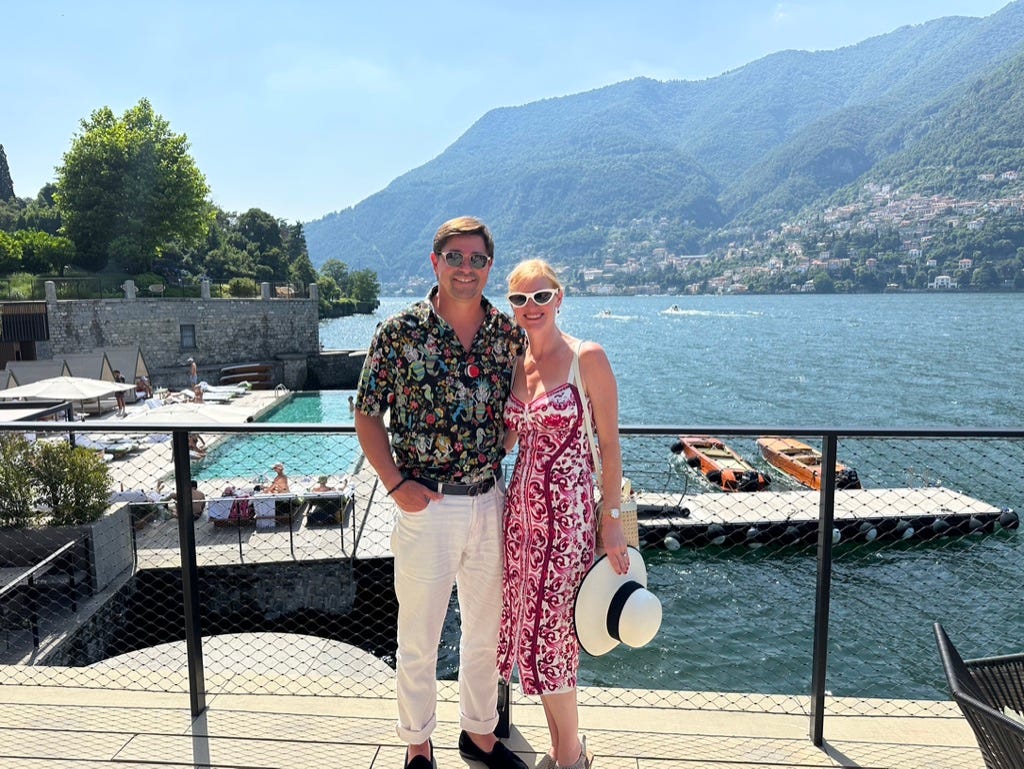
Yours truly at Il Sereno, in Lake Como, with my husband,
because what says luxury travel more than this background?
🗝️ Pre-Departure — Hospitality Hot Takes
The Forces Reshaping Luxury Travel: A Macro and Micro Economic Look
I co-own Alpenglow Travel, one of the top luxury travel agencies hosted under Coastline Travel. The past five years in luxury travel include two distinct chapters: a post-pandemic surge built on pent-up demand and emotional spending, followed by a structural reset driven by wealth concentration, supply constraints, and a fundamental shift in what affluent travelers are searching for.
Macro Forces
Wealth Concentration
The most important macro factor is that the wealthy have become significantly wealthier, and their travel spend has kept rising.
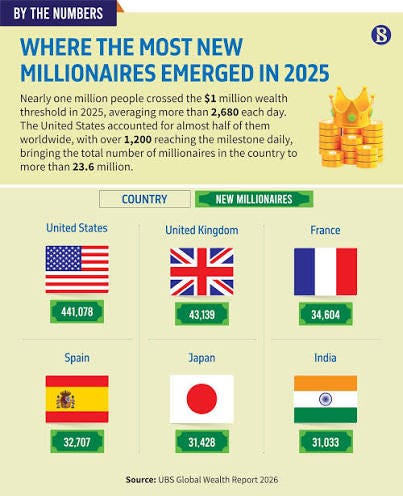
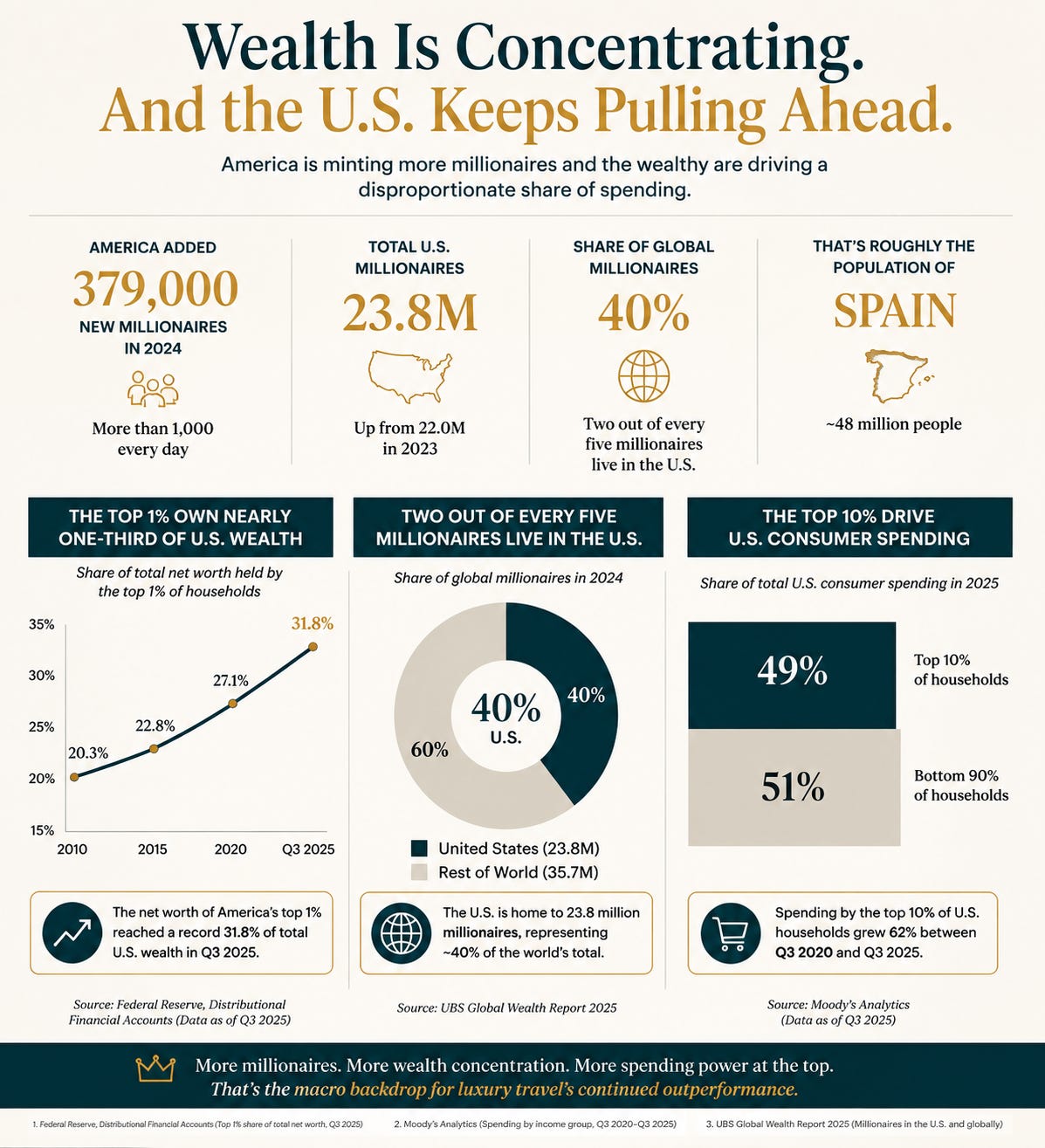
The net worth of America’s top 1% reached a record share of nearly 32% of total US wealth in Q3 2025.1 In 2024 alone, the US added over 379,000 new millionaires, bringing the total to 23.8 million and representing roughly 40% of global millionaires.4,5
That means that the number of millionaires in the US is roughly half the size of Spain’s entire population – ortwo out of every five millionaires on the planet!
Moody’s Analytics found that spending by the top 10% of US households grew 62% between Q3 2020 and Q3 2025, far outpacing every other income group.2 The top 10% of US earners accounted for nearly half of all US consumer spending in 2025, a historic high.2
Where are these newly minted millionaires spending their travel budgets?
Let’s say your net worth is $3-5M, and your annual travel spend is $60 - $100k. You want to blow it out with a $30k trip to the French Riviera. There are only so many luxury hotels in the French Riviera, and you want to stay at Airelles. The remainder goes to beach clubs, dining, and incidentals.
The French Riviera – let alone Airelles – can only absorb so many of these new millionaires, so hotels and beach clubs raise prices. Booking windows become longer. It’s no longer about having the money, it’s about connections and waitlists. In other words, luxury today = access.
The K-Shaped Economy Is Structural
Everyone is talking about the K-Shaped Economy, a decades-long pattern of uneven economic trends showing a downward pattern in wealth for the lower middle class and an upward growth trend for the wealthy.3 This is particularly visible in the bifurcation of the hospitality industry, where hotels targeting the middle class are seeing lower occupancy, but the luxury and ultra-luxury sector seems to see no softening of demand, despite increasingly sky-high ADRs (average daily rates).11
Through August 2025, the luxury hotel segment posted year-to-date RevPAR (revenue per available room) growth of 5.3%, while the economy segment shrank 1.8%. Luxury and upper-upscale were the only two chain scales to post positive RevPAR growth, with ADR up 5.0% year over year.11
The K-shape is also playing out within the luxury hospitality sector itself. Suites are selling out at record rates while opening categories sit empty. Properties are responding by converting smaller rooms into suites to follow where the money is concentrated.12
My experiences tell me that this is likely a reflection of more families traveling together with their children and childcare providers, needing larger rooms or connecting suite configurations. The new signal of wealth is no longer taking the ultra-expensive anniversary trip, it’s bringing your children and nanny along with you for a three-month Euro summer.
Airlines are capitalizing on this trend, converting cabins to make space for more business class passengers. Delta’s main cabin sales dropped 7% in 2025 while business and first-class rose 9%, with premium tickets surpassing economy sales for the first time ever.13
Intergenerational Wealth Transfer Is Accelerating Demand
The other figure I’m seeing thrown around is the $84 trillion intergenerational wealth transfer to the millennials in the US.9 Multi-generational travel has grown significantly in the past two years, and many of my millennial clients are paying for their boomer and Gen X parents to travel with them.
Bain and Altagamma identified the rise of “inheritourism,” in which wealthy families travel together and Gen Z adopts the (expensive) travel preferences of their parents.7,8
Properties with multi-bedroom configurations, private pools, and flexible programming are capturing that demand. My clients are requesting more suites and staffed villas, but eschewing Airbnb, which they view as no longer a trusted source of luxury home rentals. Distrust and scams are driving more people to work with trusted advisors.
Goods vs. Experiences: A Structural Reordering
Bain and Altagamma’s annual Luxury Goods Worldwide Market Study found a persistent global shift favoring experiential spend over conspicuous consumption as the new marker of status.6
My millennial clients don’t want a Birkin. They want a week at Hotel Du Cap-Eden Roc, reservations at Le Guerite, and a day-charter yacht.
Among top 1% travelers, 54% now prioritize private tours and immersive activities over hotel upgrades or fine dining.8
The number of my clients sending me a very specific ask or Instagram link to a private forager in Umbria, a particular beach club seating, a recommended guide in the Maasai Mara, etc. has been growing.
International Inbound: A Headwind for US Hotels
The United States is projected to have lost $12.5 billion in international traveler spending in 2025, a 6.6% drop from 2024, driven in part by perceptions of the current US political environment.16 Canadian visitation fell 23.7% year-to-date through June 2025.17
U.S luxury properties that depend heavily on European or Canadian guests are absorbing that directly as their occupancy rates plummet.
However, my US clients are also changing their travel patterns. Many of them are steering clear of Mexico following the Puerto Vallarta cartel incident this past spring and opting for Hawaii or Europe instead. I’m also seeing a large increase in requests for Japan, which is seen as politically neutral and safe for Americans.
Micro Forces
Destination Patterns
Overtourism, crowds, and heatwaves across Europe are changing where people go. LHW (Leading Hotels of the World) bookings for “coolcation” destinations, including Patagonia and UK and Irish countryside, grew nearly 40% over two years. Nordic bookings are up 45% year over year; Alpine bookings up 15%.15 In my own pipeline, interest in the Dolomites and broader Alpine region has surged.
Clients are swapping out famous cities for lesser-known ones in the same region. For example, clients heading to Greece are no longer requesting Santorini and Mykonos, but shifting to Paros and Milos. Slovenia, Sardinia, Corsica, Albania, and Montenegro are also trending thanks to social media and the perpetual search for the “next hidden gem.”
Traditional travel media and tourism boards are also launching campaigns to try spreading tourism away from the most popular locations and toward lesser-known places.
Booking Windows Are Compressing
Clients are booking closer to travel dates as they watch the news for anything that might affect their travel plans. In May, I received close-in requests for parts of Spain, Ireland, Scotland, and the South of France - trips that previously would have been booked six months in advance. A reservation at Le Guerite in Cannes for the 3 pm seating is just not possible with a three-week lead time. This has been a stressful shift for me as a travel advisor.
This shorter booking window is also creating pressure on availability at top properties, which are often sold out ever-further in advance. My relationship with sales directors has become even more valuable. Knowing which properties hold space, which have waitlists that adjust, and which release inventory according to a specific cycle is becoming the mark of an expert advisor, separating the veterans from the less experienced.
My advice for luxury travelers is to fight the urge to book close in. The surge in wealthy travelers means less availability at the places you hope to go, so book your Euro summer a year in advance. May 2027 is already too close in. Many places in Lake Como were sold out half a year ago. Why scramble for scraps?
Geopolitical Risk
The Iran Conflict Is Reshaping Routing, Costs, and Risk Tolerance
Geopolitical disruption has always been part of travel planning. Over my career at Exclusive Resorts and Inspirato running experiential travel groups for their membership, I saw cancelled private charter flights due to volcanic ash, Greek austerity riots rerouting a cruise ship, airport closures, pandemics and outbreaks, natural disasters, you name it.
The Iran conflict and the resulting fuel volatility and airspace restrictions are impacting routing, connections, and logistics for many of my clients.’
In terms of routing, the Iran conflict has exposed the vulnerability of Middle Eastern hubs for Gulf carriers. As of mid-2026, EASA (European Union Aviation Safety Agency) has toughened advisories warning airlines to avoid airspace over Bahrain, Kuwait, Qatar, the UAE, and the Gulf of Oman, with separate extended warnings for Iran, Iraq, and Lebanon.22
For travel to Africa, a connection through London, Paris, Amsterdam, or Frankfurt feels less exposed to sudden airspace closures than one through a Gulf hub.
The most direct impact of rising fuel costs is on private aviation. Charter quotes absorb higher jet fuel prices, longer routings around restricted airspace, elevated insurance costs, and aircraft-positioning problems when demand suddenly shifts.
Safaris are tied to fuel costs through logistics via bush flights, helicopters, game-drive vehicles, camp generators, and supply deliveries. I am starting to see industry-wide standardized surcharges across African operators as charter companies and DMCs (destination management companies) are now passing those increases through. 2027 rates are starting to incorporate higher transportation costs.
If you want to go to Africa next year, book NOW. Rates will keep climbing.
Yachts are absorbing the same fuel pressure. On most crewed luxury charters, the advertised weekly rate does not include fuel; operating expenses reconcile against the APA (Advanced Provisioning Allowance - APA stands for Advance Provisioning Allowance, deposit around 20-30% of the base charter fee that you pay upfront to cover all the running expenses during your charter) at the end of the charter. OPIS (Oil Price Information Service) reported that marine gas oil in Rotterdam rose by $724 per metric ton between late February and the end of March 2026, virtually doubling to $1,448 per metric ton in just a month!21
Clients Want Flexibility
Flexibility itself has become a luxury product. That means flexible air tickets, hotels willing to move dates, operators with strong local logistics, and advisors more frequently called in the middle of the night to help with flight reroutes or cancellations.
I’m seeing more clients purchasing cancel-for-any-reason coverage plans in travel insurance.
Traveler Wants Have Changed
In 2026, luxury clients are prioritizing privacy, wellness, and unique experiences.19
My clients aren’t satisfied with taking their family to Rome. They want to see all the major sites with private access or early openings, are looking for unique experiences like a golf cart tour (for those older clients or those with mobility issues - Maria Shollenbarger would like me to note that golf carts are not recommended for those who can walk easily) that sweeps them through side streets, or a gladiator class (no real swords or tridents!) for their kids. They don’t want city orientation tours but prefer a cooking class in a local home.
Among top 1% travelers, 34% are planning a trip primarily for health and wellness in the next 12 months, up from 23% previously.8 Travelers are looking for places that are far enough off the grid to keep them from being reached by email.20
My clients are also moving away from big chains and searching for independently owned boutique hotels with character. The Leading Hotels of the World reported 15% year-over-year revenue growth in early 2025. Independent and boutique luxury properties are capturing disproportionate market share relative to their footprint.15
The Bottom Line
The structural conditions in this market favor travelers who know what they want and book with intention at least several months in advance. A one- or two-month booking window isn’t going to cut it for European destinations in the summer.
The aspirational middle of the luxury market is getting squeezed by rate increases and suite conversions. A $1,000-per-night hotel room is now table stakes for a lower-tier five-star hotel; more likely you’ll see $1,200 and above.
Travelers in the luxury market are spending more per trip, booking with more specificity, and choosing properties more carefully. They are seeking flexibility, access, and reassurance.
🗝️ Substack Writers You Should be Reading
In lieu of the Room Report this week, I’m including a list of some of my favorite writers on Substack in the travel, hospitality, and culture space.
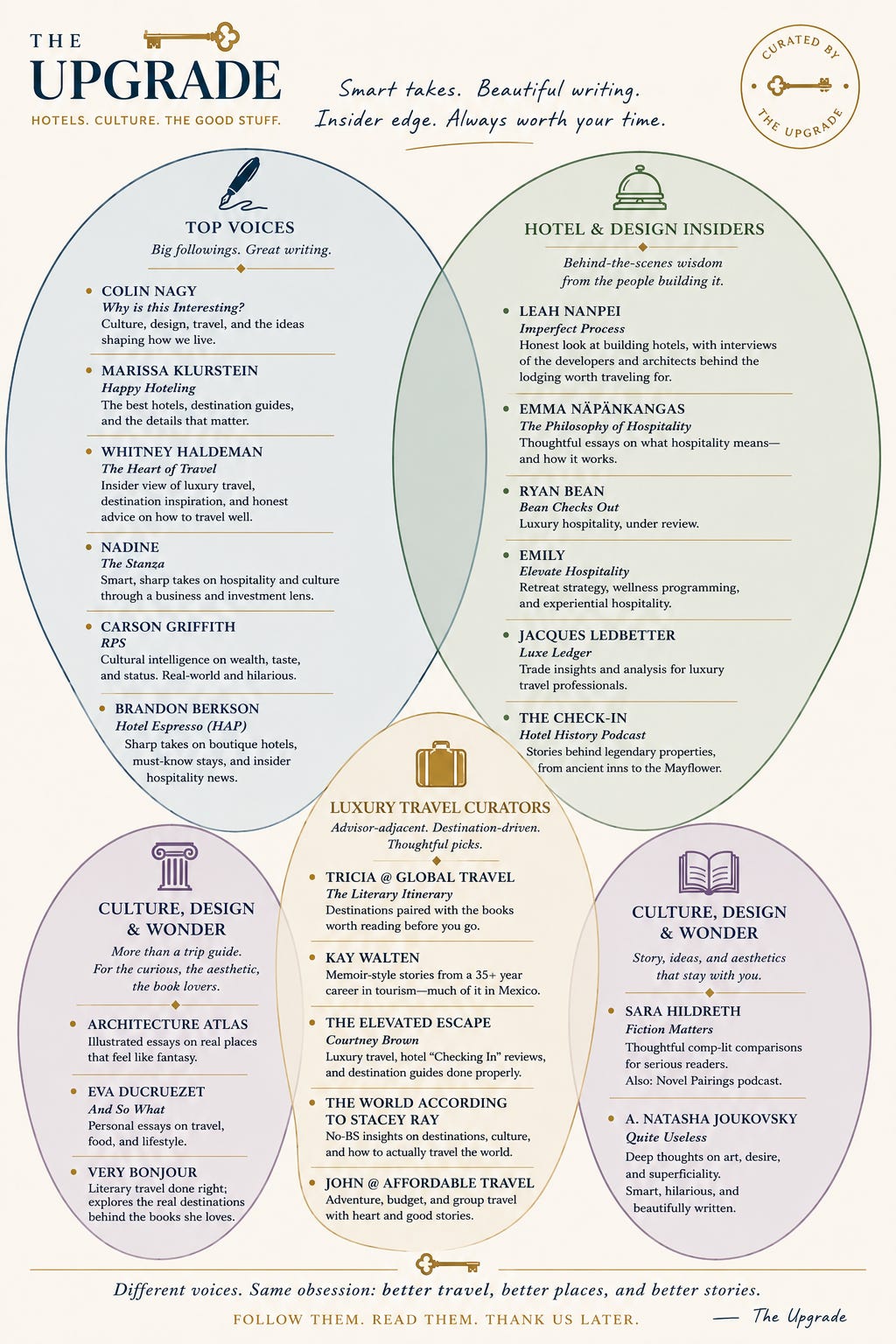
The Heavy Hitters
These are the writers that you’ll see consistently top the charts - they have significant followings already and for good reason.
Colin Nagy: A writer and brand strategist (Skift, Monocle, FT, Meta) who co-writes Why is this Interesting?, a daily newsletter on culture, design, travel, and the ideas shaping how we live. Colin is a gem, he’s so encouraging and takes the time to highlight other writers. He’s also an excellent writer, and I gobble up all his Skift articles - worth the subscription on Skift alone. Colin Nagy
Marissa Klurstein, Happy Hoteling: Marissa writes a lot about Italy, and was kind enough to let me interview her for an article about finding smaller hotels that are not on GDS (global distribution systems). covering the world’s best hotels, destination guides, and the little details that separate a great stay from a forgettable one. Marissa Klurstein
Whitney Haldeman, The Heart of Travel: A luxury travel advisor (Blonde Atlas) sharing an insider’s view of the industry, destination inspiration, and honest advice on how to travel well. I got to meet Whitney in London this summer. There are few travel advisors I admire more in our world than her. Whitney Haldeman
Nadine @ The Stanza: The publication I read absolutely every time it comes out. Nadine offers smart, sharp take on hospitality and culture through a business and investment lens, covering hotels, restaurants, and the brands defining modern taste. Her interviews with hospitality leaders are excellent, and I love her finance-focused articles on such things as the economics of Euro Summer. Nadine @ The Stanza
RPS by Carson Griffith: Buzzy cultural intelligence on wealth, taste, and status; how elite worlds actually operate. Carson makes me laugh, and she’s an excellent real-world writer with her work consistently in several large publications. This is what I read with my coffee. She was also my source for my article on membership clubs attached to hotels. Carson Griffith
Hotel Espresso by Brandon Berkson (HAP): ok, even though Brandon didn’t include The Upgrade on his list of hospitality writers you should read on Substack, I’ll forgive him and acknowledge that The Upgrade is only 17 issues deep - let’s give him time to catch on and maybe I’ll make the next list! In all honesty, Brandon offers sharp takes on boutique hotels, must-know stays, and insider hospitality news. Brandon Berkson
Hotel & Design Insiders (behind-the-scenes, industry-focused)
Leah Nanpei, Imperfect Process: A designer and hospitality brand founder writing an honest, after-hours look at building hotels, with interviews of the developers and architects behind the lodging worth traveling for. If I’m a soft product expert in hotels, Leah is the hard product one. Leah Nanpei
Emma Näpänkangas, The Philosophy of Hospitality: Positioned as "the internet's first grand hotel," a thoughtful, essayistic take on what hospitality means and how it works. I just adore Emma. I think we would be best friends if we ever met in real life. I’ve quoted several of her articles for EHL on here. Emma Näpänkangas
Bean Checks Out: Ryan Bean’s candid, sharp reviews of luxury hotels and hospitality with a critic’s eye, tagline “luxury hospitality, under review.” Bean Checks Out
Emily @ Elevate Hospitality: A newsletter on retreat strategy, wellness programming, and experiential hospitality for people building the next generation of resorts and hotels. Emily @ Elevate Hospitality
Hotel History Podcast, The CHECK-IN: Stories behind legendary properties, from ancient inns to the Mayflower. Hotel History Podcast
Luxe Ledger: Jacques Ledbetter’s trade-focused newsletter for luxury travel professionals, offering candor, context, and industry analysis on advisors, hotels, and market trends. Luxe Ledger: Private Edition
Luxury Travel Curators (advisor-adjacent, hotel and destination picks)
Tricia @ Global Travel, The Literary Itinerary: Pairs destinations with the books worth reading before you go, for readers with “more time, better taste, and less patience for bad travel.” TriciaGlobalTravel
Kay Walten: A hospitality veteran with 35+ years in tourism (much of it in Mexico), sharing memoir-style stories about the leaps, life changes, and adventures behind a life built abroad. Kay Walten
The Elevated Escape: Courtney Brown’s take on luxury travel, with hotel “Checking In” reviews (Blackberry Farm, Montage Los Cabos, Southall) and destination guides done properly. The Elevated Escape
The World According to Stacey Ray: Stacey Ray, founder of a global community for solo women travelers, delivering no-BS insights on destinations, culture, and how to actually travel the world. Stacey Ray
John @ Affordable Travel: John B’s newsletter on adventure, budget, and group travel, focused on food, culture, and connecting with people over polish. John B | Affordable Travel
Culture, Design & Wonder (aesthetic, literary, more than a trip guide)
Architecture Atlas: Mary’s illustrated newsletter on real places that feel like fantasy. Her drawings are extraordinary. This is not a talent I have. Mary | Architecture Atlas
Eva Ducruezet, And So What: Personal essays on travel, food, and lifestyle with a casual, self-aware voice. Eva Ducruezet
Very Bonjour: Literary travel done right; explores the real destinations behind the books she loves. Set Jetting as a substack. Very Bonjour
Sara Hildreth, Fiction Matters: Sara and I went to college together at Colorado College and were in several English classes together. She was a teacher for a while before starting Fiction Matters and Novel Pairings, her newsletter and podcast. I’m a huge book nerd, but she blows me away with how much she reads and her thought comp-lit comparisons. If you love to read, this should be a paid subscription. Sara Hildreth
A. Natasha Joukovsky, Quite Useless: Deep thoughts on art, desire, and superficiality; smart and approachable writing on aesthetics and culture. Natasha and I met when I was at business school at UVA, and I think she’s one of the smartest people I know. When she’s not a high-powered, badass consultant, she is casually writing bestselling novels such as Portrait of a Mirror and Medium Rare. Her prose is gorgeous and complex, and I could talk to her over a beer at the Virginian for hours. She’s also hilarious. a. natasha joukovsky
*If I have not listed your substack in this list, please don’t take offense, I will be including these highlight lists frequently, and I’m already out of word count…
🗝️ The Lobby Bar — Hospitality updates, promotions, and the occasional pun
Four Seasons opened the Danieli in Venice on July 30, converting the 200-year-old former Marriott Luxury Collection property near St. Mark’s Square. The hotel spans three buildings dating to the 14th and 19th centuries and will grow from 120 to 176 keys by 2027, with a rooftop restaurant, the lobby’s Bar Dandolo, and a spa with sauna and hammam. Rooms start around $2,700 a night. (Upgraded Points
It’s earnings season, and luxury is the only chain scale really running hot right now. Marriott’s Q2 luxury RevPAR grew more than 9% against a 3.4% systemwide number, and Hyatt and Hilton both pointed to luxury and upper upscale as their strongest segments. (Hotel Dive, Hospitality Net)
The World Cup bump is fading fast. Hyatt’s host cities saw group RevPAR up more than 13% in June, and Marriott, Hilton, and Hyatt all cited the tournament as a driver of Q2 strength, but Marriott’s CFO is already flagging a small negative hit in Q4 tied to the midterms. (Hotel Dive)
Hotel brands are shaking up fee structures. Hilton is cutting owner-side fees even as its own management and franchise fees rose 6.4% year over year, and Marriott is building an airline-style upsell system where elite members now bid for suites they used to get free. (Skift, Upgraded Points)
Hyatt’s expansion plans in India just got a lot bigger. The company is targeting a roughly fivefold increase over the next five years, up from 56 hotels across nine brands today and a 100-property pipeline already in motion. (Skift)
Marriott signed a deal for 9 hotels and branded residences across Egypt, over 1,500 keys spanning Ritz-Carlton, Luxury Collection, and Autograph Collection projects on the North Coast, in Cairo, and at Ain Sokhna on the Red Sea. (Upgraded Points)
Mexico is spending $115 million to fight record sargassum levels in Quintana Roo, funding specialized collection vessels, offshore barriers, and monitoring systems meant to intercept the algae before it reaches shore. Hotels have already cut rates by up to 40% this summer. (Skift)
Sources
1 Federal Reserve Distributional Financial Accounts. “Shares of Wealth by Wealth Percentile Groups.” Q3 2025. federalreserve.gov
2 Moody’s Analytics. “The Concentration Conundrum.” Reported via The Washington Post, January 2026.
3 U.S. Bank Economics Research Group. “The K-Economy in 2026: Same Story, New Amplifiers.” usbank.com, July 2026.
4 Grand View Research. “U.S. Luxury Travel Market Report.” 2025. grandviewresearch.com
5 UBS Global Wealth Report. Cited in AltexSoft, “Luxury Travel Market: Key Trends, Players, Destinations,” November 2025.
6 Bain & Company and Altagamma. “Luxury Goods Worldwide Market Study.” Annual report, cited in CNBC, June 2026.
7 CNBC / Robert Frank. “Luxury Spending Now Driven by Experiences and Inheritourism.” June 25, 2026. cnbc.com
8 StyleRave. “Experience Ultimate Luxury: How Indulgence Changed in 2026.” July 2026. stylerave.com
9 Cerulli Associates. “U.S. High-Net-Worth and Ultra-High-Net-Worth Markets Report.” 2024. cerulli.com
10 Hawaii Tourism Authority / DBEDT. “Visitor Statistics: Japanese Market Recovery.” 2025. hawaiitourismauthority.org
11 STR / CoStar. Cited in PwC Emerging Trends in Real Estate 2026. pwc.com
12 JLL Research and STR/CoStar. Cited in Travel Weekly. “Luxury Hotels and the K-Shaped Economy.” January 13, 2026. travelweekly.com
13 Morning Brew. “The K-Shaped Economy Is Trippin’.” May 24, 2026. morningbrew.com. Citing CNN and Delta Q4 2025 earnings.
14 China Outbound Tourism Research Institute. “China Outbound Travel Recovery Report.” Cited via Skift Research, 2026.
15 The Leading Hotels of the World. “The Luxe Report.” April 2025. lhw.com.
16 World Travel and Tourism Council. “Economic Impact Report.” May 2025. Cited in PwC Emerging Trends in Real Estate 2026.
17 Tourism Economics. “International Arrivals Forecast.” June 2025. Cited in PwC Emerging Trends in Real Estate 2026.
18 Ministry of Tourism, Government of India. “India Tourism Statistics: Departures and HNWI Travel Intent.” 2024. Cited in Skift Research 2026.
19 Deloitte. “2026 Travel Industry Outlook.” deloitte.com
20 Emma Ponsonby, CEO, Satopia Travel. Quoted in StyleRave, July 2026. stylerave.com
21 OPIS. Marine Gas Oil Rotterdam Price Data. March 31, 2026.
22 EASA. Safety Information Bulletin, Middle East Airspace. July 2026.
23 Reuters. “Syria Records 12,000 Aircraft Transits in May as Gulf Airspace Rerouting Continues.” June 2026.
24 Mastercard Economics Institute. “Travel Industry Trends: GCC Traveler Spend.” 2025. mastercard.com
25 Skyscanner and GCC Board of Tourism. “GCC Outbound Travel Forecast 2024-2034.” 2024.
Thank you so much for including me on your list of recommendations. I am honored to be included with such fabulous writers and professionals.
Excited to be including in this list! Also - so happy to hear about Hilton's cutting fees; FINALLY something for the owners!