

🗝️ The Upgrade | Weekly by Anne Marie Brown
18. The Upgrade | Weekly – The Great Beige-ification of Hotels
“I want to feel like I’m somewhere instead of anywhere.” - The Last Concierge
Travelers,
I am writing this week’s The Upgrade from the air-conditioned conference rooms of the Bellagio hotel, where I am consuming copious cups of mediocre coffee, getting the latest news from hotel partners around the world, and not sleeping enough.
Nothing other than Virtuoso Travel Week - one of the largest conferences in the travel industry - could send me to Las Vegas in the middle of August.
Sanchita has written about When Minimalism Becomes Boring and whether you can Scale Individuality. I am decidedly not a minimalist. Give me a castle with threadbare furniture in Ireland, a ranch house where you can still smell the sap in the pine walls in Colorado, a chateau filled with antique plates and tapestries.
As we are seeing this boom of historic hotel renovations, I have been wondering what is driving the tale of a split hotel development trend - on one side, we have these opulent, gorgeous restorations of old palaces. On the other, we have the mass market consolidation of the Marriotts and Hiltons that have become completely indistinguishable from each other the world over.
My guest for this piece is carolina ramirez herrera, who has sourced furniture for hotels that have won awards around the world. As usual, check out the Lobby Bar section for some hospitality gossip and travel industry news.
Happy travels!
Anne Marie
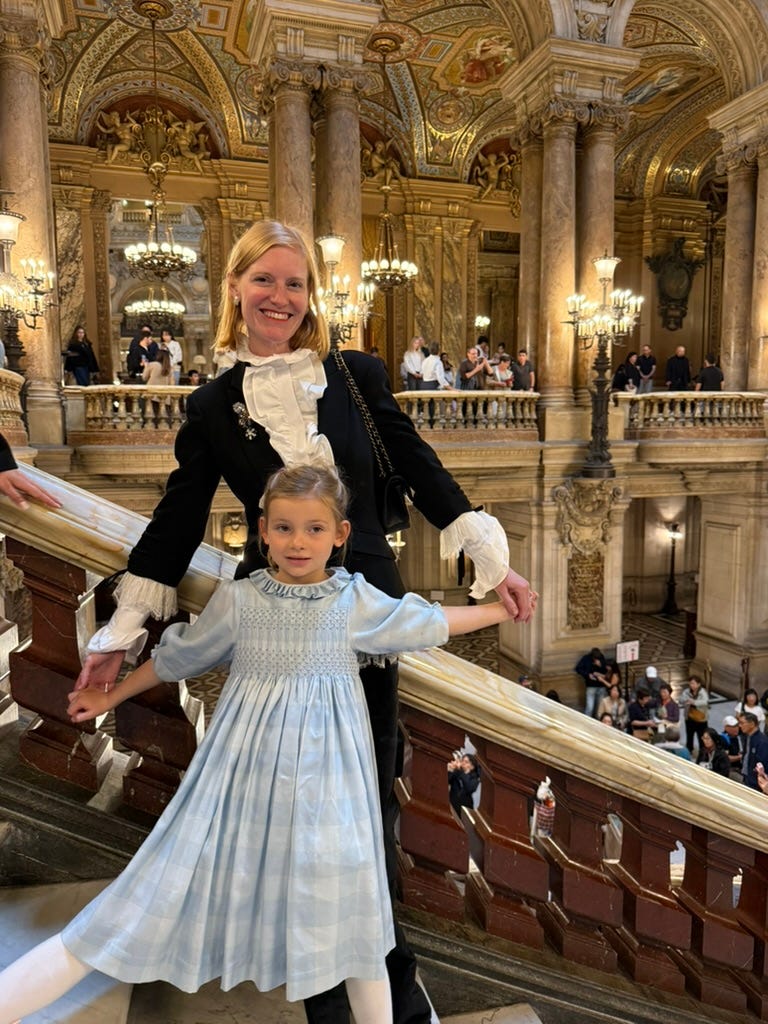
Your truly, a maximalist, in Paris with my daughter
🗝️ Pre-Departure — Hospitality Hot Takes
The Great Beige-ification of Hotels
As a rejection of my mother’s opulent 90s house, filled with trinkets, framed photos and stuff, I developed a modern/organic millennial taste in interior decorating for a hot minute. My kitchen renovation took place at this time, when I was watching Studio McGee and Chip and Johanna Gaines transform homes into modern farmhouse castles of emptiness. Ah, to have a clear, white cabinet, a clean wall, a perfectly placed tree branch in a handmade pot!
My kitchen is now all white and has a shiplap wall (I can feel my future self cringing when I sell the place). The rest of my house did not undergo the same transformation, as my mother died shortly thereafter, and I inherited her house full of stuff.

My mom, the OG maximalist
Faced with her absence and 11,000 square feet filled with things she cherished, I looked more carefully at the craftsmanship of her “fragile things,” the detail of her framed floral prints, the quality of her Waterford Crystal and Spode China. I began filling my house with memories of her, and slowly, my white home grew more maximalist, more eclectic, more … her and me.
I believe this is why my taste in hotels has evolved in my 30s and now 40s. When I posted about historic hotel renovations on Reddit, many younger readers commented that they prefer modern decor to opulence. Perhaps they will experience the same renaissance of taste that transformed my home.
Hotels are microcosms of our larger world. They reflect dichotomies, like the need to feel at home while elsewhere. Hotel decor walks the line between what makes business sense, what photographs well, and what holds up five years till the next soft refurbishment.
We’ve entered the great hotel beige-ification era.
You walk into a lobby in Hong Kong, New York, or London. White walls, linen-tone furniture, a piece of abstract art in a muted frame. Velvet pillows rest on a modern sofa, curving like a semicolon as if to say, “We are edgy!”
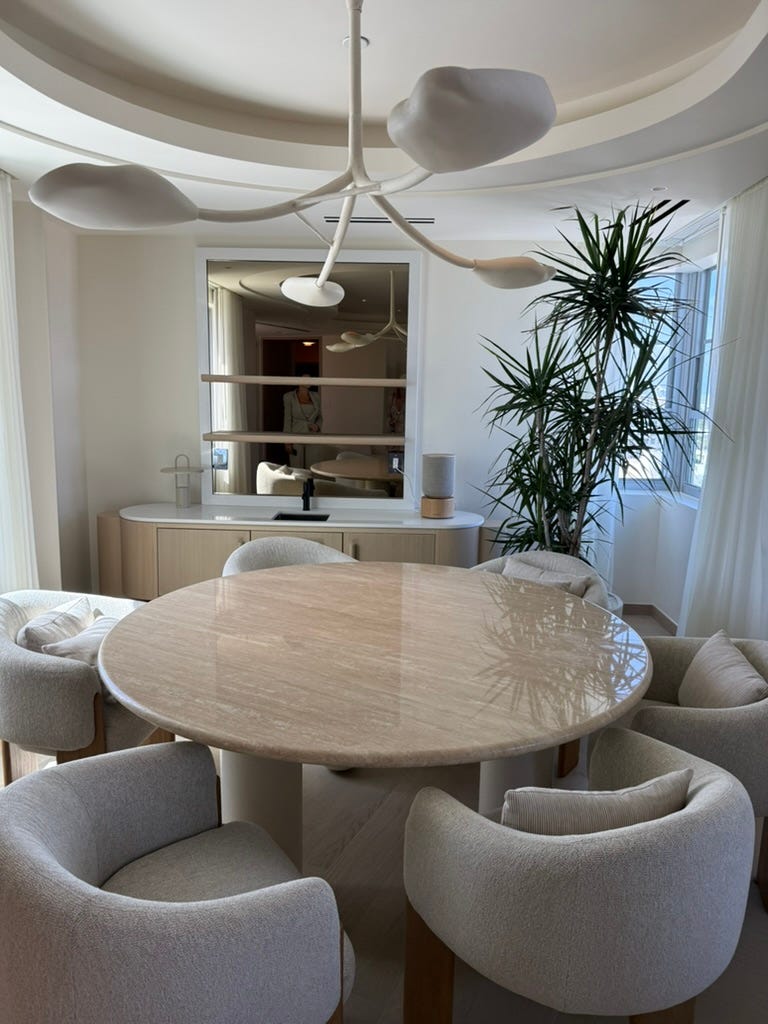
I stayed at the newly renovated Delano Miami recently, a temple of modern, white furniture. It reopened in 2026 after a complete renovation by Elastic Architects, Ennismore’s go-to firm. They also designed Delano Dubai. The “Delano-white” aesthetic harkens back to the white curtains and pale minimalism that were Philippe Starck’s creative vision. I found it a bit soulless.
The Value Chain for Hotel Decor
Like all things, beige-ification comes down to money. Roughly 65% of luxury hotels worldwide are now run by global chains like Hilton and Marriott 1. At that scale, replicating design details is as much cost control as brand consistency.
The hotel industry runs on FF&E (Furniture, Fixtures, and Equipment) procurement. Selections are standardized so every property reflects brand identity while minimizing sourcing, design, and shipping costs.
Let’s take a look at the players in this FF&E value chain.
FF&E Procurement
FF&E procurement companies buy and coordinate delivery of everything that goes inside a hotel room and public spaces. Think beds, chairs, lighting, art, casegoods, linens. They are engaged by hotel owners, and negotiate with approved vendors to hit brand standards, budget, and opening deadlines.
Benjamin West, the world’s largest FF&E purchasing firm, spends roughly $1.5 million per day on behalf of its hospitality clients and serves over 1,000 Marriott-flagged hotels and 350 Hilton properties 2. It also works for IHG, Hyatt, and Four Seasons, sourcing from overlapping approved vendor pools. If you have ever renovated a house, you know what decision fatigue feels like. Imagine that on an astronomical scale - and you can start to understand why a hotel might outsource this decision making process to these guys.
Manufacturing
The furniture comes from an equally concentrated supplier base. Kimball Hospitality, owned by HNI Corporation since its $485 million 2023 acquisition, has supplied hotels since 1985 and counts Marriott, Hilton, MGM, and IHG among its clients 3. Chinese manufacturer SUNSGOODS operates 12 automated production lines with over 3,000 in-stock styles and serves clients in 80+ countries.
At the luxury European end, three dominant Italian manufacturers, Poliform Contract, Molteni&C, and B&B Italia, supply many brands. Poliform has furnished the Mandarin Oriental Milan, Four Seasons San Domenico Palace in Taormina, and Hotel Lutetia in Paris. Molteni&C’s portfolio includes Four Seasons Hotel at the Surf Club Miami, 45 Park Lane in London, Aman Canal Grande in Venice, and the Waldorf Astoria New York.
B&B Italia’s list spans Bulgari, Mandarin Oriental, Aman, Grand Hyatt, Peninsula, W Hotels, Kempinski, The Connaught, The Berkeley, and Four Seasons. Its 25-year relationship with Bulgari alone spans properties in Milan, London, Beijing, Shanghai, and Paris 4. Pieces at this level are custom-specified, preserving some distinctiveness.
In sum, the supply chain is narrow.
Design concentration is equally pronounced.
Design firms decide what the hotel should look like in terms of concept, layout, color palette, material choices, custom furniture specs, while FF&E procurement firms execute that vision by sourcing and purchasing everything from those designs.
HBA has ranked first in the hospitality category of Interior Design’s Top 100 Giants list for over 25 consecutive years, with a client list spanning Four Seasons, Kempinski, Shangri-La, Hilton, Ritz-Carlton, Hyatt, and JW Marriott 5. Yabu Pushelberg’s roster adds St. Regis, W Hotels, Park Hyatt, Mandarin Oriental, and Peninsula Hotels. AvroKO topped the most admired list in 2025.
To paraphrase Churchill, never have so many hotel interiors looked so alike thanks to so few major designers, all constrained by brand standards.
The Consolidation Accelerating All This
In business school, everyone learns about vertical integration, which means a company owning or controlling links in its supply chain over outside vendors. Instead of buying furniture from an independent factory and hiring an independent design firm, a vertically integrated hotel company owns factory, FF&E procurement company, and design firm, (or any combination thereof).
Backward integration moves toward suppliers. Example: a coffee shop chain owning a coffee plantation.
Forward integration moves toward customers, such as a shoe manufacturer operating its own stores.
The point is control and increasing margin by reducing dependence on outside vendors, capturing their profits, and coordinating links in the chain. The tradeoffs of consolidation are capital intensity, less flexibility, and the risk of getting locked into your own supply chain despite better outside options. And there are pesky antitrust laws to think about as well.
HNI’s acquisition of Kimball International created a combined company with roughly $3 billion in revenue, further entrenching North America’s largest hospitality furniture supplier in brand-standard contracts 3. In interior design, HBA was acquired in 2020 by Suzhou Gold Mantis Construction Decoration Company, one of China’s largest interior decoration conglomerates, deeply tied to the manufacturing supply chain that produces HBA-specified furniture 10. Everybody is getting in bed together.
The Operational Case for Neutral Interiors
Vertical integration and Mckinsey-style operational efficiency aside, why would a hotel opt for beige-ifciation? Outside of the public spaces, neutral interiors are easier to clean.
For bedding and towels, white/near-white linens can be washed hotter and bleached without fading. Washing whites together without color sorting keeps a red towel from ruining a load. Colored linens require separate loads and faster discards because bleach damages dye. This doesn’t work for a hotel turning hundreds of rooms a night.
White and beige also add the illusion of size to small rooms, feeling “light and airy” rather than “heavily opulent.”
Yet, beige and white show marks and dirt more readily. As a parent of young children, I’ve learned white chairs and couches are an absolutely terrible idea.
COVID accelerated the flattening. Laminate flooring replaced carpets and accent rugs, and tile showers pushed bathtubs aside. Both are easier to clean. The design consequence: less texture and warmth.
A hotel arrives at beige thanks to global scale, procurement efficiency, cost control, and risk-averse design committees.
AirSpace, Instagram, and COVID
In a 2016 essay for The Verge, writer Kyle Chayka named this phenomenon AirSpace 6. He described how an affluent, mobile class moving through spaces linked by technology had spread particular sensibilities till distant places began resembling each other: minimalist furniture, reclaimed wood, industrial lighting, the same aesthetic from Portland to Prague. His 2024 book Filterworld extended the argument to algorithms, which reward the same visual language because it performs consistently in feeds 7.
In the Instagram era, social media also influences hotel design. White and beige photograph cleanly and look calm on a small screen. Bold cobalt walls or aggressively patterned fabrics are less universally palatable, and no hotel wants to gamble a seven-year development on a fabric that’s dated by opening day.
Development and Refurbishment Timelines
Hotel design timelines are lengthy. A new luxury hotel, from land acquisition to opening day, typically takes four to seven years.
FF&E procurement starts 12 to 18 months before opening, with custom casegoods (hard furniture) requiring 16 to 22 weeks in production. FF&E represents 12 to 15% of total development budget, and poor procurement management causes nearly 60% of project delays 8.
Custom orders mean delayed timelines. For hotels, every opening delay hemorrhages money.
The mechanism that produces identical rooms across a portfolio is called the room matrix. Procurement platforms source from approved vendor lists. A 20-week lead time punishes all who deviate from that room matrix. While owners wanting a custom piece from an Oaxaca artisan may miss an opening date, incurring a cost overrun, owners ordering from approved catalogs open on time.
Beige is also a safe bet that cuts soft refurbishment costs.
Luxury hotels run soft refurbishments every three to five years and hard refurbishments every seven to ten. A hotel that opened in 2018 with an interior conceived in 2015 is running on a decade-old design vision. For a brand managing hundreds of properties that cannot refresh rooms every four years, it’s an asset-management strategy as much as an aesthetic one.
One emerging counterforce is tariffs. Section 232 tariffs imposed in late 2025 put a 25% duty on upholstered wooden furniture from China, and anti-dumping duties on Chinese wooden bedroom furniture now exceed 200% 9. Vietnam and India are growing alternative sources. Whether this produces more design variety or simply shifts the neutral catalog to different factories remains to be seen.
Capital Structure
Back to the money. Nadine @ The Stanza, Nadine Choe, one of the hospitality industry’s most quoted critics, spent years structuring $7 billion in development capital for hotel projects before founding The Stanza. In a July 2026 Beyond Luxury interview, she argued that the reason so many hotels feel interchangeable results predictably from how their capital is structured 12. Investment committees outsource taste to architects and consultants because they never developed their own. The proven template clears, quarterly reporting rewards repetition, and that’s why you can’t tell properties in Milan, New York, and Doha apart.
Her counterexample is Passalacqua on Lake Como, self-funded over 50 years by the De Santis family on patient capital with no time pressure for returns 13. That freedom shows up in the details: Murano glass in every room, a full set of Dyson tools in each bathroom. To her, such details reflect a hotel that thinks about guests before they arrive. Patient capital buys the freedom to notice what guests might want.
The Commercial Case for Character
Despite the consultant-driven efficiencies of consolidation and value chain collapse, we are seeing an incipient, commercially driven distancing from beige. Properties commissioning local artisans, sourcing regional materials, and letting the destination shape the design report better guest satisfaction and longer stays. Research from DLR Group links authentic-design storytelling with higher guest satisfaction scores, and Preferred Hotels & Resorts has identified the rejection of neutral sameness as a defining movement in luxury travel 15.
The architects doing hospitality’s most interesting work, including Gathy, Kerry Hill Architects, Kengo Kuma, AvroKO, and Rockwell Group, all share creative autonomy. They are building to a philosophy, working outside the catalog.
My Take
My take - the beige hotels that allow for good unit economics across consolidated brands like Marriott and Hilton are going to become the de facto, non-risky choice for the upper middle and lower upper class travelers. They may stretch for a Four Seasons on occasion, but they will exercise their loyalty to predictably neutral hotels. The luxury and ultra luxury hotel brands are going to have to really focus on true differentiation as the wealthy traveler seeks a departure from the semblance of ubiquity, and craves storytelling in their hotel choice.
In Africa, hotels often have a social contract with local tribes to hire tribal members and use their art and decor when possible. This leads to a positive externality that creates truly unique camps with a true sense of place. I’d like to see more ultra luxury properties embrace antiques, storytelling, and the incorporation of local artisans in a similar fashion.
🗝️ Industry Insider Interview: Carolina Ramirez Herrera

I believe we’ll see character and maximalism returning to both boutique and super-luxury historic hotels (like the ones taking over old palaces, though the Danieli Four Seasons opened recently with disappointingly beige rooms, at least their public spaces are gorgeous). carolina ramirez herrera is one of my Substack friends who agreed to lend her insider expertise to my article.
What is your background and current role sourcing furniture for hotels
For over a decade, I’ve consulted across brand, marketing, PR and development for luxury hotels primarily in Africa and the Middle East and co-founded Happy Go Lucky, a hospitality design studio specializing in concept development, interiors, and FF&E sourcing and procurement with a knack for giving spaces soul and “making magic happen” - their words, not ours.
What have you seen change in the last 5-8 years in the world of hotel FF&E?
COVID was a huge reality check for the industry. One of my clients had furniture and materials stuck in China and Mexico as supply chains completely froze, forcing hotels to rethink their reliance on a small number of global suppliers. It accelerated a shift toward sourcing locally and working with regional makers and artisans—which, honestly, is how it should be. Beyond being more resilient, local sourcing gives a hotel a much stronger sense of place and makes the guest experience feel far less generic.
Have you seen consolidation amongst large hotel chains or luxury level properties on the FF&E and design side?
I tend to work with smaller, independent hotels, so I haven’t experienced that consolidation firsthand. But from the outside, you can definitely see more of the same suppliers, designers and pieces being used across different properties. It might make sense from an efficiency and cost perspective, but it’s also why so many hotels are starting to look and feel the same. (please no more millennial pink…)
What is something you wish people knew about decorating and sourcing for hotels?
This is really for ownership groups and the people controlling the budgets and timelines: if you want the character and craftsmanship that comes from working with artists and artisans, the budget and schedule have to respect their process. You can’t ask for something handmade, one-of-a-kind and steeped in history, then expect 25 identical pieces to arrive yesterday at an Amazon price and speed.
On one project in Morocco, we found an artisan with these incredible vintage doors he had collected and hand-painted over many years. The client loved them, but then wanted 25 immediately. That disconnect between the creative vision and the realities of producing it caused so many unnecessary issues. You either value the artisan process or you don’t; you can’t have it both ways.
I also wish people understood how much research (and how many missions!) sit behind a single object. Once you pull off one impossible project, word travels quickly, and in 2021 we were brought into Habitas AlUla as essentially the special-ops team, with only eight weeks until opening. Saudi had only recently opened to tourism, and this was the first luxury hotel in AlUla. We took around 25 flights across the country in those eight weeks, searching for artists, artisans and makers who could help us bring the property to life.
One of those missions took our all-women team to Dammam and then Al-Ahsa to find a specific potter whose family had kept these vessels for generations. His jaw dropped when we said we wanted his entire stock. My business partner and I just looked at each other like, “I can’t believe this is our real life.”
And yet, guests now see a terracotta pot at the entrance; they don’t see the mission behind it.
Where do you see industry trends going in terms of how hotels appear? More minimalist? More maximalist? Something else?
Maximalism is definitely making a comeback, but I think the larger shift is toward specificity. You hit the nail on the head, people want to feel like they are somewhere, not in the same beige lobby transplanted between Milan, New York and Doha.
The Middle East has always understood this because more is more, and I love it. Raffles Doha is a great example: it’s theatrical, opulent and completely over the top. I literally gasped when I walked in because it was so unapologetic and fing cool.
In Africa, hotels often have to source locally because of budget, timing and logistical constraints, but that necessity produces some of the most beautiful craftsmanship. Batoka’s Zambezi Sands in Victoria Falls features incredible locally made baskets, while Gorgeous George, a Design Hotels™ property in Cape Town designed by Tristan du Plessis, was a true labor of local love from the tiles and furniture to the art. Those properties couldn’t simply be dropped into another city, and that’s exactly what makes them memorable.
What are your top three favorite hotels?
Oof, hit me where it hurts! My top three are constantly changing, but right now I’d say Bvlgari Hotel Roma, The Imperial New Delhi and Rosewood Hong Kong. Bvlgari Roma is still one of the most beautifully designed hotels I’ve ever visited, from the monogrammed Nespresso machine to the chic but incredibly thoughtful gym. The Imperial is the perfect example of preserving a hotel’s history while updating it with modern luxuries; hello, Dyson vanity! And Rosewood Hong Kong? I had quite literally no notes.
🗝️ Industry Insider Interview: Emily Mattucci
This week, we are lucky enough to hear from two industry insiders who operate in this space.

What is your background and current role sourcing furniture for hotels
I’ve spent the last several years in the commercial furniture industry, and today I work with RH Contract, partnering with hospitality designers, purchasing firms, developers and ownership groups to source and specify furniture for hotels and other commercial projects.
What have you seen change in the last 5–8 years in the world of hotel FF&E?
There’s been a much bigger focus on creating spaces that feel residential and welcoming rather than traditionally “hotel.” At the same time, clients are under more pressure around budgets, lead times and durability, so there’s a constant balance between creating something distinctive and finding products that can actually meet the practical demands of a hospitality project.
Have you seen consolidation amongst large hotel chains or luxury-level properties on the FF&E and design side?
Yes. We’re seeing more centralized decision-making, particularly with larger ownership and management groups, and more emphasis on preferred vendors, purchasing partners and repeatable standards. There are obvious efficiencies to that approach, but I think the challenge is maintaining enough flexibility for each property to still feel specific to its location and guest experience rather than overly standardized.
What is something you wish people knew about decorating and sourcing for hotels?
How many competing factors go into selecting a single piece of furniture. It isn’t just about what looks good- you’re considering durability, cleanability, lead times, inventory, budget, code requirements, scale and how the product will perform with hundreds of different guests using it. The best hotel spaces make all of those decisions feel invisible.
Where do you see industry trends going in terms of how hotels appear? More minimalist? More maximalist? Something else?
I think we’re moving away from both generic minimalism and maximalism for the sake of maximalism. Guests want spaces with personality, warmth and a sense of place. I’m seeing more layered materials, natural woods, texture, warmer colors and residential influences, but paired with pieces that feel intentional rather than overly decorated. The most interesting hotels feel collected and specific to where they are.
What are your top three favorite hotels?
I love the bunkhouse group! I used to work with them in Austin before they were purchased by Hyatt.
🗝️ Room Report
If you prefer hotels with character, these are some maximalist properties that are eclectically decorated.
I recently stayed in London with my kids at Firmdale’s Covent Garden Hotel. The building dates to the 1890s, originally a French hospital whose bones remain visible in the brickwork. Kit Kemp, who cofounded Firmdale with her husband Tim in 1985 and has personally designed all eleven of their hotels, filled it with rich patterned textiles, a collision of modern and traditional art, and furniture that appears chosen by someone with actual opinions 11.
Le Négresco, Nice. A 1912 Belle Époque landmark on the Promenade des Anglais, Le Négresco remains independently owned. Jeanne Augier ran it for over five decades and refused every chain offer. When she died in 2019, she left the hotel to the animal-welfare foundation that runs it today. The interiors reflect her lifetime of taste, with over 6,000 pieces of art across five centuries.
Inn at the Five Graces, Santa Fe. Ira and Sylvia Seret spent decades in Central Asia and the Himalayas, collecting textiles, tiles, and antique doors. They built interiors around what they found. Each of the 24 suites combines Rajasthani mosaics, Tibetan rugs, Turkish tiles, and Southwestern adobe.
The Fife Arms, Braemar, Scotland. This Hauser & Wirth hotel features tartan carpets, taxidermy, actual Picassos and Freuds on the walls, and a stag-skull chandelier by Louise Bourgeois. Probably today’s most aggressively maximalist luxury hotel.
Blakes Hotel, London. Anouska Hempel opened Blakes in 1978, and it remains the reference point for personality-driven hotel design. Rooms have individual themes. White linen drapes the Corfu Room, deep red fills the Cardinal Room.
Palazzo Margherita, Bernalda, Italy. A 19th-century Jacques Grange-designed property in Basilicata, the hometown of Francis Ford Coppola’s family. Its nine rooms, all different, have hand-restored frescoed ceilings.
Suján Rajmahal Palace, Jaipur. A maharaja’s former residence restored by Adil Ahmad, its rooms feature peacock wallpapers, pink and turquoise saturation, and hand-painted murals.
Hotel Costes and L’Hotel, Paris. Jacques Garcia designed both properties, and both are drenched in deep red velvet, gold, and brocade. This hotel is the opposite end of the aesthetic scale from Delano-white. L’Hotel has the added distinction of being where Oscar Wilde died.
🗝️ The Lobby Bar - — Hospitality updates, promotions, gossip, and the occasional pun
Oops - A superyacht crushed a WWII wreck off the south of France. The 220-meter Orient Express Corinthian dropped anchor in Les Lecques Bay in mid-July and destroyed a Lockheed P-38 Lightning fighter resting 38 meters below, prompting French authorities to open an investigation and push for permanent mooring buoys at protected wreck sites.
The Peninsula is putting $268M into Hong Kong and Tokyo. Hongkong and Shanghai Hotels committed HK$2.1 billion to renovate both flagships, a signal that luxury demand in Asia is holding up and a heads-up to plan 2027 and 2028 Asia itineraries around construction phasing.
Russian hackers are targeting hotel Wi-Fi. Microsoft warned that state-backed actors are running credential theft campaigns at hotels, airports, and conference venues using fake login pages and phony update pop-ups, so use a VPN and treat every hotel network notification as hostile.
Utah shut down the drinking water at Sorrel River Ranch. A Tier 1 “Do Not Use” order took effect July 31 after inspectors found an uncertified operator, failed chemical pumps, and staff washing dishes with pool water.
Amanyara may be deflagged from Aman. Mortimer Sackler's CR Hotel Ltd. has told Amanyara villa owners it plans to terminate Aman's management contract over Vlad Doronin's decision to build an adjacent Janu-branded resort, with the split potentially taking effect as early as September or extending to April 2027 to protect the $19,000-a-night high-season bookings.
Offers:
Paul Gauguin and Ponant are running a $1,000 shipboard credit on French Polynesia sailings. My clients get up to $1,000 per stateroom on any 2026 or 2027 departure aboard the m/s Paul Gauguin, plus select Le Jacques Cartier voyages that reach the remote Gambier and Austral archipelagos on top of the usual Society Islands, Tuamotus, and Marquesas, for new bookings deposited between August 1 and October 31.
The Six Bells is offering murder weekends. August, November, and December, a miniatures workshop retreat September 23-25, and buzzer trivia every Thursday night.
Collegio alla Querce in Florence has three offers on the table right now. Book connecting rooms and get 50% off the second through the end of 2026, book three nights and get the fourth free through September, or book two nights and get the third free through December 18
Sources
Bloomberg, on the share of luxury hotels operated by global chains.
Benjamin West company data on daily FF&E procurement spend and brand-property counts.
HNI Corporation press release, 2023 acquisition of Kimball International for $485 million.
Poliform Contract, Molteni&C, and B&B Italia hospitality client portfolios (company references).
Interior Design magazine, Top 100 Giants list, Hospitality category rankings.
Kyle Chayka, “Welcome to AirSpace,” The Verge, August 2016.
Kyle Chayka, Filterworld: How Algorithms Flattened Culture, Doubleday, 2024.
Hospitality Net and industry procurement data on FF&E timelines, budget share, and delay causes.
U.S. Department of Commerce, Section 232 tariffs on wooden furniture from China, 2025.
Suzhou Gold Mantis Construction Decoration Company, acquisition of HBA, 2020.
Firmdale Hotels company biography, Kit Kemp design portfolio.
Nadine Choe interview, Beyond Luxury, July 2026.
Passalacqua, Lake Como, De Santis family ownership history.
Cain International and Saudi Public Investment Fund investment in Aman Group, $900 million financing round.
DLR Group research on authentic design and guest satisfaction; Preferred Hotels & Resorts trend reporting.
Dear Anne Marie, you were absolutely right with your comment on my latest article 'The Age of Average Hotels'.
Yours is a brilliant supply-chain-level analysis of exactly the same phenomenon from a different angle. Where you follow the money through FF&E procurement and vertical integration, I followed it through OTA commodification and the loss of hotel identity at the guest-experience level. Both roads lead to the same beige lobbies, hollow marketing symbolism, destination/community-extraction and capital power. Thank you for making my argument richer. Keep on going with your mission to make people aware that they can choose more wisely and joyfully!
This is the best breakdown of the beige problem I’ve read, Anne Marie. And it names a distinction I defend constantly.
There’s a world between subtraction and beige. Beige removes soul to cut cost and risk.
Real subtraction removes everything that competes with soul, so the one true thing can finally be felt. Same empty wall, opposite intention. One is a spreadsheet. The other is taste.
Your capital-structure point is the whole game. You can’t outsource taste to a procurement catalogue and expect a sense of place to survive it. A hotel that feels like somewhere was decided by a person who cared, long before any guest arrived.
I’m at the Delano myself in February, so I’ll report back on whether ‘Delano-white’ reads as calm or as absent. My bet, sadly: I’ll remember the light and forget the room.
Sense of place can’t be procured. It has to be lived first, by whoever built it