

🗝️ The Upgrade | Weekly by Anne Marie Brown
19. The Upgrade | Weekly – Who Can You Trust? The Trust Matrix Involved In Your Travel Decisions
Travelers,
Wow, I can’t believe there are almost 1,000 people who have decided to subscribe to The Upgrade! In 19 weeks of publishing these weekly articles, I’ve met so many interesting people in the hospitality, reporting, and literary spaces. In the same week, the iconic Colin Nagy called out The Upgrade in a Skift article, and Plum Sykes restacked my note and then messaged me on Instagram. Be still, my heart. I’m so thrilled to have found this corner of the internet, filled with fellow hospitality and travel obsessives who love a little bit of luxury and pizzaz.
This week’s Upgrade took me longer than most articles do. I wrote it while waiting for my daughter to get her tonsils out, in the surgical center, then spent the next several days reworking it over and over again. There has been much buzz about the Amanvari controversy, and I realized that I very much wanted to touch on the players involved in people’s reactions, from the industry side, to the UHNW traveler side, and finally, from the point of view of one of the people who reads Reddit more than I should.
Happy travels!
Anne Marie
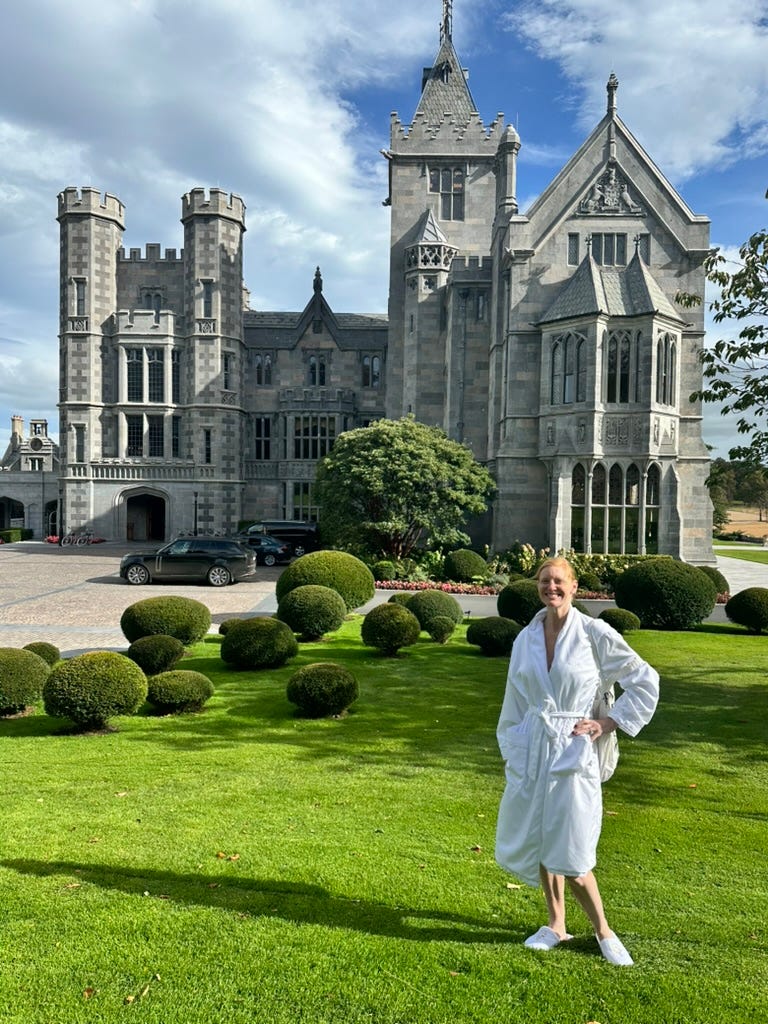
Yours truly, in my happy place, Adare Manor. Don’t I look trustworthy?
In case you missed it:

🗝️ Pre-Departure — Hospitality Hot Takes
Who Can You Trust?
The recent online and industry discourse around the Amanvari controversy has me thinking a great deal about trust in the travel industry. When we spend money to travel, particularly at the luxury level, there is an element of trust and a social contract involved with the players in the booking matrix.
The typical players in a travel booking are:
· Traveler
· Hotel
In a luxury booking they may be:
· Traveler (and/or assistant or family member)
· Hotel, DMC (destination management company)
· Travel Advisor
On top of that, a traveler may seek input or inspiration from travel industry publications and media, social media videos, OTAs (Online Travel Agencies) like booking.com, online forums like Reddit, AI, and search engines.
The Trust Matrix
· A traveler trusts that an advisor is recommending a hotel in good faith as the right fit for their budget and travel preferences.
· A travel advisor trusts that a client is engaging their services in good faith with the intent to book the trip if the budget and inclusions are met.
· A hotel trusts that a guest will act respectfully to staff and other travelers.
· A guest trusts that a hotel will check them in on time, provide a clean room, accurate billing, prompt service, and a pleasant stay.
This is a relatively straightforward trust matrix.
However, in the age of online forums like Reddit, Instagram, and YouTube, we have another group of players entering the matrix – anonymous accounts, reviewers, and influencers.
These individuals have motivations driven outside the matrix of travel trust. YouTubers and reviewers are compensated by clicks and views. The more eyes they attract, the more money they stand to make. In the world of pay for views, controversy and new information sell, but nuance doesn’t.
Moreover, online commenters are difficult to pin down. Some are bots paid to stir discord, some are just bored people craving attention. It’s difficult to take someone seriously when their Reddit account was created mere days ago as if their understanding equals that of an experienced travel professional. Yet Reddit gives all comments equal weight.
Trust in the UHNW community
I’m a luxury travel advisor, but I’m also in the UHNW (Ultra-High Net Worth) community.
I travel the way my clients do, and I know what it takes for people with complex finances to build trusted relationships with financial and tax advisors, family office staff, and other professionals we work with.
At a certain level of wealth, everyone wants your attention. We are asked almost nonstop for charitable donations, meetings to hear startup and investment pitches, meetings to consider switching wealth advisors, volunteer positions, and board seats. Because wealthy individuals are constantly asked for things, we tend to be wary – even suspicious – when asked to place our trust.
When Trust is Broken
As more millionaires are minted in the US than ever before, the luxury travel sector is growing. The internet is increasingly crowded with opinions, making it hard for travelers to know whom to trust. We are thus seeing ever more clients moving away from online search and engaging with luxury travel advisors. It’s difficult to cut through the noise online, and people – particularly at a certain echelon – crave interaction with a real person who has considerable personal travel experience.
This also means we are working with more clients who have never before engaged a travel advisor, and a large part of the onboarding process is now dedicated to education about what a travel advisor does, how we are paid, and what differentiates a professional advisor from a platform like Amex.
We don’t nail this every time. I recently lost a booking because a client was frustrated that I wasn’t able to match a hotel’s promotional flash sale rate for a booking and include Virtuoso or Preferred Partner benefits. I could match the rate, but the hotel was unwilling to include benefits like free breakfast as they were already discounting the rate. For the client, it was the same to book through me or directly with the hotel, except that she arrived at her booking decision only after weeks of my efforts to quote different properties, counsel her about wedding blocks that would affect their stay at certain properties, and reaching out to hotel sales directors and wholesalers to find the best price.
She didn’t see that research as valuable. She saw only that she could get the same rate by booking directly with the hotel or with me, and somehow along the way, she had decided that booking with a professional advisor was supposed to get her an extra discount. That unrealistic expectation broke the implied social contract of reciprocating an advisor’s efforts with a booking.
I had failed to set expectations and clearly explain the difference between BAR (Best Available Rate) and promotions in advance.
To establish trust between an advisor and a new client, education is key. There’s a big difference between booking.com and a benefits and advocacy partner with decades of luxury travel under their belt.
Incentives and how they can affect trust
The recent Ryan Walker controversy stirred a lot of discussion about trust in our industry. The situation seemed like a classic David vs. Goliath – Ryan Walker, a YouTube hotel reviewer known for his less-than-stellar review of the Four Seasons Yacht inaugural sailing, had booked a night at the newly opened Amanvari, whose ADR (Average Daily Rate) is $6,000. When he arrived to check in, his driver took him to the employee entrance, where he was turned away and told they didn’t have a reservation for him as his booking had been cancelled. In the video, he discovers a cancellation email from the hotel sent the day before. The hotel gate guard threatened to call the police. People were outraged that he could be turned away in this fashion when he had a confirmed reservation, particularly at that high price point.
Jessica Flint and Sebastian Modak at the Wall Street Journal received a statement from Aman, which addressed the framing and editing of the video and not the actual way the interaction was handled.
Aman said it never called the police and showed the paper an incident report with no mention of law enforcement. (In Walker’s footage, a staff member clearly says she needs to call the police.) Aman also noted that they had sent an email five days earlier, asking Walker to postpone filming for a month during construction. Walker insisted on being treated as a standard guest, and said Aman agreed to work with him on what he could film. The disconnect seems to be whether or not those emails amounted to permission or refusal to honor his scheduled reservation.
This is a clear communication failure, and certainly not a luxury level experience. None of it excuses Aman’s handling of the incident in the moment. Nobody at the gate had the authority to sort things out, and a guest was left standing outside with no explanation.
The Amanvari controversy highlights the role of outrage in online discourse
In online travel forums on Reddit, readers with accounts that were only days old posted conspiracy theories around whether the advisors who run those channels are in the pockets of hotel companies like Aman. The word “shill” was loosely thrown around, and people who had never worked with these agents demanded statements from them. Readers were out for blood, and there was nothing the moderators could say to assuage them.
On one side, the forum moderators didn’t have enough information to issue a statement. This was not their client, they weren’t involved in the reservation, Aman wouldn’t provide public information, and Reddit moderators are not investigative journalists. '
On the other side, readers of those forums wanted to know that these advisors saw the situation the same way they did – a guest, who could be a proxy for their own travel experience, was mistreated by a large hotel brand. They wanted to know that they could trust the moderators and advisors they work with if something similar were to happen to them.
But the fact remains that Walker was an online influencer and not a normal guest.
As Flint and Modak put it, “public perception is shaped less by what happened than by who posts first.”²
Is the travel industry too “cosy”?
A Substack writer, SexyStays John McMahon, posted an article about the Amanvari fallout, Aman of Few Words. I have to give him credit for the pun; I'm a sucker for puns. John is a General Manager at Boss Hunting/Luxity Media, so not a straight forward member of the travel industry (advisor, hotelier, etc), but seems to be involved in an ancillary manner as a writer. In his article, he wrote “The luxury hotel scene is controlled. All sides of the industry – travel agents, PR firms, luxury media – are cosy. They’re far too willing to trade sales, coverage, or access for honesty.”¹
While this may have raised my hackles a bit, I understand where that comes from. Unless you’re an advisor who has called hotels to task over the 18 years that I have, it’s easy to look in from outside and assume we would rather prioritize our relationship with a hotel brand than with a single client.
However, I don’t think it’s fair to lump all these players together, as all are paid differently, and thus have different incentives. As I have said many times in past Upgrade articles, follow the money. Let’s examine the incentive structures for the members of the travel trust matrix.
Every source telling you something about a hotel has a reason for framing information the way they do
The YouTube reviewer or online personality.
Their business revolves around attention. A calm, straightforward hotel review rarely gets the same number of views as a hot take showing you that these expensive experiences may not be all they are cracked up to be, or that they are even more awesome than you imagined. For the population online who may never be able to afford such an experience, that is a nice bit of schadenfreude. Influencer TravelWithLivii rose to Instagram fame not by showing the trips she planned that went smoothly, but by showcasing complex “client requests” (mostly fake interactions), for the entertainment of viewers. She is an actual advisor and does handle clients, but much of what she puts online aren’t real phone calls.
The credit card booking channel.
Amex, Centurion, Bilt, and Chase’s travel portals are all incentivized to keep as many transactions as possible on their portals, but with a client base in the thousands, you are just a number to them. If something goes wrong, you won’t be talking to the person who made your booking. Most likely, you’ll be routed to a call center.
The advisor.
A luxury travel advisor’s motivation is client retention above all else. If my client has a terrible time at a hotel, the trust in our relationship is broken and that client will likely not book with me for a future trip. A hotel that treats my clients badly loses my business for future bookings, because my trust in that hotel has been broken.
I am paid by the hotel after a client travels, but I’m not paid unless that client travels. Advisors are an important channel for hotels because we cost them about 10% in commission, compared to OTAs like booking.com that charge 25%. I also charge planning fees, so I’m paid directly by travelers for FIT business (Free Independent Travel, more complex itineraries than just hotel bookings).
In the attention economy, an online personality may argue that they are driving bookings for hotels, and they may be right, but it’s not as easily measurable as an advisor booking under a trackable IATA (International Air Transport Association) number.
Additionally, advisors are often in the industry for years, where an online personality may gain a following quickly and then the platform changes its algorithm the next year and they become passé.
I’d be lying if I said that I don’t recommend hotels based on how strong my relationship is with them, or whether or not I’ve stayed there myself. If I know a sales director is more likely to upgrade my client and make them feel really special during their stay, I’m more likely to recommend that property than one where I don’t know the onsite team and my client may just be another name on a register.
Some of my favorite hotels (e.g., Estelle Manor) have received less than stellar feedback from me in the past, but we’ve worked through it together and they’ve come out stronger as properties thanks to the candid feedback. I now know how to work better with them before my clients arrive to ensure they have the best time possible.
Ultimately, the client matters more than the brand relationship. The brand might change sales directors or ownership, but a client could keep booking for years and refer their friends.
Losing an advisor’s trust is a larger cost for a hotel than a bad write-up from an online reviewer.
Now, let’s talk about the claim that hotels woo advisors with free stays.
There are FAM trips (familiarization trips) that hotels, rep groups, and DMCs host for advisors. These are usually in off season and run like a press trip, with a packed schedule to show a group of advisors what a hotel offers. We are not allowed to bring friends or family. FAM trips require that advisors pay our own airfare, and usually come with a nominal fee to attend. I saw one poster on Reddit postulate that advisors are flown business class to stay for free in luxury hotels and I almost spat out my coffee. If that were the case, there’d be a lot more advisors. I try to avoid FAM trips. I have a family at home, and don’t need to be out of the office for a week just to come home more exhausted.
Hotels will also occasionally give an advisor a discounted “advisor rate.” These advisor rates are usually bestowed the first time an advisor stays at a property, upon request, and only after they’ve driven volume to that property. A new advisor with little history in the industry will likely not be granted an advisor rate. To be honest, these discounted rates are pretty hit or miss. We don’t get a discounted stay over spring break or in high season. It’s usually for one or two nights midweek in the middle of off season. I tried for an advisor rate today, mid week, in London for a single October night, and was shot down.
The idea behind FAM trips and advisor rates is that advisors who have experienced a property firsthand are more likely to be able to describe it accurately and in worthwhile detail. While some advisors have newsletters, not many of us spend our time writing reports on Substack (except yours truly).
If an advisor has a bad time at a hotel on their personal trip, that hotel loses their future business, both personal and professional, but it’s unlikely they will suffer reputational damage from a widespread online writeup.
Travel writers.
Legacy media are invited on press trips in the same way that advisors/agents go on FAM trips. I’m not a reporter, so I honestly don’t know the cost structure involved in hosting a press trip from the hotel side. I don’t know if the hotel or the publication pays for the reporter’s travel, but I assume the reporter isn’t footing their own bill the same way an advisor does for a FAM trip.
Travel writers are typically going to a hotel opening in good faith to review the property in a favorable light. If a publication pans a property, it’s unlikely their reporters will be invited back to other properties, or that that hotel or brand will pay for ads or awards ceremony tables.
However, if a travel publication appears to be too partial to hotels and writes fluff pieces that aren’t representative of the experience travelers encounter, they will lose credibility with readers. There’s also the matter of journalistic integrity – a code of ethics that traditionally drives reporters.
Trade publications also walk the line between honest representation and making sure they don’t lose ad revenue from a property or brand.
Online Posters.
An anonymous Reddit account can be created the same day it starts publishing claims about a travel advisor, property or brand, with no name, no business, no client history, and no reputation on the line if the claims turn out to be false or misleading. By the logic that made Walker’s video credible, that account should be the least trustworthy voice in the conversation. It has nothing at stake, and it can say anything. Yes, there are some forums that require a certain amount of “karma” before posting, but the two largest travel sub Reddits don’t have that requirement.
Algorithms don’t weigh your credibility when deciding how far a claim travels. Outrage content performs the same whether the source has a track record or was created twenty minutes ago. Sometimes the person with nothing to lose is telling the truth because they have no reason to lie. Sometimes the person with nothing to lose is lying precisely because they have nothing to lose and clicks to gain.
An advisor operates in the opposite way. My name, my business, and every client relationship I have are attached to what I tell you. I can’t disappear and start a new company tomorrow if I’m wrong about a hotel.
Different clients source trust in the travel matrix from different places
The general public, most of the mass-affluent traveler base, builds trust from what’s easily accessible to them online. These sources are reviews, videos on YouTube and IG, price comparisons from AI, forum threads on Reddit, maybe their friends. These are not travelers who may have a travel agent on speed dial.
This group is more likely to encounter conspiracy-flavored claims about properties and advisors online, since they don’t yet have a track record with one to weigh those claims against.
High-net-worth clients are usually somewhere in the middle. They’re starting to use advisors seriously, but they still want to understand the math. These new clients are wary of being taken advantage of, they may have had a fraudulent or unhappy booking in the past with something like an Airbnb or booking.com. They are just as likely to book direct, through a credit card portal, or OTA as they are to consider booking with an advisor. These are the clients that argue with me about what ChatGBT says their trip should cost or include.
Ultra-high-net-worth clients operate almost entirely on relationship, personal referrals, and track record.
While they may read Reddit threads about a hotel controversy for entertainment, they certainly aren’t taking the posts of anonymous accounts at face value. They’ll call me directly and ask whether they should still go, what I’ve heard from the hotel, and my professional opinion.
What advisors owe you during a brand controversy
If you are working with an advisor and something viral like the Ryan Walker situation causes you concern, call your advisor. Ask for their opinion, what they’ve heard from the brand. I’ve told my clients when I don’t think a hotel is ready (the Amanvari is not ready), but that’s always my rule of thumb – don’t send people to a property too soon after opening. There are so many kinks a hotel has to work out in those first few months.
I also offer my opinion on how a hotel should have handled a situation differently.
In this case, Amanvari should have:
1) Called the client instead of assuming they read an email the day before
2) Made it very clear the client’s reservation had been cancelled when the filming discussion came up, not left the door open for them to film with restrictions
3) Let the guest through the gate, and bring in the GM to explain in person, with the option to stay if he skips filming.
4) If staying wasn’t workable, walked him to a comparable property and handled the logistics, refund included.
5) Responded within days after the issue by calling the guest.
6) Made a statement that wasn’t so nebulous. Waiting a week to make a public statement hands the story to whoever posted first.
The right to film, and who grants it
Finally, I want to discuss filming rights, which are an increasingly hot topic in the industry as we see more influencers interrupting the experience of other guests.
A reviewer doesn’t have an inherent right to film and publish inside a hotel for commercial consumption. This line has gotten blurred as online celebrities and YouTubers position themselves as “just another guest,” but the fact is they aren’t normal guests. They are making money from what they post, potentially disrupting the experience of other guests, and not necessarily posting accurate – let alone contextualized – information.
A property is private property, and it can set terms around photography and filming the same way it sets terms around anything else that happens on site, such as dress codes, pool hours, and which spaces stay closed to outside vendors. Reviewers and advisors alike operate on a property at the owner’s discretion when it comes to content creation, paid stay or not.
Before I post a review of a hotel I’ve stayed at in The Upgrade, I always email the hotel’s sales director to make sure that the information in my article is accurate. Yes, my experience is my personal experience, but I can certainly get details wrong. A perfect example of this is that I stated that Estelle Manor didn’t have food options available between breakfast and noon because we had been unable to find a restaurant open to feed our kids in that time frame. The sales director corrected my article, noting that there were grab-and-go options available in the potting shed coffee shop. I just hadn’t found them.
It all comes down to trust
In this era of online personalities, “post truth media,” Reddit forums, AI optimized search, and so much noise – whom you place your trust in is more important than ever.
Remember, a YouTube reviewer and a travel advisor do not have the same incentives. Your aunt’s friend who stayed at a hotel a few years back, or an online forum’s random poster do not have the same professional experience as a seasoned advisor. Seek information, sure, but seek it with a discerning eye for the incentive structure motivating that source.
Sources:
¹ John McMahon, “Aman of few words,” SexyStays, August 12, 2026. ²
Jessica Flint and Sebastian Modak, “A New Luxury Hotel Canceled a YouTuber’s $4,663 Stay. Then Came the Viral Feud,” The Wall Street Journal, August 2026. ³
🗝️ The Lobby Bar
Hospitality updates, promotions, gossip, and the occasional pun
There are more buyers than there are good rooms. Virtuoso’s average nightly rate hit $1,983 in June, double what it was before 2020, with fall bookings running 69% ahead of last year and trips over $100,000 up 49%.
Americans took 24 million trips to Europe last year. More than half the country holds a passport now against fewer than 5% in 1990, which is the entire reason a hotel that had space three weeks out in 2018 now wants nine months.
Boomers are paying for a lot of it. US boomers hold roughly $93 trillion in assets, 64% of adults over 50 expect to travel this year, and they are planning an average of 3.9 trips each.
Europe’s rivers are too low to cruise on. The Danube hit a 30-year low and a Viking ship ran aground in Bulgaria with 238 people aboard, so check that your policy names high and low water, because standard trip interruption will not pay for a shallow river.
The Hawaiian Council bought Sea Life Park. The sale from Herschend closed August 11 and CEO Kūhiō Lewis is moving the park toward Native Hawaiian culture and marine science, with existing passes honored and no layoffs planned. This may seem insignificant to you, but I grew up going here. This is a big deal to me!
Qatar’s emir reportedly flew a $400 million 747 to Mallorca for 96 seconds of eclipse. Doha does not get another total eclipse until 2081, so the 3,000-mile flight and the $500 million yacht waiting offshore were arguably proportionate.
Samsonite is buying BÉIS. 85% of the equity for $178.5 million on a $210 million valuation, with Shay Mitchell keeping 15% and staying on as head of creative, eight years after she launched it.
I’ve been on plenty of press trips, let me add some color!
How to get invited: Journalists are typically invited to experience a hotel by an external PR agency. That agency could rep dozens to hundreds of hotels, so you want to stay in their good graces or else you won’t be invited on future trips to other destinations.
Who pays: The agency wants you to have confirmed coverage in advance, and all expenses are covered by the hotel, including flights, food, accommodations, and excursions. There are, however, publications that do not accept press trip pitches (like the NYTIMES). But usually, journalists aren’t making enough money to have these experiences and media today isn’t an industry that can foot the bill. So when pubs don’t accept press trips, that means only a small sector of writers can afford to write about luxury travel.
The ethics: At the magazine I worked for, we had an internal policy that if we had a bad experience, we wouldn’t write a bad review — we just wouldn’t write anything. Or, we would change the angle of the piece to be more focused on the destination, briefly mentioning the hotel. I think this is a classy approach still. Something else to note is that the hotel, of course, knows you’re there and is putting on their best performance.
A fair and balanced take. Credit to you for your thoroughness! Alyssa’s perspective above is the exact party line that is rife through the lifestyle journalism world.