


🗝️ The Upgrade | Weekly by Anne Marie Brown
What It Takes to Run a Retreat
Travelers,
Last week, I traveled to Italy to run the third edition of an annual poetry and yoga retreat I co-host with my friend and fellow writer, Christi Steyn. Christi and I met via early days of Tik Tok when she read my poem “Pretty” on the platform and it went viral. She now has 1.5M followers on the platform where she shares her poetry. (And I now no longer know my Tik Tok login.)
We have run retreats in Greece, Ireland, and Italy that include daily yoga and writing workshops. Our retreats, Christi teaches daily yoga and leads writing workshops. If ever there was a fairy in human form, it’s Christi. I swear she’s made of light and has this just magnetic personality. My undergraduate major was creative writing and I specialized in formal poetry. Thus, I teach classes on rhyme, meter, and poetic form during these retreats. I also handle all the finance, contracts, vendors, and logistics.
While at Exclusive Resorts and Inspirato, I ran small group journeys and chartered cruises of 12 to 20 people per departure, and I often escorted groups onsite. Running retreats operates similarly.
As more online creators have begun to monetize their audiences, retreats have become a popular option. I’ve seen boutique owners, antique collectors, wedding photographers, painting professors, life coaches, and more try their hands at running retreats. A strong creative personality does not necessarily empower people to handle group logistics, and I’ve seen these endeavors go south more times than I can count. These group trips take a great deal of work behind the scenes and can be full of financial, logistical, and legal pitfalls. Run well, they can still operate with thin margins and depend heavily on cost control, contract negotiation, and strong registrations.
This week’s Upgrade rabbit hole is a peek behind the curtain to show you what it takes to run these retreats as a professional.
Even a retreat leader needs a retreat. If you’d like to follow my experience onsite this week in the English countryside with Molly Carr of Belle Vie Retreats (as a retreat guest ad not a leader), check out my Instagram stories. I’m going to be interviewing Molly for a future edition of Master Key about what she has learned running her business.
Happy travels,
Anne Marie
🗝️ Pre-Departure — Hospitality Hot Takes
What It Takes To Lead a Retreat
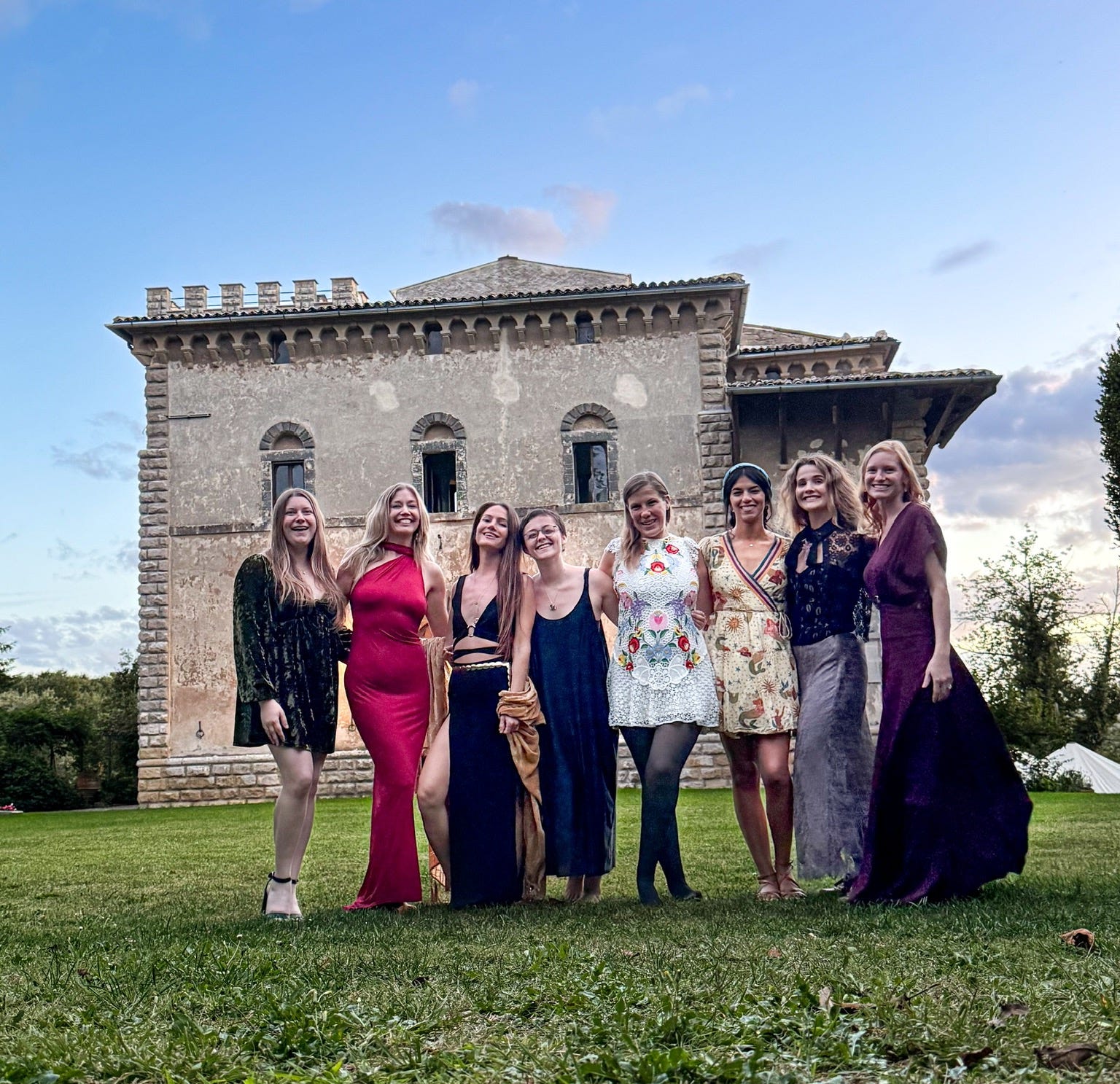
The final night of our Italy retreat, we lit candles, read poems we had written for one another, and placed found items on a stone table like an altar in a clearing as the night fell. It was all quite witchy and felt like sisterhood. My heart burst with pride and love for this group that had come together just days earlier bonding in such an ancient location.
Running group trips such as these poetry retreats is one of the things I love most, but it’s not for the faint of heart. Hefty deposits are due well before any cash comes in, marketing takes months, and participants expect a lot onsite.
There are entire companies built around connecting online specialists and influencers with retreat venues and DMCs, such as Trova Trip, who position themselves as a marketplace rather than a tour operator. There are distinct financial liabilities involved in being a tour operator, and positioning as a platform can skirt those responsibilities - think like AirBNB vs a hotel.
Creative leaders are often not the people with the logistical and financial skillset to handle a trip on location, yet many creatives believe they must be all things at once - financial manager, accountant, marketer, trip designer, tour leader, coordinator, and onsite talent and host. This is a lot to ask of themselves.
In the retreats I’ve helped run, I advise that it’s good to have two people onsite to prevent burn out. One person handles logistics, the other handles the group interaction and creative aspects. I am both a teacher and coordinator for our poetry retreats, but only the coordinator on others, such as the Mahjong retreats I’m assisting with in Aspen, Sonoma, and Scottsdale.
No matter whether the trip is a $17,000 per person epic jaunt through Egypt, or a $3,200 retreat to Italy, the pricing part is always the most difficult aspect of running a group trip. That is, pricing a retreat so it’s approachable to a creator’s audience, while also covering all costs and our time. The time piece is the part most creators forget to factor in.
The fact is that retreats are not a get-rich-quick idea. At intimate group sizes less than 10 participants, margins are slim unless you price upwards of $6k per person for a five-star accommodation experience. Breakeven is typically priced around $3,200 per person. Larger group sizes or higher price points can yield more take home pay, but come with their own downsides.
First, there’s the venue selection
This is the hardest part. It involves emailing venues around the world for pricing, putting the quotes in a spreadsheet to compare apples to apples because no two quotes use the same format, and confirming the space meets our requirements. With the advent of Claude in my life, this step has become easier - I used to spend hours generating these spreadsheets. Now, I can just drop emails into a project and say “Claude, dear, make a table comparing all these elements across these proposals to give me a per person price per day, and contract terms.”
What we look for are spaces where we can have all our meals in one place, a yoga studio, private living room areas where we can hold writing workshops, and flexible accommodations. Flexible means that rooms can either be twin beds or kings, which allows you to adapt more to whoever happens to sign up. It’s not a requirement, but certainly helps. Activities onsite are a plus so you don’t have to factor in more transfers or time spent off site.
Homes and hotels each have pros and cons. Rental homes have better group spaces, and allow you more control of the group dynamics. You can also bring your own chef and alcohol, which can lower costs. However, room categories are often uneven, which can cause dissatisfaction from the start and makes billing lumpy if you charge different price points. They typically lack yoga spaces, and they are a large fixed cost up front. You can’t drop a room if you don’t fill the trip. I find a lot of rental home spaces in Europe on Oliver’s Travels. Past locations I’ve loved: Temple House in Ireland, Frampton Court in England (currently here, gorgeous), Castello Santa Cristina in Italy (less lux but incredible spot).
Hotels allow for even room allocation and let you drop rooms through attrition clauses up to closer in. They also have more flexible bedding options. However, they cost more per room, the F&B rates are higher, and they often charge to privatize group spaces.
The year of work leading up to the retreat
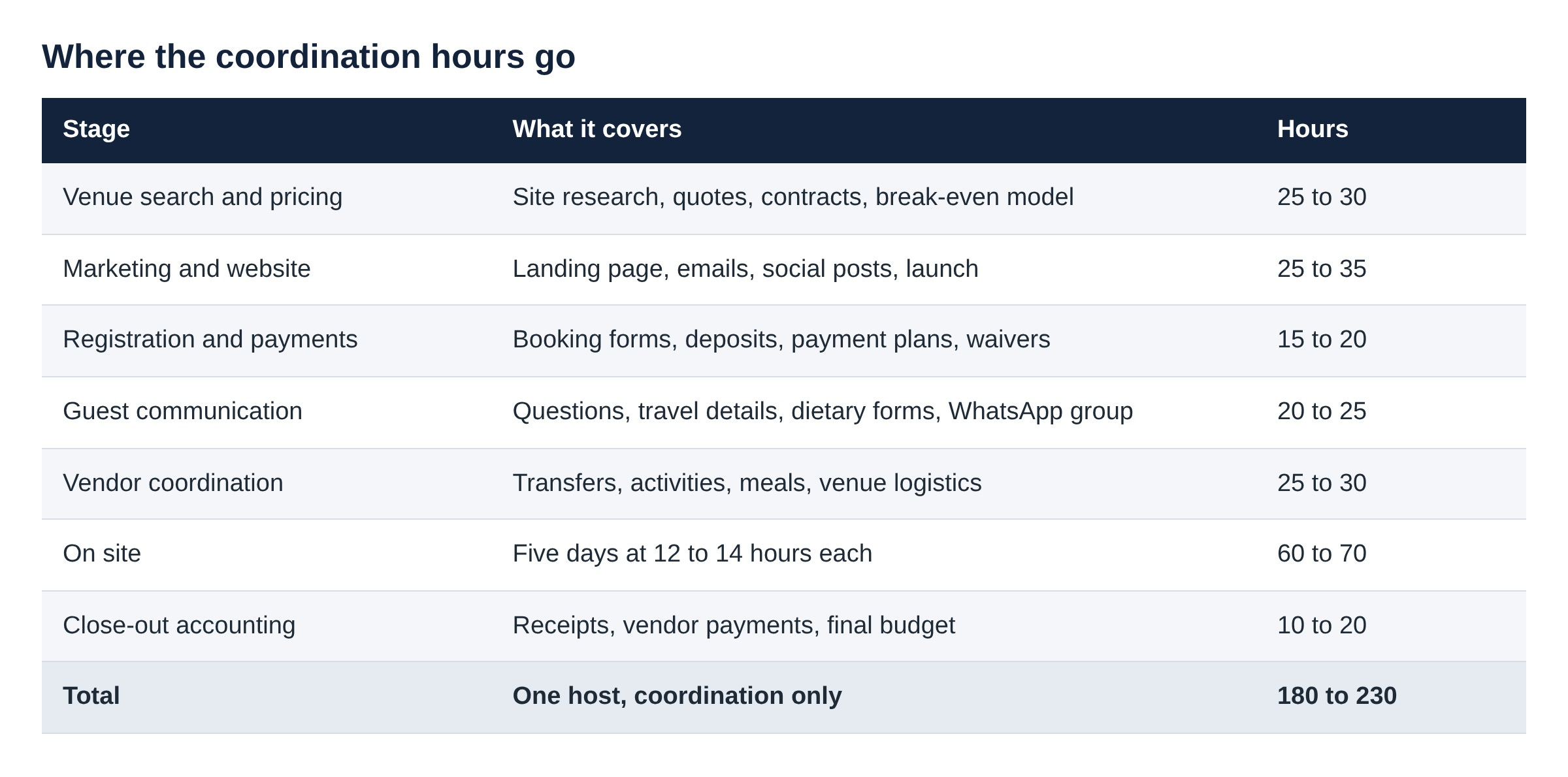
I estimated my time on the 2026 retreat at Castello Santa Cristina, October 6 to 10, at 180 to 230 hours over the year. That covers coordination only, not teaching two workshops onsite.
The hours ran from venue search and pricing through marketing, website creation, guest registration and communication, vendor coordination, 14 hour days on site, and financial close-out. That is roughly five full-time work weeks, mostly before guests even arrive. That’s about 10% of my working year designated to one trip. If we run trips in the same location across multiple years, or run back to back departures in the same location, that lift up front becomes easier.
On site
The prep work starts with packing. You need to bring things not only for yourself, but lots of “just in case” items like a ibuprofen, Benadryl, cold medicine, bandaids, safety pins, sewing kit, multiple international outlet adapters because people always forget them, several phone banks… etc. I always set up a WhatsApp group a couple weeks in advance so people can ask last minute questions as they pack. You’ll become an amateur meteorologist, trying to predict the weather for each day.
Once the group arrives, I manage the daily schedule and timing (which often requires adjustments) and text the schedule out each evening, weather changes, communication with vendors the day before and day of activities, dietary restrictions, group dynamics, the balance of free time, lessons, and activities, and cash, including tips and meal payments, with every receipt logged. I also manage my own energy across days that run 12 to 14 hours. When the group has free time, I’m responding to my clients from my travel agency, Alpenglow Travel (my other work doesn’t stop just because I’m on location running a retreat).
Transition days are the hardest. Some guests do not know how to turn on international data, which leaves them without Google Maps or WhatsApp. Vendors run late. The transfer I expected to be a sprinter van shows up as a minivan (in this latest retreat hiccup).
There are always surprises and stressful moments, but I’ve learned to take them in stride. Not everyone reacts the same to stress, so know how your retreat partner reacts in various conditions and be open with each other if you get frustrated.
For example, on arrival day this year, everyone was due at our hotel 15 minutes before the van transfer. One guest’s taxi dropped her in the wrong spot, so she dragged her suitcase down cobblestone streets looking for the entrance and messaged the group for help. I was greeting the guests who had arrived and helping the driver load the bags like a game of Tetris, so I didn’t see her message. Christi was working on the lesson plan for the welcome workshop, and was frustrated I wasn’t answering the message. Everyone was stressed. We talked it through later and let it go.
This is why I argue for smaller groups, even if they are less profitable, and fewer stops. Questions and problems multiply as you spread your attention across more people and more vendors for activities. First-time retreat leaders often feel they need to include a ton of activities. In reality, they are the activity, and they need time for workshops and guest interaction between events, plus downtime, because not everyone is an extrovert (myself included).
How we determine price
The first number a host needs is break-even guest pricing, the price per guest at which the hosts earn nothing, but lose nothing. That pricing should be set at the minimum number of people you can run the retreat with.
Costs on a retreat fall into two groups: fixed and variable costs.
Variable costs, such as meals and activities, rise and fall with each guest.
Fixed costs are what you have to pay regardless of how many people are on the trip, such as a rental home, retreat leader flights, etc. Smaller groups mean fixed costs are allocated across fewer people.
Travelers often do not understand what a single supplement is. It covers the fixed costs that are spread out over one fewer person in the group by having only one person in a room vs two, minus the variable costs, such as food, that you do not pay when the group is one person smaller. Some retreat leaders also add the margin they lose with one fewer person in a room.
Our 2026 Italy retreat charged $600 more for a single room. A five-star retreat that I attended cost $4,225 per person in a shared room and $6,950 in a single room, a supplement of $2,725 for six nights. For a group size that small where rooms are few, I think that premium is more than faire.
Fixed costs stay the same whether 6 people come or 15, so price a retreat to cover them and the floor of what you are willing to make. Treat your time as a minimum host fee that is a fixed cost input in your pricing proforma.
Then, decide on your inclusions and stick to them rather than adding things after bookings open. I’ve hosted trips where costs kept being added late, like private rooms for dinners, which decreases margin.
Our retreat model covers rooms, all meals, a couple of external activities, gratuities, transfers, gifts, workshops and yoga led by us, and a contingency fund. Host costs include an economy flight, a pre-trip hotel night, meals, and a room for each of the two hosts.
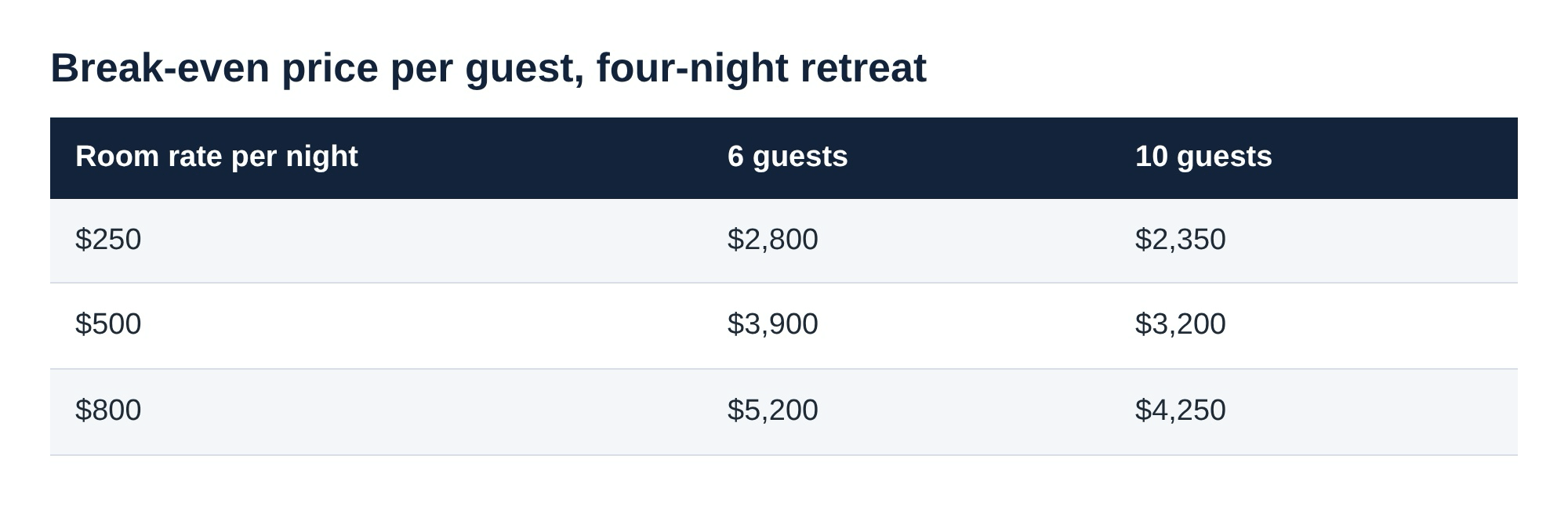
For a four-night retreat, break even guest pricing looks something like this:
Pricing above break-even
Running a trip at breakeven doesn’t pay for the time of the coordinator or the creative leader, let alone add any profit to make it worth their time to travel away from home and spend 10-14 hours a day being onsite with guests. Remember, this is not a vacation for a retreat leader.
To take anything home, a retreat leader must add a markup of 25 to 30 percent on top of break-even. That pays each host roughly $30 an hour. Card processing takes 3.5 percent of every payment, so many hosts must remember to pass those processing fees on to guests.
At an $800 room rate, a group of six needs a price near $6,500 to pay the hosts for their time.
How the country changes the price
Some countries have lower accommodation, activity, and meal costs than others, so the same retreat has a lower break-even depending on your location choice.
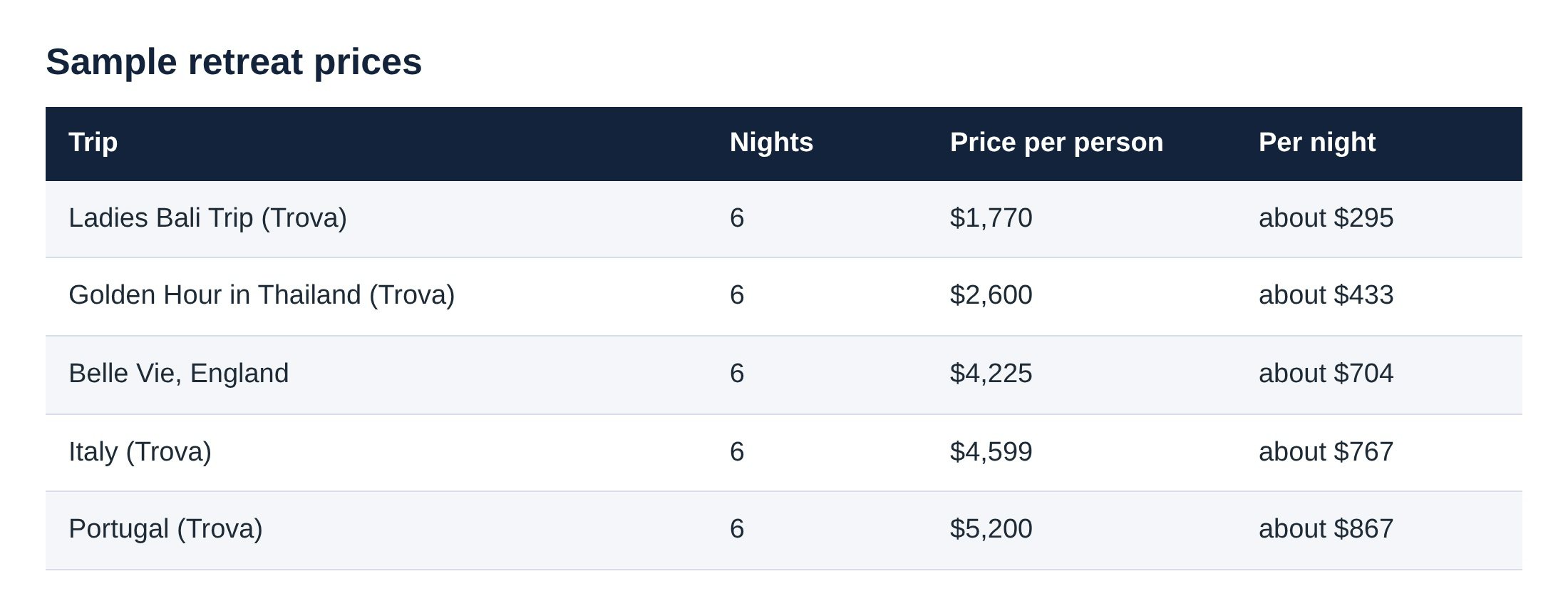
Most Trova trips priced below $3,500 per person are in Thailand, Costa Rica, Bali, Vietnam, and Mexico. Around $4,000, the destinations shift to Patagonia, Peru, Sardinia, Europe, and Japan. No price includes airfare.
Comparing apples to apples
I find no matter what the price of a trip is, I feel like I need to defend it. Two retreats at the same price per night can include very different things, so check what each price covers.
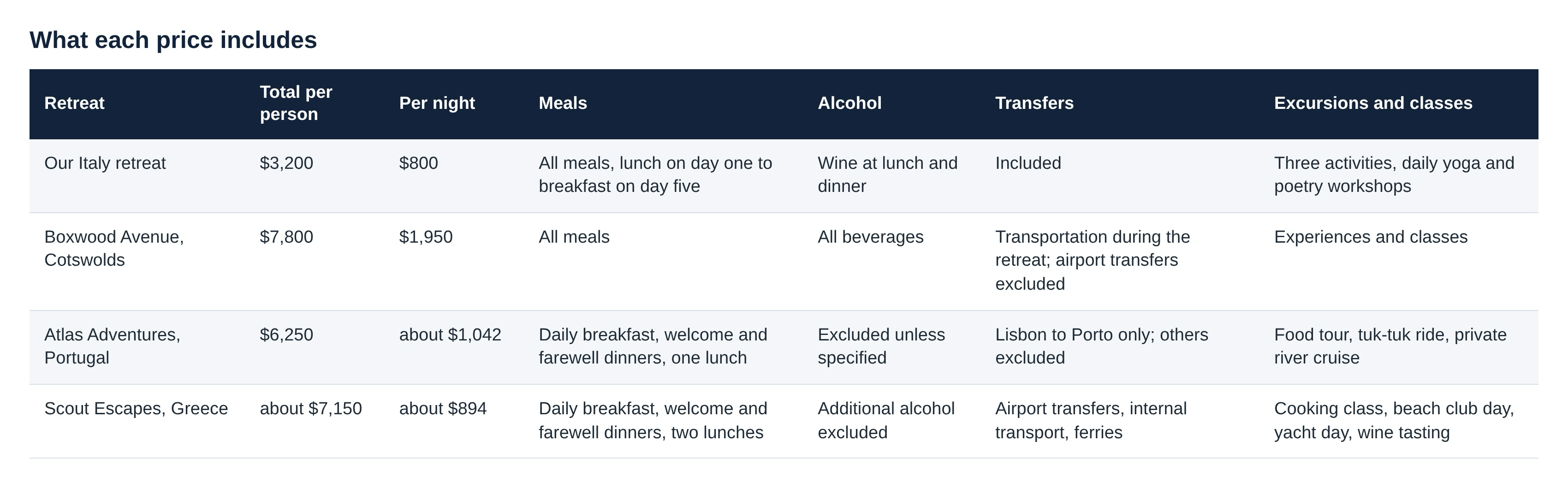
Atlas and Scout also require travel insurance on top of the price. We also covered wine in our recent retreat, an added bonus.
Legal exposure, insurance, and forms
I am not a lawyer, so hire a travel attorney before you sell any spots.
A retreat leader takes money months ahead, signs vendor contracts, and answers for a group’s safety abroad, so these are the legal exposures you are at risk for: guest injury, transportation, venue contracts that penalize a drop in headcount (ours went from 14 to 8), deposits and refunds, claims about the program, state seller-of-travel laws (California, Florida, Hawaii, and Washington are most cited), and the passports and medical notes you hold.
Carry insurance as a retreat business. Ask about general liability, professional liability, retreat or event packages, hired and non-owned auto, and event cancellation, and check each policy’s coverage territory, since many cover US activity only. Also check your vendors’ coverage.
Track down force majeure coverage: what happens if you can’t run a trip due to a natural disaster or global event, or if you or the creative leader gets sick or injured?
Many creative leaders don’t want to commit to a schedule in advance. What you list on any guest materials must match the inclusions guests experience, or you risk a false advertising claim. This is why we keep our schedule pretty vague. If you promise yoga daily and skip a day, a guest may be upset.
Guests should carry their own trip cancellation and medical evacuation coverage.
Before anyone pays, have a booking agreement, a liability waiver, a health questionnaire with emergency contacts, activity waivers for anything like horseback riding, a photo release, dietary forms, and contractor agreements for co-hosts and teachers.
How big a group should be
A larger group lowers the break-even price point because host flights, the van, and the host rooms spread across more people.
Creative retreats tend to work better with smaller group sizes, because a writing workshop depends on every guest getting time and feedback. Antiquing, strictly yoga, or historical tours can handle larger groups because they need less one-on-one time.
You can protect the economics without enlarging the group by running two departures back to back. Two groups of six in consecutive weeks share one set of fixed costs, like host flights.
What I’ve learned over 18 years of running group travel
People will always ask for a discount or a payment plan. Put your answer in the booking terms before the first request and stick to it. If you have low sign-ups, fight the urge to discount; you end up running the same trip for less money. Every time I make an exception, it comes back to haunt me.
Set hard cancellation terms to protect yourself. Your terms need to line up with the venue’s. Some retreat leaders charge a cancellation fee to cover their admin time spent handling a cancellation and refilling that spot.
Add an emergency fund cushion to every budget. A trip always finds a use for it.
Pay for the little things. Guests do not want to feel nickel and dimed. Take out more cash than you think you need.
Maslow’s hierarchy of needs applies. Guests need meals, sleep, and the right temperature before they can experience wonder.
Minimize the number of transition days.
Plan no more than one offsite activity every other day.
Build in free time.
Use a corporate credit card for on-site payments. It keeps them professional and trackable. Photograph every receipt.
Start a group WhatsApp chat the week before arrival.
People who are constantly late are the hardest guests in a group. Group trips require respect for others and showing up to things on time.
Plan for safety. Many creatives are famous and have their share of overzealous fans, so do not publish the retreat location on public sites.
What the same six nights cost on your own
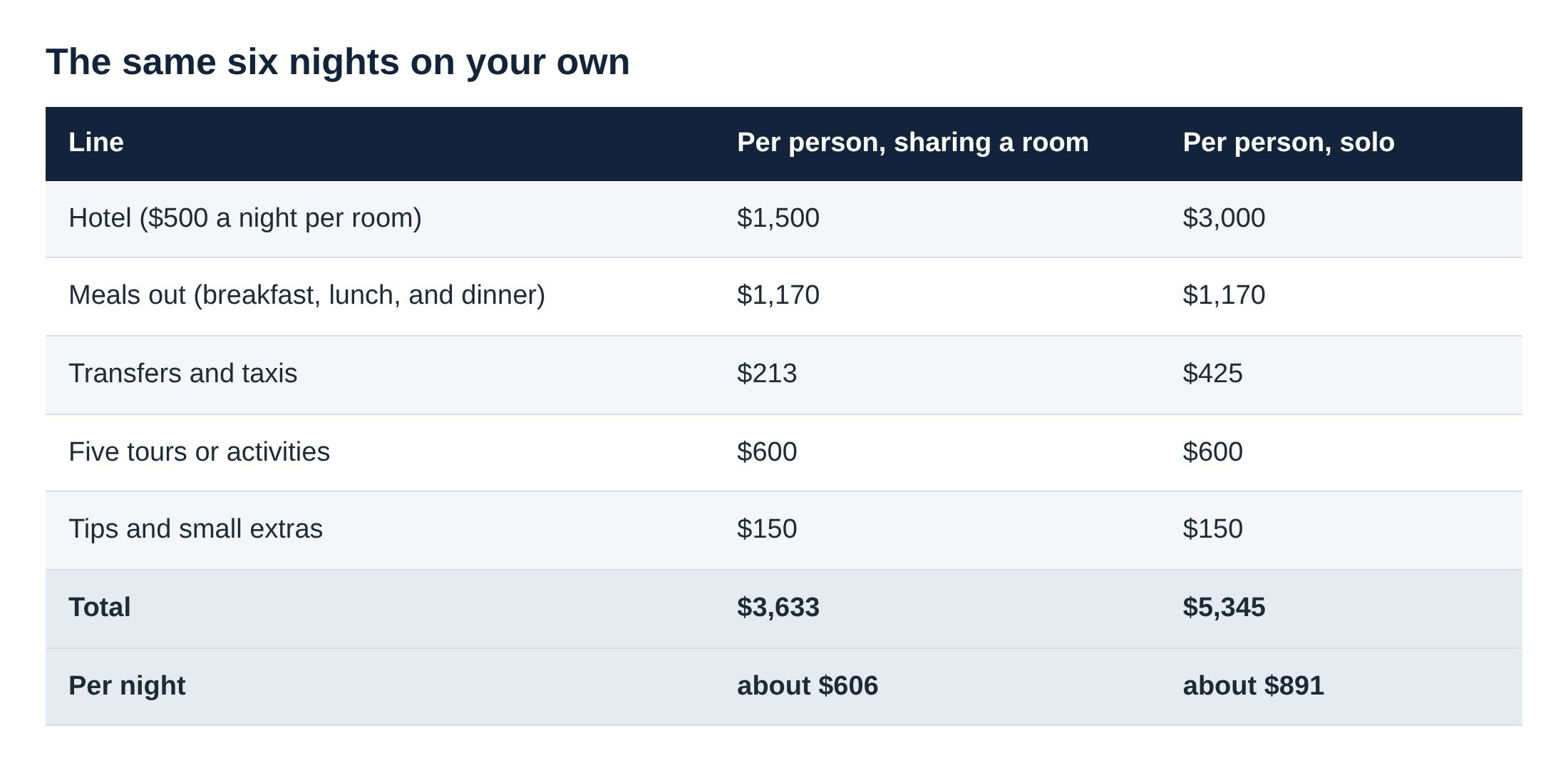
Whether running $17,000 per person Exclusive Resorts trips or $3,200 per person poetry retreats, I invariably hear from guests that they don’t understand the pricing and could travel for less on their own.
My friends, a professional trip like this is not a bargain basement product. It is not meant to be less than you can build a trip for on your own. A retreat is often all inclusive, so comparing one to your average vacation where you aren’t tracking your spend on activities, meals, and transfers does not give you apples to apples.
Additionally, you are hiring professionals as a service to plan and run these trips for you so you can have maximum enjoyment. Sure, you can give yourself a root canal and it’s cheaper than going to the dentist, but are those really comparable?
In my table solo traveler spends about $5,345 for a six night trip in a hotel that costs $500 per night. The retreat I am attending for fun in England this week charges $6,950 for a single room, so that gap is close to $1,600.
Add the 230 hours I spent coordinating this trip, spread across six guests and valued at $30 an hour, and each guest is also getting $1,150 of planning labor. That is one host’s time, not both.
Whether you are thinking about leading a retreat, coordinating one, or attending one, or just curious what all my instagram stories were about this week (full of frolicking in front of a castle, lighting candles in a forest, riding horses through open fields, etc), I hope this article gave you more information than you wanted to know.
Join me on a trip in the future - I like to think I’m pretty good at my job. And, if a retreat at $3,500 for four nights feels expensive, remember the hours in this article and what goes into making the magic happen.
🗝️The Lobby Bar
Hospitality updates, promotions, gossip, and the occasional pun
The ultra-wealthy have found a hobby
with a low rate of return and plenty of sunk costs…
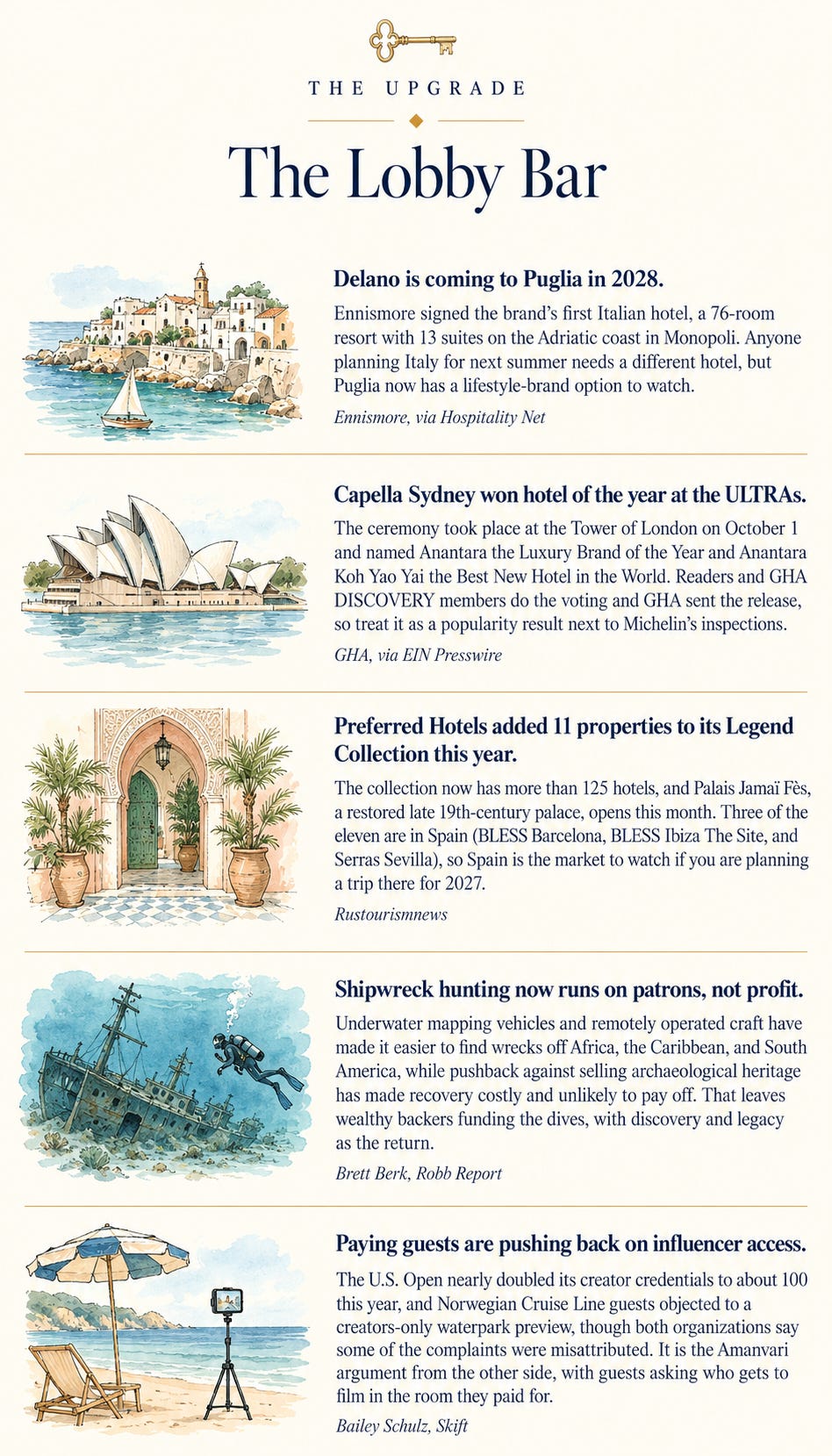
Preferred Hotels Legend Collection: https://rustourismnews.com/2026/10/01/preferred-hotels-adds-11-luxury-hotels-to-legend-collection-in-2026
Influencer backlash: https://skift.com/2026/10/01/content-creator-backlash-travel-tourism/
Delta media network: https://skift.com/2026/10/05/delta-air-lines-building-out-its-own-media-network/
Leela Palaces CEO: https://skift.com/2026/10/01/leela-palaces-ceo-on-the-overlooked-detail-that-can-make-or-break-a-hotel-stay/
Shipwreck hunting (Robb Report): https://apple.news/AZ8pkyb8ASBu3d69WV8Dmkw
So much goes into planning retreats and like you said, not for the faint of heart!! I think many details can be easily overlooked by non-travel professionals in terms of experience and logistics design, so your retreat guests are so lucky 🧁🧁
This is so comprehensive! I also loved the insight as a guest to know how to act respectfully.