


If you missed it or if you’re new here:
28. The Upgrade | Weekly - I Went Hiking With A Count at an Agriturismo Castle
Travelers,
Two weeks ago, I had the pleasure of hosting a poetry and yoga retreat at Castello di Santa Cristina, a centuries-old castle with outlying farmhouses. It sits where Lazio, Tuscany, and Umbria meet (not quite half the distance north from Rome toward Florence), and on the property you can play duchess, play farmer, or canter through the countryside living out your horse girl dreams.
It is also an agriturismo, and if you haven’t heard that term before, this article is about to explain it. Listing sites use this term for almost any stone farmhouse with a pool and a view of cypress trees, but Italian law gives it a specific meaning. A property cannot use it unless a working farm is associated the guest rooms. The system behind that rule is more than half a century old, and it ties together tax policy, EU farm subsidies, and the long shrinkage of Italian agriculture.
Early on in my Upgrade publication, I wrote about Farm Hotels, and why they are a good investment in terms of how much ancillary revenue they produce (they capture more share of wallet on location, or “cover” in industry terminology). That article largely covered British farm hotels.

Like all things in the Upgrade Weekly, this article stemmed from a late-night research rabbit hole I jumped through instead of sleeping when I was jet lagged in Italy. I hope you enjoy it.
Read to the end for an interview with Count Antonio, the absolutely wonderful owner of Castello Santa Cristina.
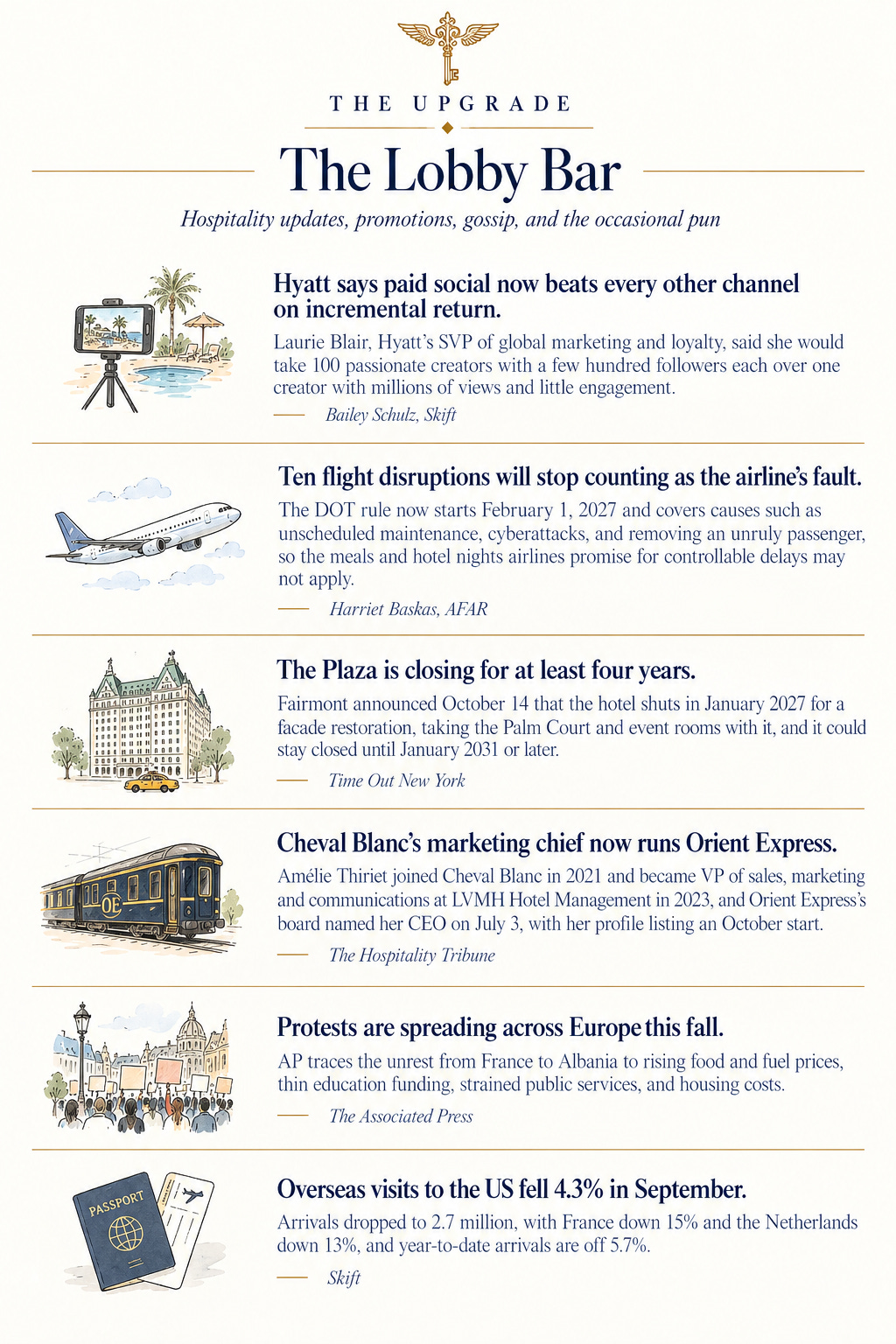
This week’s Lobby Bar covers Hyatt shifting budget to paid social, a new DOT rule that shrinks what airlines owe you for delays, the Plaza closing for years, a new CEO at Orient Express, protests spreading across Europe, and a September drop in overseas visits to the US.
Happy Travels,
Anne Marie
🗝️ Pre-Departure — Hospitality Hot Takes
What the law says an agriturismo is
Law 96 of February 20, 2006 says that an agriturismo is a hospitality business run by an agricultural entrepreneur, an imprenditore agricolo, who uses the farm’s own buildings, land, and resources to host guests.¹ The law lists what counts as agritourism: lodging, meals and drinks made mostly from the farm’s products and those of neighboring farms, tastings of farm products including wine, and recreational or cultural activities tied to the farm and its countryside. Farming is supposedly the main business, but in many cases, it serves to support an existing hotel concept.²
How long it has been around
The autonomous province of Trento passed the first agriturismo rule in 1973, and Veneto followed in 1975.³ Each region wrote its own version, and the results varied enough that Parliament passed a national framework in 1985. Law 96/2006 replaced that framework, so the national system is 41 years old and the regional rules are 53.³
Three later changes shape what a traveler encounters today at such a property:
• A 2013 ministerial decree set national criteria for classifying agriturismi and created the “ˆ” mark.⁴
• A 2021 amendment handed over to the regions³ the question of how much farming counts as “prevalent.”
• Since January 1, 2025, every accommodation in Italy, agriturismi included, must display a national identification code, the CIN, on the property and in every online or printed listing.⁵
The sector is large. ISTAT (Instituto Nazionale di Statistica) counted 26,360 authorized agriturismo businesses in 2024. About four in five offer lodging, and roughly half serve meals. Tuscany holds the biggest share, followed by the autonomous province of Bolzano. More than half of all guests come from outside Italy.⁶
What a property has to do to qualify
National law provides the framework, and each region fills in the specific numbers for each requirement. The details change depending on where the farm is located, and the common requirements run like this.
The operator must be a qualified agricultural entrepreneur. Someone who buys a farmhouse and plants nothing does not qualify.
The paperwork is extensive. The business must register for a VAT number, join the Chamber of Commerce and the regional agritourism registry, file a notice of activity with the municipality, and request a CIN (the Tourism Ministry’s National Identification Code). Fire, sanitary, and waste permits are additional requirements.
Farming remains the primary purpose. Regions define this differently. Bolzano, for example, treats farming as prevalent automatically when lodging is limited to ten beds or meals to ten seats.⁷
Meals come mostly from the farm and its neighbors. Bolzano requires at least 80% of ingredients to come from the farm or nearby farms, with 30% from the farm itself.⁷
Capacity is capped. Sardinia allows up to 16 rooms and 30 beds. Molise allows up to 25 beds. Lombardy sets a daily meal ceiling, with a much smaller limit for family-scale operations using the owner’s own kitchen.⁷ As a practical matter, an agriturismo is a small place.
Lodging properties must be classified. The system uses five levels, shown as sunflower icons, to rate areas such as setting, management, lodging, food service, recreation, and typical farm production.³ One sunflower is the legal minimum. Higher levels require points in each area, and the top levels also require special features, such as a private bathroom in every room. The scoring counts the property’s features, so a five-sunflower rating describes the full range of what an agriturismo offers. Point thresholds differ by region, and the Lazio thresholds for Castello di Santa Cristina were not available at the time of writing.
What the farm gets out of it
The 2006 law aims to keep people working in rural areas, spread farm income across more than crops, and protect land and landscape by increasing farm income. The Ministry of Agriculture is also required to draw up a three-year program promoting Italian agriturismo at home and abroad.²
Sicily’s regional law adds a protection that bolsters agriturismo’s workability. On that island, agriturismo does not penalize moving farm buildings and land out of agricultural use. This allows a farm owner to keep the property’s status as a farm even while housing guests in a renovated barn.⁷
Tax treatment
Agritourism has its own tax rules under a 1991 law. A sole proprietor or partnership can pay income tax on a quarter of revenue net of VAT and owe VAT on only half of what it earns. On €100,000 of revenue, the taxable figure is €25,000.⁸ Lodging, camping, and meals carry a 10% VAT rate, and activities such as horseback rides carry the ordinary 22%.⁸ Companies cannot use the income-tax arrangement, and a farm on the flat method deducts no costs, so a farm with heavy expenses can opt for ordinary accounting under a three-year commitment.⁸ Staff count as agricultural workers for pension, insurance, and tax purposes.⁸ Agritourism income falls outside farm income for regional business tax, which applies at the ordinary rate.⁸
Subsidies
The EU farm plan for 2023 to 2027 includes an investment measure, called SRD03, for farms that add agriturismoactivities. Lazio’s agricultural agency put the national allocation at €286 million.⁹ Each region sets its own eligibility rules and caps, and Lazio issued a call under the measure dated October 6, 2026.⁹
Is it working? How the program has performed
The 2006 law set out to keep farms operating, so the national farm numbers should show us how well it has done its job.
Italy had 1.62 million farms at the 2010 census and 1.13 million at the 2020 census, a loss of about 487,000, or 30%.¹⁰ Farmland shrank by only 2.5%, so the remaining farms are larger, averaging 11.1 hectares vs. 7.9 a decade earlier. Farm heads under age 44 fell from 17.6% to 13.4% of the total, and Umbria lost a quarter of its farms in that decade.¹⁰
Agriturismo grew slowly over the same stretch, from about 23,600 businesses in 2018 to 26,360 in 2024.⁵ That is roughly 2.3% of all Italian farms, a share too small to move the national count.
Within the agritourism sector, the numbers look healthy. Agritourism revenue rose 3.3% in 2024, guests reached 4.7 million, and the sector skews young: a 2022 report from the agricultural market institute ISMEA found that people under 40 run 18.7% of agriturismi, about double their share of farms overall.¹¹
The strongest evidence on whether farm stays keep farms alive comes from a 2025 study in Tourism Economics by Matthias Firgo and Dieter Pennerstorfer.
It found that agritourism raises a farm’s chance of surviving by more than 10 percentage points per decade, with a larger effect for conventional farms than for organic ones.¹²
The authors worked with Austrian farm data, so the study is not an Italian measurement. The Italian studies are smaller. A survey of 77 agritourism farms found that those with long-running diversification performed better through COVID, and a study of 15 Sardinian farms found more work for family members as agritourism grew.¹³ None of them tracks what would have happened to the same farms without agritourism.
The evidence supports agriturismo as a tool that helps individual farms stay in business. The national decline continues among the roughly 98% of farms without it.
Thinking about booking an agritursimo stay? Here’s some food for thought…
• Ask what the farm produces. A property that cannot tell you what it grows or raises has a problem with its own license.
• Confirm dinner. Only about half of agriturismi serve meals. Where there is dinner, it is usually a set menu built around the farm’s products, and you must reserve it in advance. Not all of them can accommodate dietary restrictions, but Castello Santa Cristina did a great job with ours.
• Expect a small place. In the regions checked, the caps run about 25 to 30 beds.
• Send your arrival time before you fly. Check-in windows can be short. One agriturismo in Trento lists a 90-minute arrival window between 5:00 and 6:30 p.m.¹⁴
• Budget for the tourist tax. It is paid at the property and varies by town. One agriturismo near Florence charges €3.50 per person per night, and one in Trento charges €1.50.¹⁴
• Look for the CIN. It has to appear on the listing and at the property, and a listing without one is out of compliance.⁵
• Read the sunflower icons as a feature tally. They add up amenities, services, farm activity, and setting.
• Plan for a car and confirm the season. Most agriturismi are rural, and some close for winter. Castello di Santa Cristina shows a closure from November 9 to the end of February.¹⁵
🗝️ Room Report — Castello di Santa Cristina - An Interview With A Count
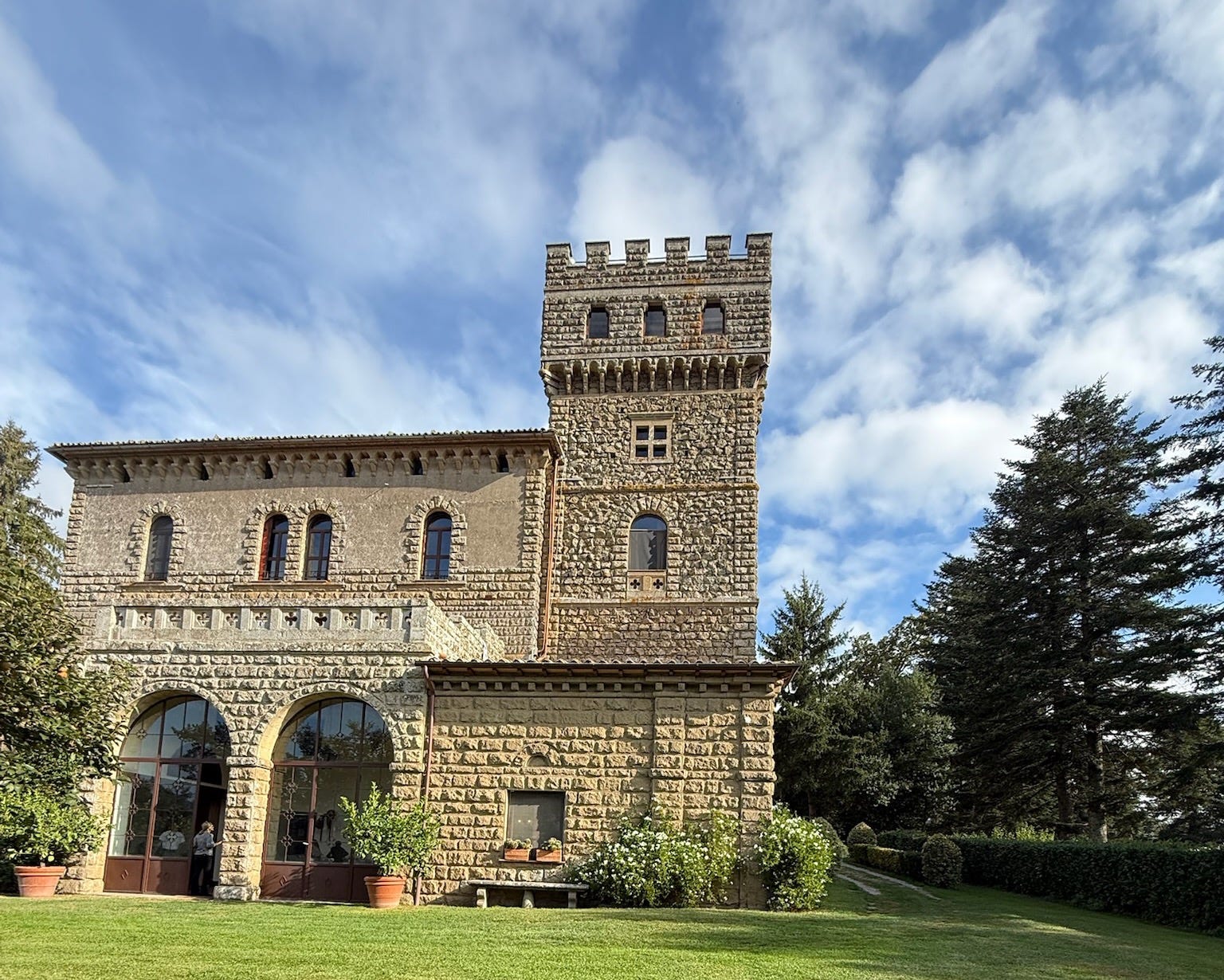
Castello di Santa Cristina sits near Grotte di Castro in the province of Viterbo, in northern Lazio. The property places itself about halfway between Rome and Siena, with Lake Bolsena roughly nine kilometers to the south and Orvieto about 35 kilometers to the east. From the castle tower, you can see all three regions.¹⁵
The Caterini family still lives in the castle. Count Antonio Mancini Caterini and his wife Cristina have run the agriturismofor more than twenty years.¹⁵ Antonio tells the family history in his own words below.
The estate also tells a story about 1848, when Pius IX fled Rome for exile at Gaeta. According to the estate, Prospero Caterini, a close adviser to the pope, drove a caravan of carriages carrying Church treasures and documents to Santa Cristina before they continued south.¹⁵
Pius IX made Caterini a cardinal in 1853.¹⁶ No independent source for the carriage story turned up, so it belongs to the family. The Pacelli connection is documented. Prospero’s mother was a Pacelli, and the young seminarian Eugenio Pacelli, later Pope Pius XII, spent holidays at the Caterini castle.¹⁶
The guest rooms are in the old farming hamlet a few steps from the castle, where the stone houses once accomodated farm workers. The owners have converted them into cottages and rooms furnished with antiques and pieces from the castle, with a capacity of 48 guests.¹⁵ The estate covers more than 100 hectares by its own count and offers a pool, a tennis court, an equestrian center, a yoga room, cycling, cooking classes, and wine tastings.¹⁵ Sawday’s lists a larger figure of 250 hectares and describes the property as part of a working farm.¹⁵ Check-in is at 2:00 p.m. and checkout at 10:30 a.m.¹⁵
In Antonio and Cristina’s words
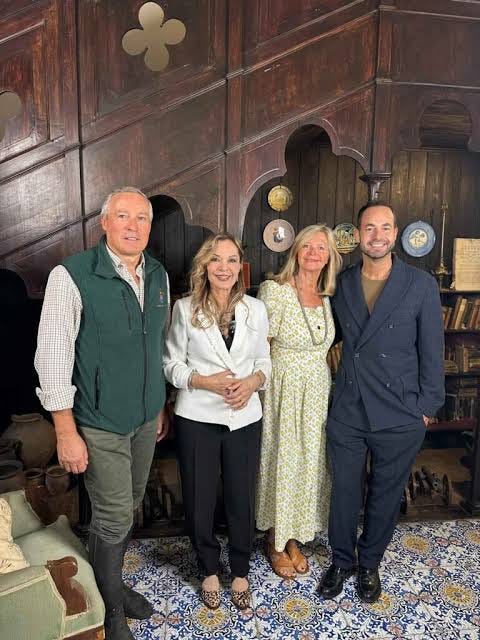
After our poetry and yoga retreat, I emailed Antonio and Cristina with a few questions. Antonio answered and his answers appear here in his own words, with only spelling and spacing corrected.¹⁷
Can you tell me about the history of your family and Castello Santa Cristina?
The Caterini family came to this area precisely to Acquapendente around the beginning of the XVI sec. [century] from Umbria, there they were part of an important family named Cattanei. In that period changed their name to Caterini to honor S. Caterina from Alexandria.
Always strongly connected with the church they climbed the hierarchic ladder inside the Vatican state receiving the title of counts later on from pope Leone XIII. They settled in the Castle at our present location at the end of XVIII c. during Napoleon times.
The Castle and its estate provided a source of living to many farmers families throughout the years including the difficult period of WW2, when the Castle became a German radio station and was later freed by the Allied troops.
What drove you to hold on to property and welcome guests?
I spent when I was young, long summer months at the Castle enjoying the beautiful nature but also working very hard on the farm. We returned to Rome during the winter school season, but those summer months built a strong tie with the Castle.
When my mother and my brother in the late 90s started considering selling the estate due to a difficult economic situation, I left my job in advertising in Rome and took over the Castle business determined to change direction. My wife supported me in this critical moment and the result is what you see now.
My wife Cristina has a natural wonderful talent in interacting with our guests from all over the world, matching my more practical problem solving attitude.
Doing sports and activities in this fantastic countryside is for me the real privilege and it is so rewarding sharing it with our guests.
What are the agriturismo requirements you must adhere to in your region?
In order to adhere to the agriturismo regulations you simply have to continue working the land, cultivating the most part of the estate. At the moment we mostly sow hay for our horses.
In general let’s say that tourist business must never stop the farming part of the estate.
What are you most proud of at Castello Santa Cristina?
We are mostly proud of two things:
A) Bringing people of all nationalities to this remote and so far unknown part of Italy and sharing the Italian experience with them.
B) We are really proud of having saved this enchanting property, where our family is rooted, from some uncertain future providing jobs to the local community.
What is most challenging in operating this property?
The most difficult part is to cope with the Italian absurd bureaucracy and total lack of support from local institutions. Most of the infrastructures are missing and our local community is slowly discovering what tourism is about.
What is next – what are your future plans for the hotel?
Our next step could be adding a Spa to the present Castle list of facilities.
We had an incredible time there for our retreat – what would you want other retreat leaders to know about hosting their retreats at your property?
I think other retreat leaders should just know that there is a Castle only 2hrs from Rome where you can really relax, enjoy yourself, eat good healthy food and feel the real Italian experience while doing lot of activities ranging from horseriding, to yoga, swimming, biking, hiking, visiting hilltop fortresses, wine tasting, cycling... adding any cultural hobby. Enough?
TLDR - from Anne Marie
For a traveler, the property delivers what the law intends an agriturismo to be: guests staying inside a working estate, with the family that runs it in residence.
I really loved my experience there and hope to return with my kids some day!
-Anne Marie
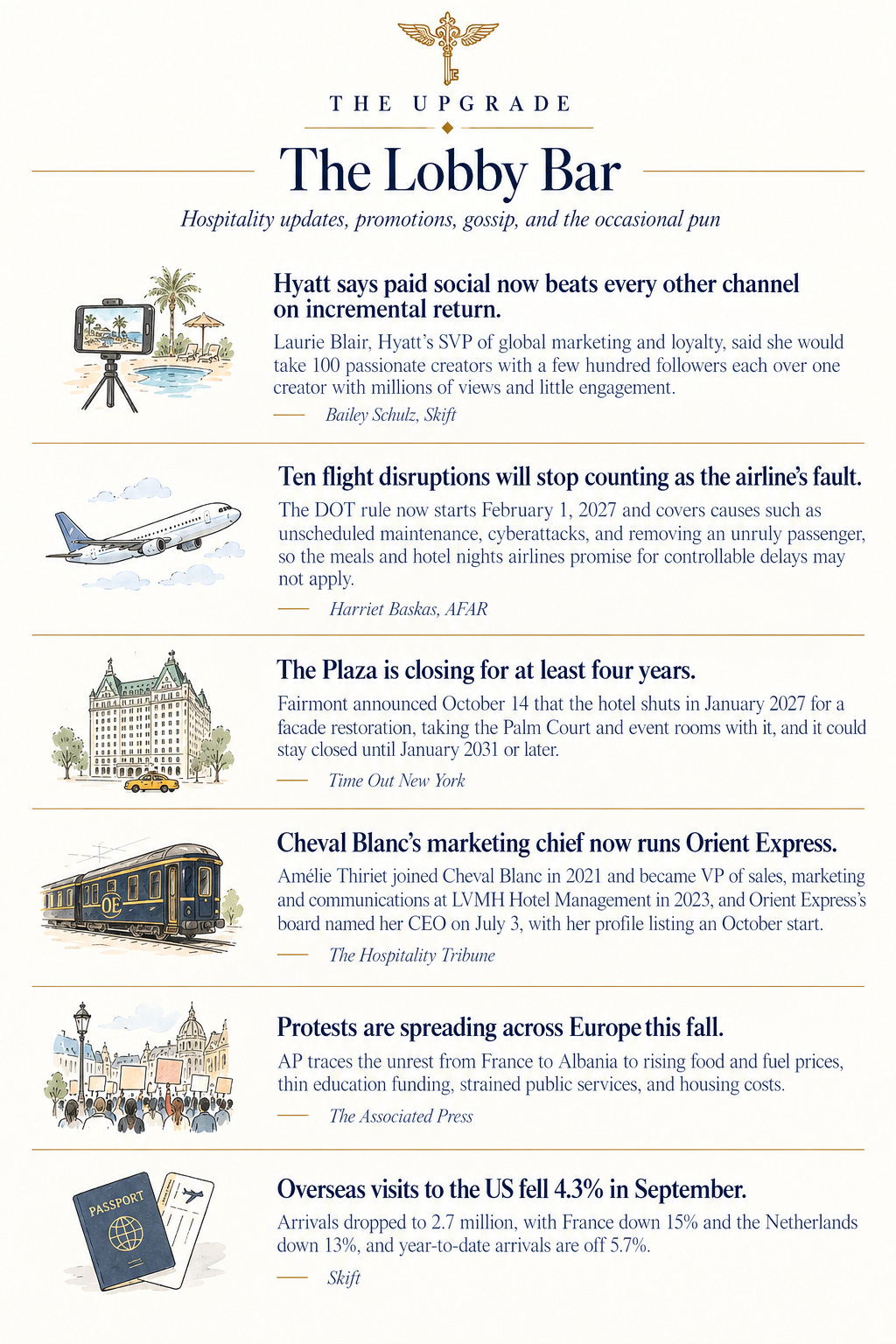
🗝️ The Lobby Bar
Hospitality updates, promotions, gossip, and the occasional pun
Hyatt says paid social now beats every other channel on incremental return. Laurie Blair, Hyatt’s SVP of global marketing and loyalty, said she would take 100 passionate creators with a few hundred followers each over one creator with millions of views and little engagement. Meta’s Diana Lucas said click-based attribution misses most of the impact because 60% of what people watch on Instagram and Facebook is video, and months can pass between a viral video and the booking it inspired. (Bailey Schulz, Skift)
Ten flight disruptions will stop counting as the airline’s fault. The DOT rule now starts February 1, 2027 and covers causes such as unscheduled maintenance, cyberattacks, and removing an unruly passenger, so the meals and hotel nights airlines promise for controllable delays may not apply. Refund rights for canceled or significantly changed flights stay separate. (Harriet Baskas, AFAR)
The Plaza is closing for at least four years. Fairmont announced October 14 that the hotel shuts in January 2027 for a facade restoration, taking the Palm Court and event rooms with it, and it could stay closed until January 2031 or later. Anything you have booked there past January, including weddings, needs a new plan. (Time Out New York)
Cheval Blanc’s marketing chief now runs Orient Express. Amélie Thiriet joined Cheval Blanc in 2021 and became VP of sales, marketing and communications at LVMH Hotel Management in 2023, and Orient Express’s board named her CEO on July 3, with her profile listing an October start. Accor and LVMH announced their Orient Express partnership in June 2024 to grow the brand across trains, hotels, and ships. (The Hospitality Tribune)
Protests are spreading across Europe this fall. AP traces the unrest from France to Albania to rising food and fuel prices, thin education funding, strained public services, and housing costs. If you have clients heading to any of these countries this fall, check for strike dates and demonstration routes before they leave. (The Associated Press)
Overseas visits to the US fell 4.3% in September. Arrivals dropped to 2.7 million, with France down 15% and the Netherlands down 13%, and year-to-date arrivals are off 5.7%. (Skift)
Sources
1. Italian Real Estate Lawyers, “Opening an Agritourism or B&B in Italy.” https://italianrealestatelawyers.com/investment-news/opening-an-agritourism-or-bb-in-italy/
2. Legge 20 febbraio 2006, n. 96, “Disciplina dell’agriturismo,” Parlamento italiano. https://www.parlamento.it/parlam/leggi/06096l.htm
3. ecnews.it, “Agriturismo sempre più ‘regionalizzato’” (https://www.ecnews.it/fiscale/?p=53713); Università di Milano-Bicocca course slides, “Agriturismo” (https://elearning.unimib.it/pluginfile.php/936101/mod_resource/content/1/Agriturismo.pdf); ILF Law Firm on Tuscany (https://italylawfirms.com/en/italian-agriturismos-updates-tuscany-law/).
4. Decreto 13 febbraio 2013, Gazzetta Ufficiale n. 54, via Regione Umbria. https://regione.umbria.it/documents/18/20452512/DM13-2013/6cf68438-ede4-4537-9686-39e5705e87bd
5. Holidu, “FAQ: National Identification Code (CIN) for Italian Properties.” https://www.holidu.com/help/host/taxes-and-regulations/faq-national-identification-code-cin-for-italian-properties
6. ISTAT, “Le aziende agrituristiche in Italia, Anno 2024,” March 2026. https://www.istat.it/comunicato-stampa/le-aziende-agrituristiche-in-italia-anno-2024/
7. Regional laws: Bolzano (https://edizionieuropee.it/LAW/HTML/104/bz4_01_094.html); Sardegna, L.R. 11/2015 (https://web.unica.it/static/resources/cms/documents/Leggeregionale11maggio2015n.11.pdf); Molise, via Agriturismo.it (https://www.agriturismo.it/it/extra/aprire-un-agriturismo-in-molise-495); Lombardia (https://www.edizionieuropee.it/LAW/HTML/122/lo3_01_150.html); Sicilia, L.R. 25/1994 (https://www.edizionieuropee.it/law/html/140/si3_01_053.html).
8. ecnews.it on Law 413/1991 (https://www.ecnews.it/fiscale/?p=90752); Agriturismo.it, “Aprire un agriturismo” (https://www.agriturismo.it/it/extra/aprire-un-agriturismo-25); Il Sole 24 Ore NT+ Fisco on IRAP (https://ntplusfisco.ilsole24ore.com/art/fisco-e-agricoltural-attivita-agriturismo-non-sfugge-all-irap-AEgq8AJG).
9. ARSIAL, 2023 (https://www.arsial.it/app/uploads/Selmi_Arsial_Rieti_2023.pdf); Regione Lazio call (https://www.regione.lazio.it/sites/default/files/documentazione/2026/DD-G13561-06-10-2026-Allegato1-avv-pubb.pdf).
10. ISTAT 7th General Agricultural Census, via Terra e Vita (https://terraevita.edagricole.it/economia-e-politica-agricola/censimento-istat-in-dieci-anni-sparite-un-terzo-delle-aziende-agricole/); Contoterzista (https://contoterzista.edagricole.it/economia-e-mercati/censimento-istat-meno-aziende-agricole-ma-piu-grandi/); Regione Umbria (https://webstat.regione.umbria.it/ca2021_aziendesau/).
11. Dissapore, summary of ISMEA’s 2022 “Agriturismo e multifunzionalità” report. https://www.dissapore.com/notizie/agriturismi-negli-ultimi-10-anni-il-valore-del-settore-e-cresciuto-del-50/
12. Matthias Firgo and Dieter Pennerstorfer, “The causal effect of agritourism on farm survival,” Tourism Economics, 2025. https://doi.org/10.1177/13548166241308300
13. MDPI Land 11(8):1215 (https://www.mdpi.com/2073-445X/11/8/1215); Springer, agritourism in a less favoured area (https://link.springer.com/article/10.1186/s40100-021-00199-z); Italian Review of Agricultural Economics (https://oajournals.fupress.net/index.php/rea/article/view/13209).
14. Agriturismo.it listings for Fattoria di Malavolta (Florence) and Agriturismo 8 Grappoli (Trento).
15. Castello di Santa Cristina, “The Estate” (https://santacristina.it/en/the-estate/); Sawday’s (https://www.sawdays.co.uk/italy/lazio/viterbo/castello-di-santa-cristina/); Zampavacanza and Matrimonio.com listings.
16. Wikipedia, “Prospero Caterini” (https://en.wikipedia.org/wiki/Prospero_Caterini); The Holy See, biography of Pope Pius IX (https://www.vatican.va/news_services/liturgy/saints/ns_lit_doc_20000903_pius-ix_en.html).
17. Email interview with Antonio and Cristina Mancini Caterini, Castello di Santa Cristina, October 2026.