

Travelers,
November arrived with much fanfare this year, following an election and now rocketing into “Black Friday” season for hotel deals. In my own travels so far this month, I dipped over to New York and stayed at the gorgeous new Fifth Avenue Hotel, (room report to come this week), spent time with my godmother (Melinda Bush, a hotel industry legend), and some friends, and researched a bit for my article about the Gilded Age Dollar Princesses.
I come from a hotel family. My siblings and I are divided politically, which makes for interesting Zoom discussions after elections. On a recent call, some bemoaned the coming post-midterm tax increase and others celebrated the blue wave. I still think these discussions are some of the best forays outside of our political bubbles that we can hope for.
I vote solidly blue, (I’ll be interested to see if my subscription numbers drop after that announcement), but that wasn’t always my leaning. I was raised by a Reagan-era Republican who also strongly supported abortion rights and LGBTQ rights. I voted red in my first election, then volunteered for the DNC in Denver for Obama’s first run.
As a hotel owner, LP (limited partner) investor and travel agency owner, I want to take off my partisan lens and look at actual numbers for the travel industry in the US over the Trump and Biden administrations. The data is interesting in its own right.
Happy Travels,
Anne Marie
🗝️ Pre-Departure — Hospitality Hot Takes
Washington and the Hotel Room
How do US elections affect the travel and hospitality industry?
Obviously, major exogenous factors like the pandemic come into play with these numbers. Still, I think it’s important to look at how government policy and elections affect tourism. To do this, I had a date with Claude to look at several leading indicators for the health of the US travel industry.
Hotel rates and RevPAR (revenue per available room)
Occupancy
Inbound (to the US) visitor numbers
Hotel stocks and total return
Airfares
Hotel development pipeline, new openings, and loan data
S&P total return
Inflation (CPI, Consumer Price Index)
I also added interest rates, hotel loan delinquency, TSA (Transportation Security Administration) throughput, the dollar, visa policy, and international opinion of the US. I tracked the pandemic and the Iran war as outside forces, although how the Trump and Biden administrations handled those shocks has also affected travel.
The voting ended last Tuesday – just a week ago. Control of Congress will shape the next two years of legislation, but your flight cost, your hotel rate, and your visa line depend mostly on decisions made far from Capitol Hill.
What the midterms change, and don’t
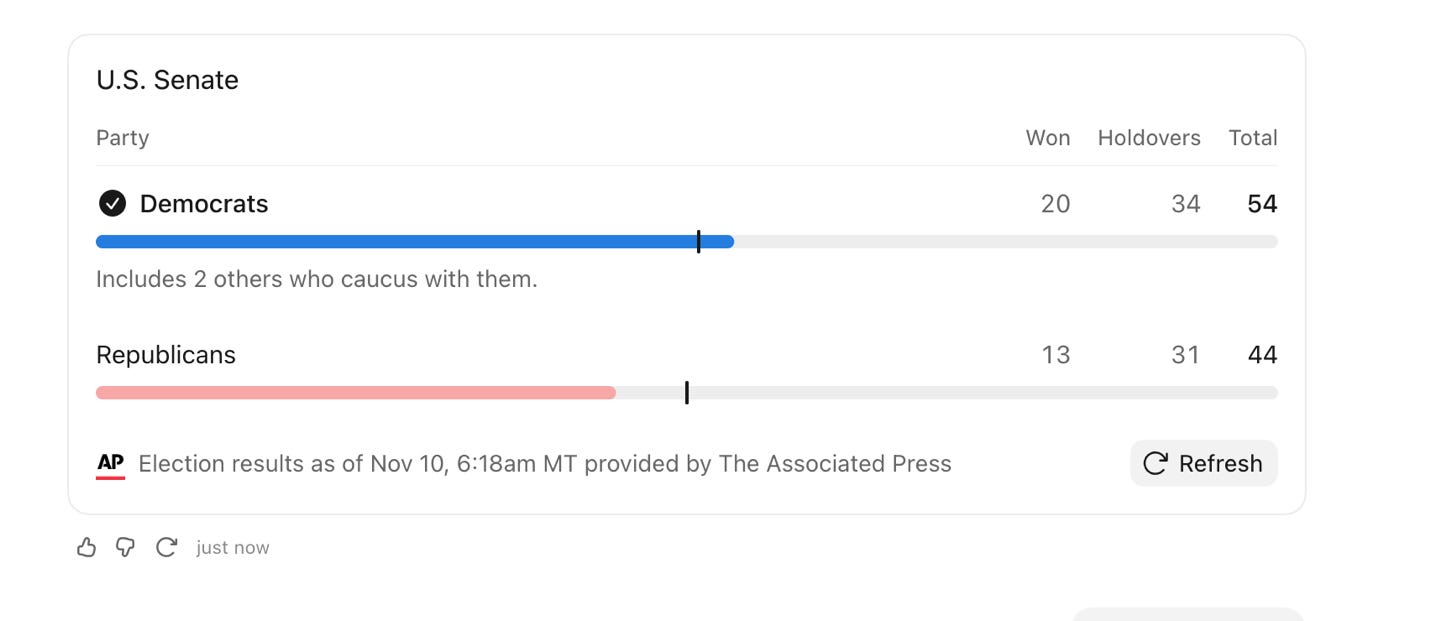
Democrats won both chambers. As of 6:18 a.m. (Denver time) on Tuesday, November 10, the Associated Press counts 254 House seats for Democrats and 165 for Republicans, with 218 needed for a majority. In the Senate it is 54 Democrats, 2 independents who caucus with them, and 44 Republicans, a net gain of 7 for Democrats, and two races are still undecided.
Democrats are short of a filibuster-proof Senate, and the president can veto anything they send him, so they will pass very little on their own.
On the Skift Travel Podcast, (which I love listening to), Seth Borko of Skift Research and Skift Editor-in-Chief Sarah Kopit reached the same conclusion. Seth expects gridlock, investigations, and vetoes, with no major changes to interest rates, legislation, or congressional funding.²² Skift reported the same thing on the day of the 2018 midterms: expect most regulatory change to come from the administration.² Visa rules, entry restrictions, tariffs, and war decisions belong to the president, not the House of Representatives.
Spending is where the Democrats wield influence. Every funding bill now needs their votes, and those bills provide the money for airport security staffing, air traffic control, national parks, and the agency that promotes the US to foreign visitors.
A budget fight between a Democratic Congress and the Trump White House raises the odds of a government shutdown. Sarah noted that the government is funded only through December 11. A lapse would hit air traffic controllers just before Christmas.²²
Your winter trips carry the highest exposure to shutdown impacts, so buy travel insurance.
What is up to local policy vs federal?
Melissa | theCEOffice Melissa K. Jones, who runs the CEOffice, a leadership coaching firm for small business founders, would add local policy here: “The ease of permitting/building and hiring labor are all influenced locally, not nationally.” Whether a hotel gets built or staffed in your destination often turns on the city, county, and state, not on who controls Congress. She also suggested a map of new hotel permits next to a map of hotels closing, “a visual migration of sorts.”
Such a map as Melissa wants to see requires closure data, but I could not find a public state-by-state set covering both administrations. Melissa wanted to know, are more hotels closing because of blue state tax and labor policies? Oregon’s hotel businesses shrank only 0.2% a year from 2021 to 2026,²³ and California foreclosure notices rose in 2025, which signals stress, not closures.²⁴
Though, it’s worth noting, that hotel closures might not be the right indicator. Often hotels trade down in a market where prior owners are wiped out of their equity (wholly or partially) and the basis is reset lower with a new buyer. So technically the hotel stays open, but as the NOI is hit by new labor costs, the asset isn’t as valuable and so the market trades it down. Not a closure, but certainly a failed investment. Read my husband’s guest article for Master Key about this.
Los Angeles perhaps demonstrates the strongest case behind Melissa’s question. Its hotel wage ordinance began at $22.50 in 2025, the $30 target has slipped to 2030, and an industry-commissioned study found hotels cut or plan to cut about 6% of jobs, though I found no count of closures.²⁵ That is a city policy, not a state one. Anecdotally, as a hotel investor and owner, I will admit that California has become difficult to operate properties in. We feel that as owners more from the raising of minimum wages rather than tax policies. Elsewhere, distress follows debt: Texas faces refinancing stress, and Hilton-branded and limited-service hotels show the highest delinquency.²⁶
Will a change in government leadership make America attractive again to visitors?
In the Skift podcast, Sarah pointed to a 2025 Skift Research survey in which about 70% of international travelers said they did not want to visit because of the president, but would reconsider once the administration changed. Seth said 74% of those who had changed their minds would consider traveling again after Trump leaves office. He called the election “very clearly a repudiation of Trump” and said the core question is whether that message brings tourists back.²²
How is Wall Street reacting?
Investors like the election result. The Dow rose more than 1,200 points shortly after trading opened on Wednesday,³ and history shows that stocks have been higher twelve months after every midterm election since 1946.⁴
Seth said Wall Street has long liked divided government. At the time of recording, the S&P 500 was up 1.7%, Expedia 12%, Airbnb 6%, and Delta 6.7% as crude futures fell 8%.²²
Travel stocks in 2026 have reacted to oil prices and the Iran conflict far more than to politics, so watch fuel prices for airfare signals.
On oil, Hakeem Jeffries, the expected next Speaker, plans to bring a vote on the Iran war to the floor, though the president holds a lot of executive power over the military, and even a reopened Strait of Hormuz might not start the oil flowing right away.²²
Stocks show what investors expect. Inflation squeezes household travel budgets and, by raising interest rates, makes hotels costlier to build and refinance. Fuel drives airfares, since airlines have a fixed number of seats. Delinquent hotel loans show owner strain, and inbound visitors depend on the dollar, entry rules, and overseas opinion of the US.
Now, let’s look at all these hospitality indicators across the last two administrations
Trump’s first term, 2017 to 2020
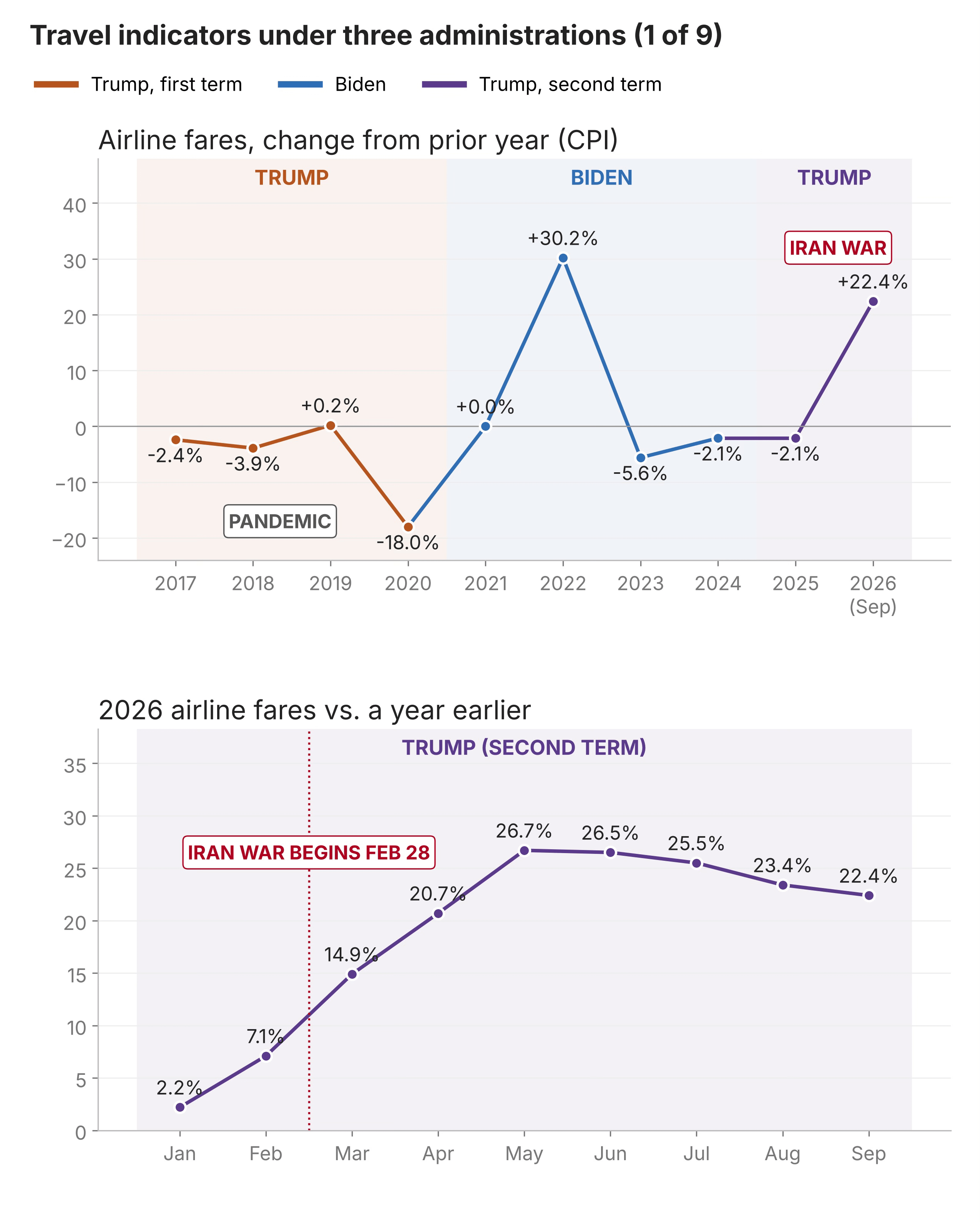
Flying was cheap. Airfares fell in 2017 and 2018, and in 2018 average inflation-adjusted fares hit their lowest-ever record.⁵
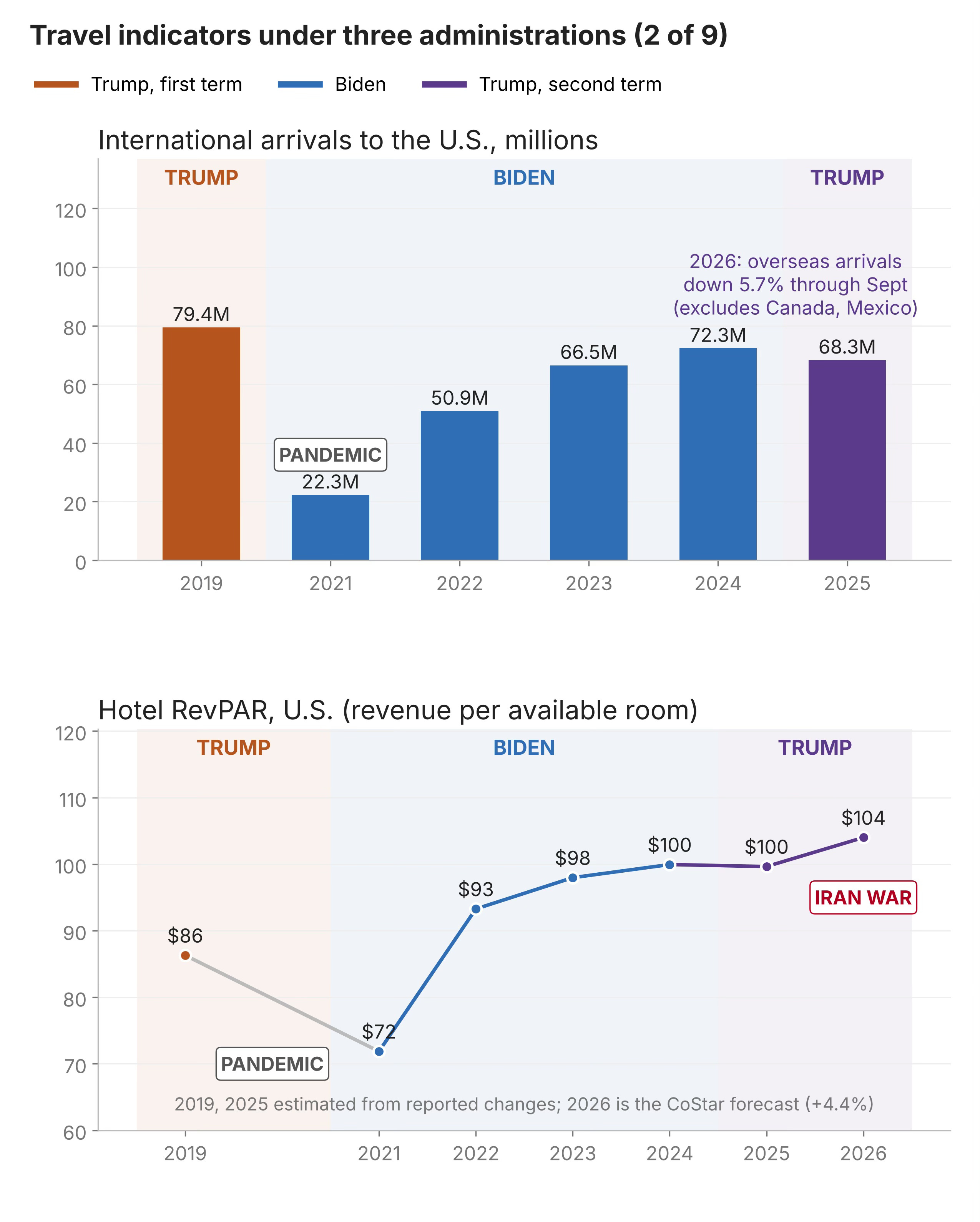
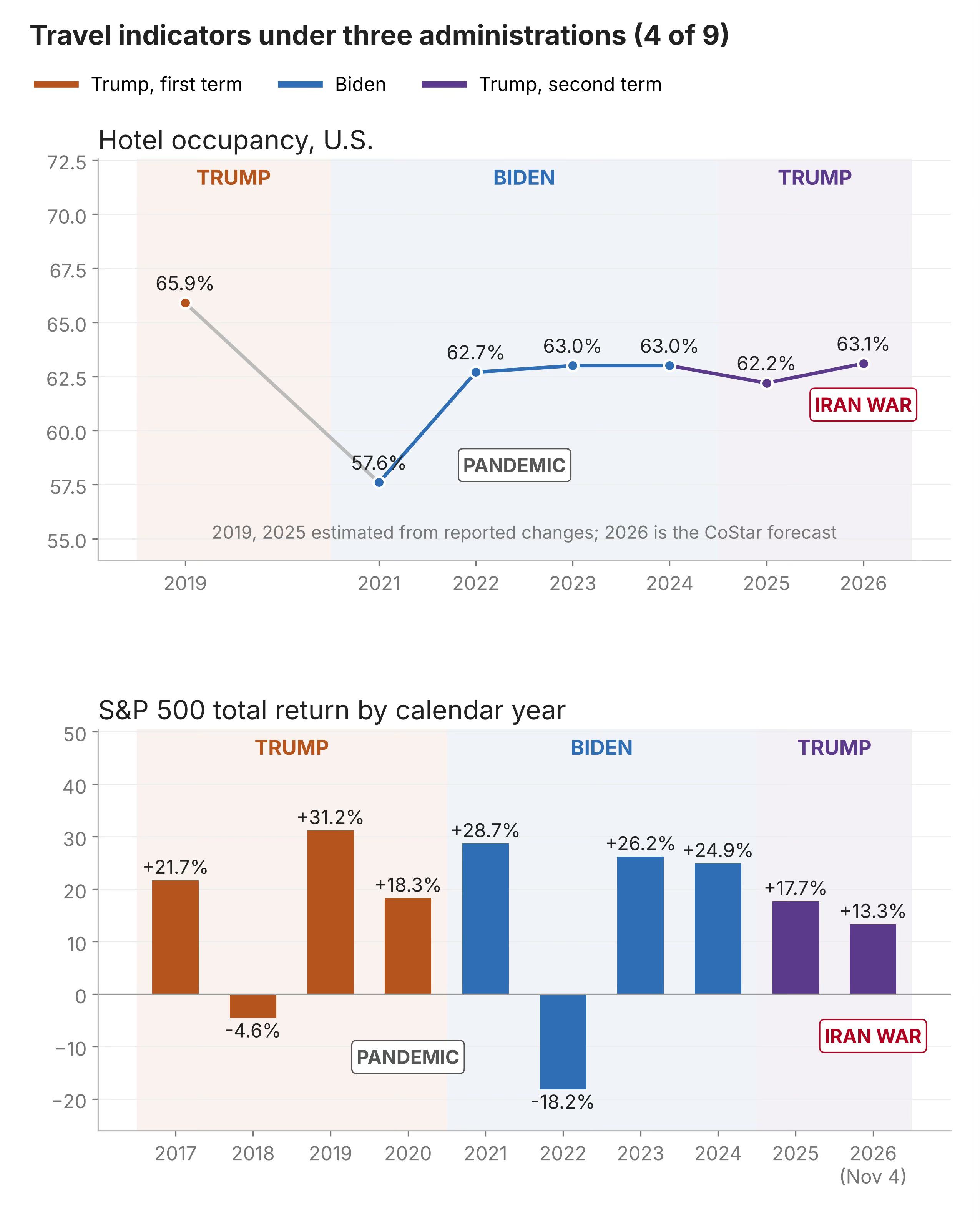
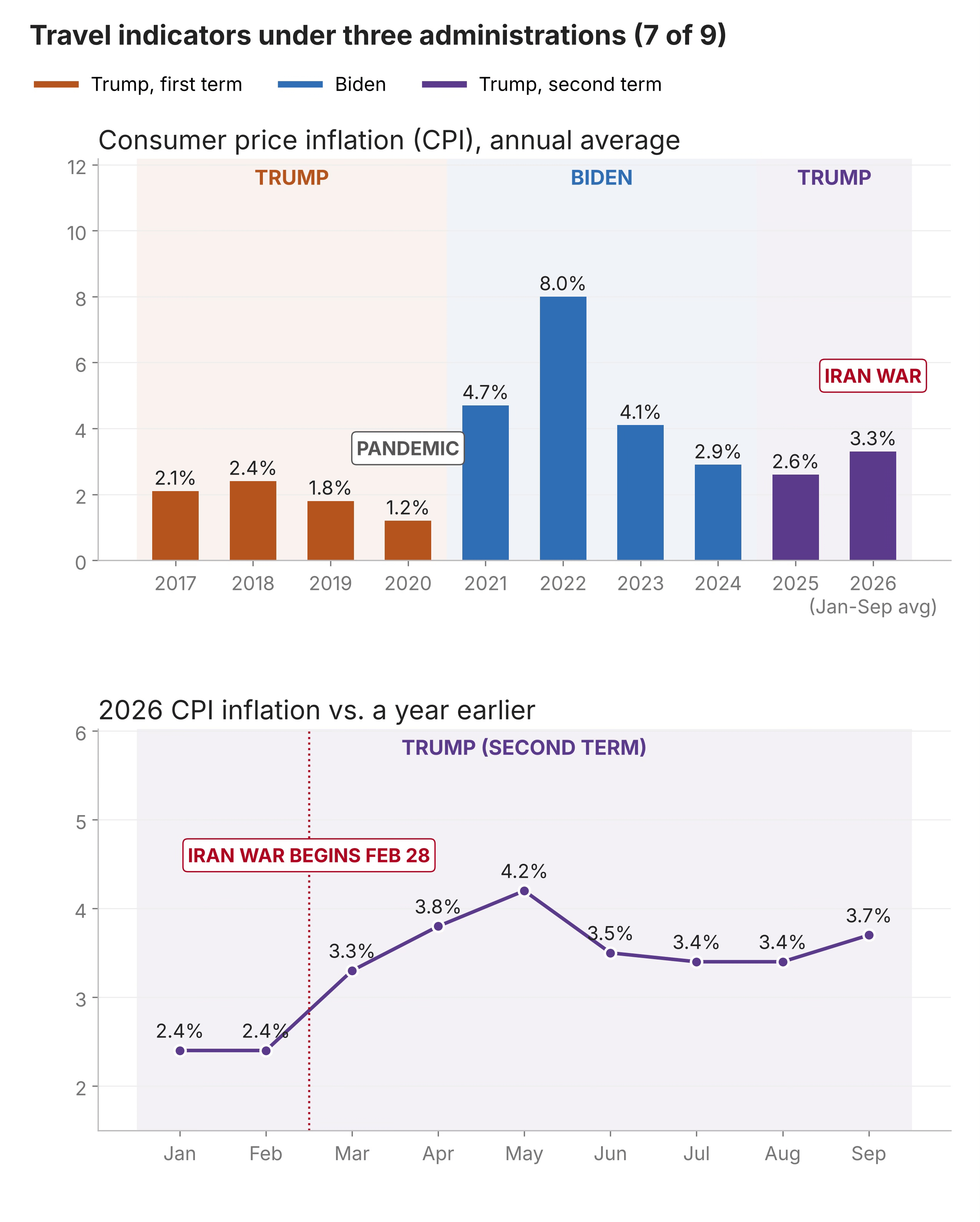
Inflation ran at about 2% a year,⁶ international visitors peaked near 80 million in 2019,⁷ and developers opened 947 US hotels in 2018 and 1,017 in 2019, the highest counts in this comparison.⁸ Hotels were also busy, with occupancy near 66% by 2019 (my estimate from CoStar’s later comparisons).⁹
On policy, the first travel ban (on seven predominantly Muslim countries) came in January 2017, a week after Trump’s inauguration, and a 2018 banking law loosened some lending rules.
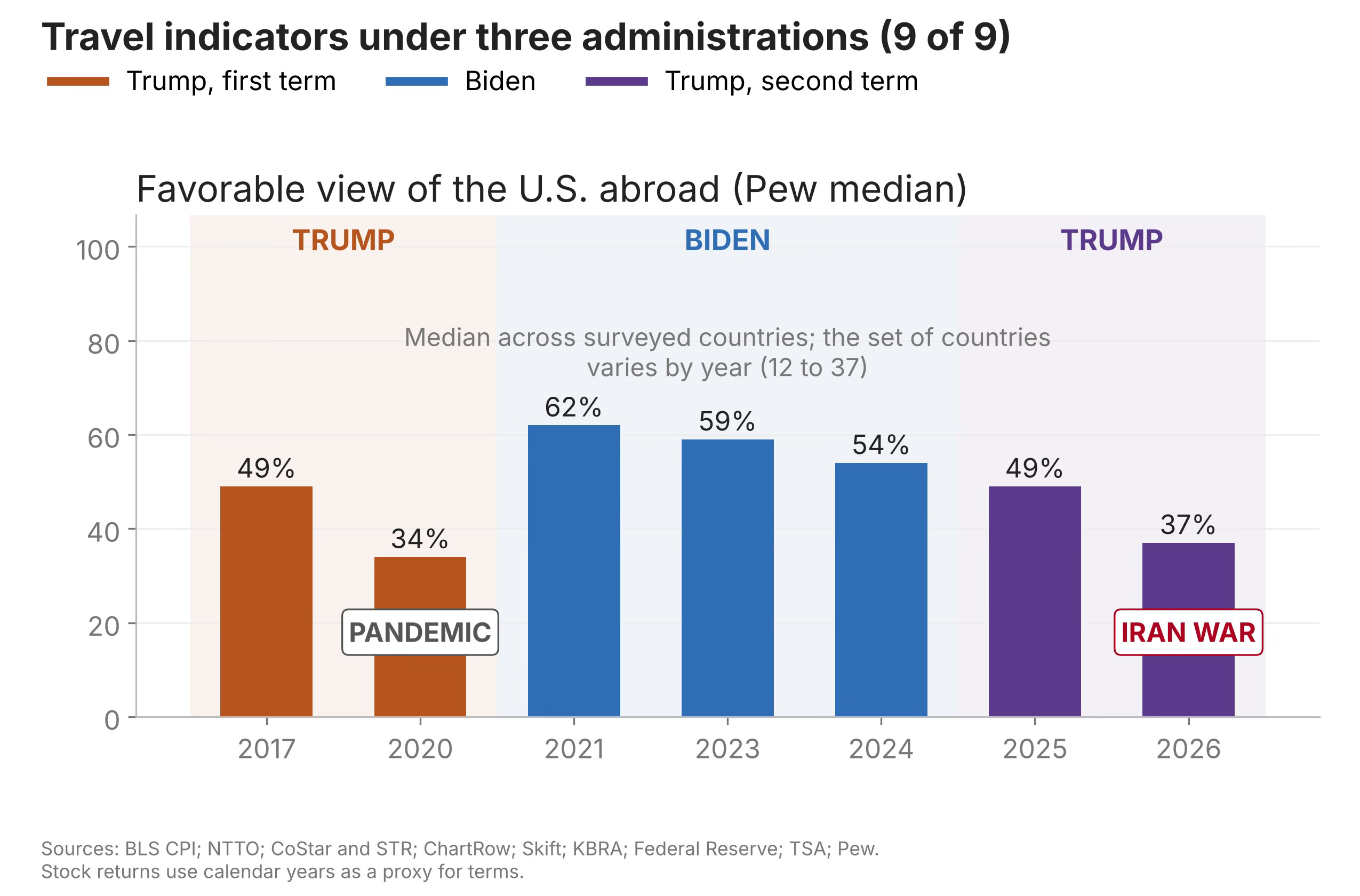
Foreign opinion of the US fell from the start, to a median of 49% favorable in 2017 and 34% in 2020 in Pew’s surveys.¹⁰
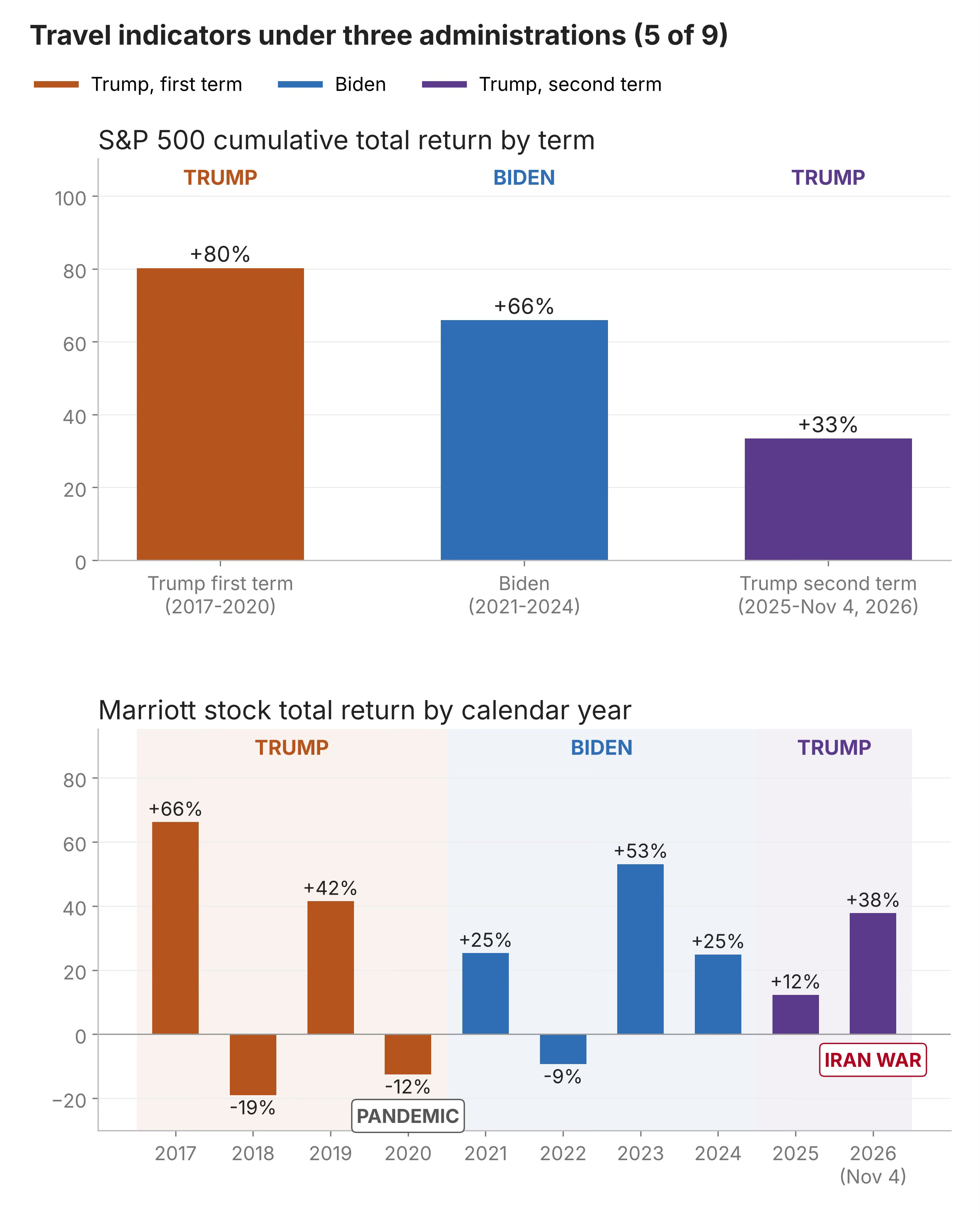
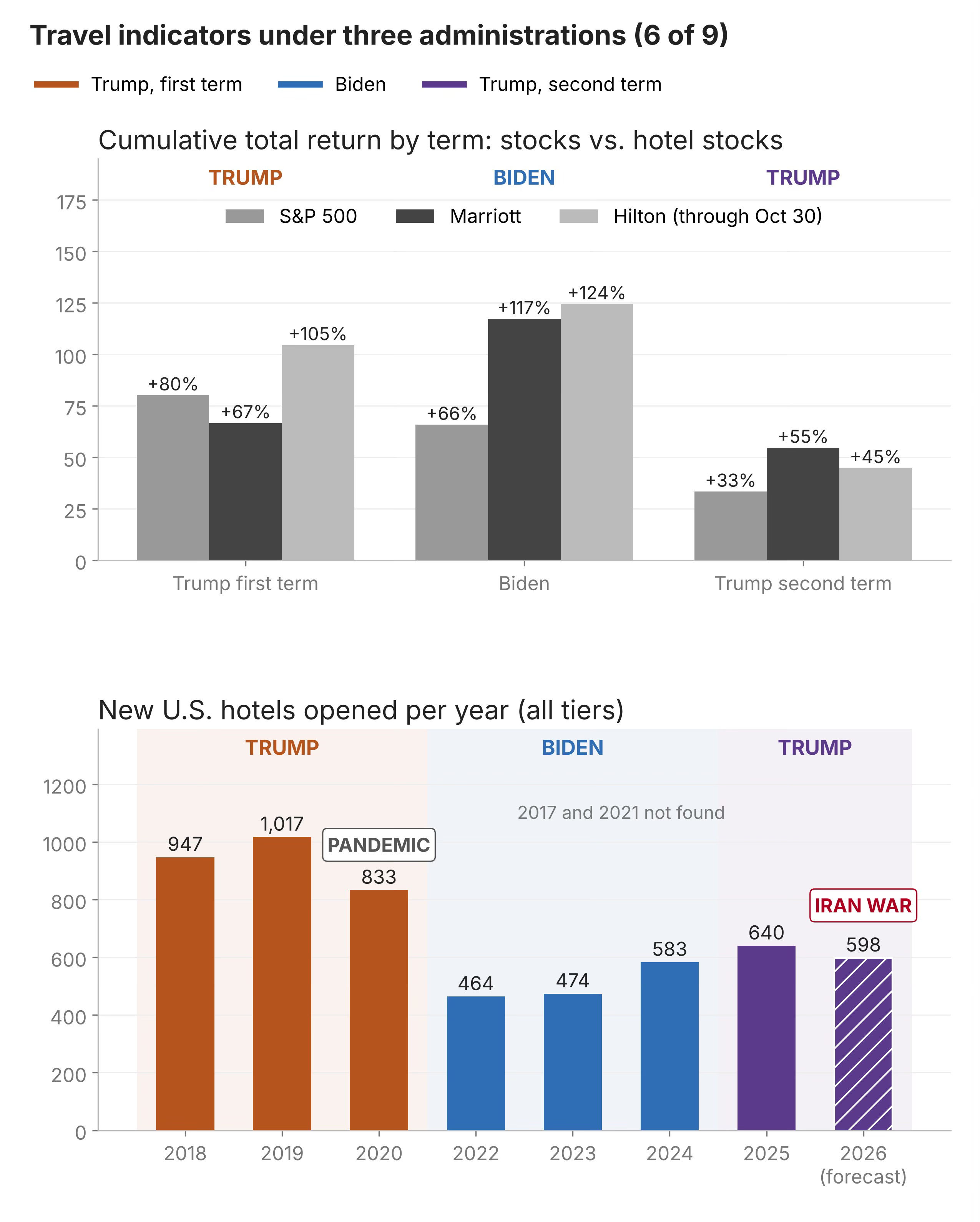
The pandemic closed the term, handing Biden a distressed economy. Airfares dropped 18% in 2020, visitors fell to 19.2 million, and only 833 new hotels opened.⁶ ⁷ ⁸ Even so, stocks rose over the four years. The S&P 500 returned roughly 80%, Marriott about 67%, and Hilton about 105%.¹¹
The Biden years, 2021 to 2024
Biden took office as travel began recovering after the pandemic, and it climbed fast.
Overseas visitors skyrocketed from 22.3 million in 2021 to 72.3 million in 2024, and RevPAR climbed from about $72 to about $100, with record room rates in 2023 and 2024.⁷ ⁹
Inflation was the cost.
Prices peaked at a 9.1% annual rate in June 2022, and airfares jumped 30% that year before falling back in 2023 and 2024.⁶
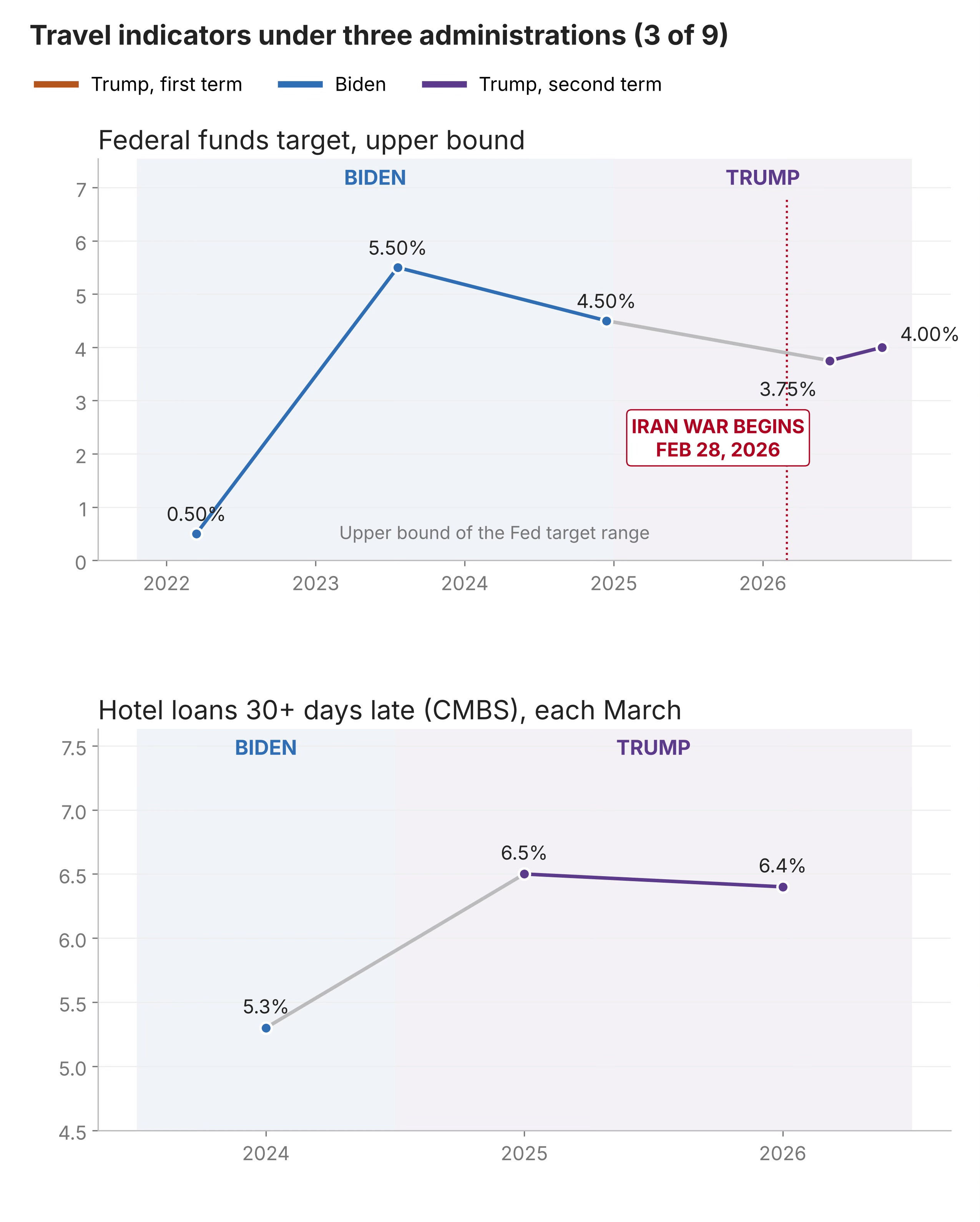
The Federal Reserve answered by raising its target rate from near zero to 5.50% by mid-2023.¹²
Hotel borrowing held up, but builders slowed down. Openings fell to 464 in 2022, 474 in 2023, and 583 in 2024, about half Trump’s first-term pace, even though the pipeline of planned projects hit a record.⁸
Hotel stocks had their best run of the three terms. Marriott gained about 117% and Hilton about 124%, compared with about 66% for the S&P 500.¹¹
The second Trump term, 2025 to date
The biggest change this year came from the Iran war. The United States and Israel struck Iran on February 28, airspace closed across the Middle East, and an estimated 5 million passengers were affected.¹⁴
Within two weeks the price of jet fuel nearly doubled.¹⁴ A ceasefire and a June agreement to reopen the Strait of Hormuz brought oil prices down, then the president declared the ceasefire over on July 8.¹⁴
Fares followed fuel skyward, reaching 22.4% above last year in September, about six times faster than prices overall, and inflation climbed from 2.4% in February to 3.7% in September.⁶ I just paid $900 to fly to New York for 48 hours on a Thursday. Ouch.
In terms of domestic inbound tourism, entry policy tightened. As of January 1, 2026, 19 mostly Muslim countries face a full travel ban, 15 more developing-world nations face partial restrictions, and the Trump administration has proposed collecting social media history from some visa-waiver travelers.¹⁵
The July 2025 budget law cut federal funding for Brand USA, the agency that markets the US overseas, by 80%.¹⁶
Melissa, who read through Brand USA’s business plan, notes that federal matching funds fell to $20 million for FY 2026 from a $100 million cap. In her words, that “reduces guaranteed public backing” and means “higher reliance on private sector contributions.”
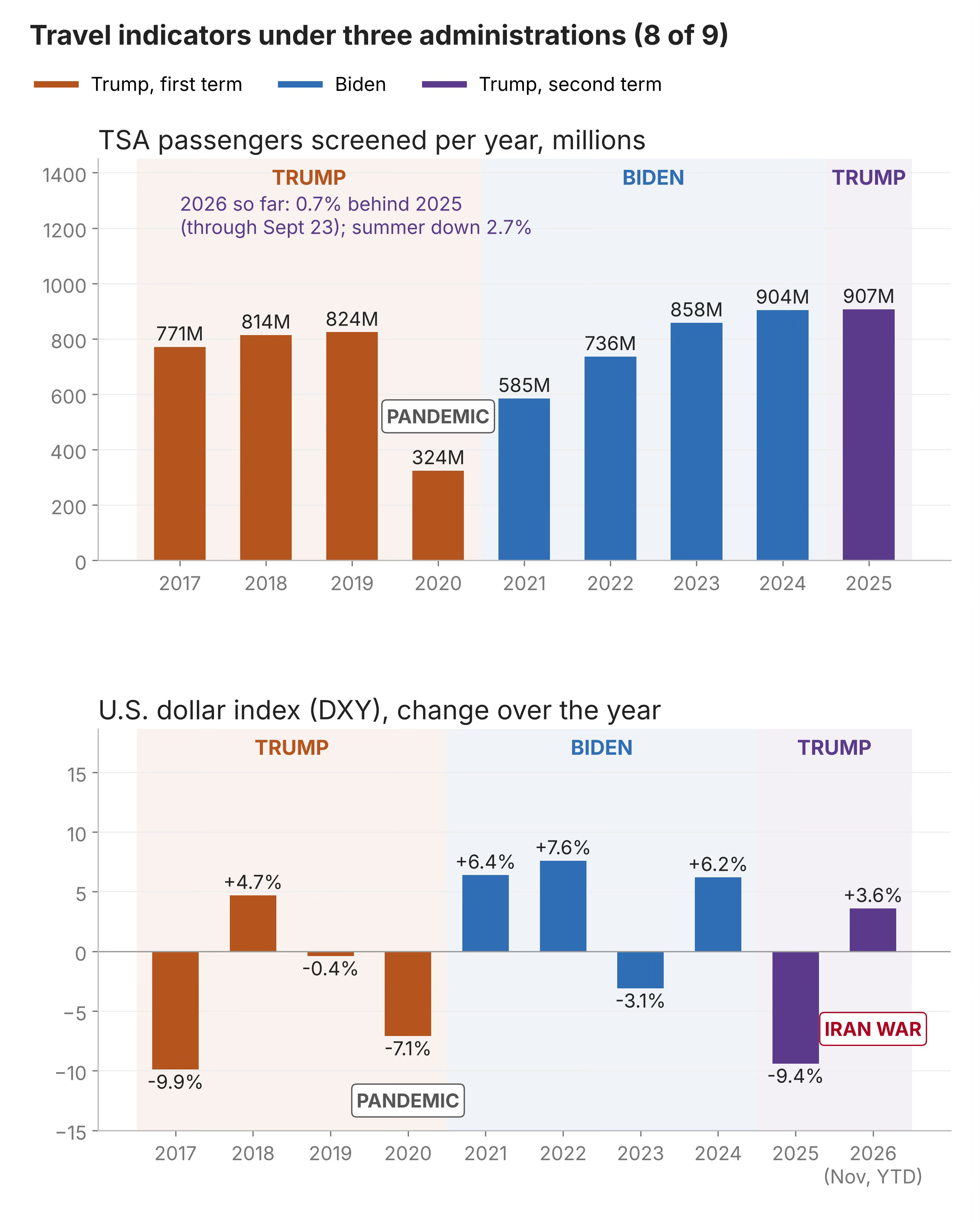
International arrivals fell 5.5% in 2025, with Canada down 20.9%, even though the dollar fell about 9.4% that year, making a US trip cheaper.⁷ ¹⁷
Favorable opinion of the US fell to a median of 37% across 36 countries.¹⁸ ¹⁰
Money is expensive again.
Putting on my investor hat, I haven’t seen a single hotel deal pencil out for us. The Fed raised rates a quarter point in September and held the target rate at 3.75%–4.00% on October 28.¹²
Hotel construction loans run roughly 8% to 10% or more, and a wave of loans from the commercial-mortgage era is coming due at much higher payments.²⁰ By March, 6.4% of hotel loans in commercial mortgage securities were late, up from 5.3% two years earlier.²⁰
New hotels show the strain. US developers opened 640 in 2025, and the forecast for 2026 is 598.⁸
Money is moving to the top of the market, with luxury projects in the pipeline at a record 108.⁸
Hotels already open are doing fine in the luxury tier, but the middle market is softening.⁹ We own positions in several select service properties that have significantly under performed what our select service portfolio did prior to 2018. CoStar and Tourism Economics expect RevPAR to grow about 4.4% this year, though that is just a forecast.⁹
Melissa of the CEO Office connects this to the K-shaped economy and the bifurcation of classes: “the misalignment of experience with cost. This burns travelers and leads to a lot of frustration for those that spend extra for a family vacation and get a mediocre experience. A lot of ‘luxury’ branded services with average experiences. Social media plays a role in inflating expectations on both sides.”
In terms of hotel stocks, Marriott stock is up 38% this year and Hilton 31%, and the S&P 500 is up about 33% since Trump returned to the White House.¹¹
What else helped move these numbers
Washington explains only part of these numbers, because each administration inherited a different economy. Trump’s first term ended inside the pandemic and the Biden term began in it, so Biden’s gains start from the 2021 bottom, and a rebound from near zero looks bigger than steady growth from a peak.
When demand returned in 2022, airlines flew fewer seats than in 2019, which helps explain the fare spike and the record room rates. Russia’s invasion of Ukraine then sent jet fuel higher, and Spirit’s exit took cheap seats off the market.
I credit the 2026 fuel spike to Trump’s decision to start the Iran war. You may disagree with me.
Hotel stocks rode a stock market and an interest rate cycle that no president controls. The drop in Canadian arrivals is partly a political reaction to US policy, so I might not call it outside Washington’s influence, and part of it almost certainly results from Trump’s continuing insults and Canada-specific tariff hits.
The numbers side by side
In quick summary of the above:
The first Trump term had the cheapest flights and the most new hotels.
Biden’s term had the fastest recovery and the best hotel stock returns.
The second Trump term has the fastest fare increases since 2022, falling arrivals, and hotel loan delinquencies above where they stood under Biden.
Policy shapes fares, entry rules, and borrowing costs.
Government infighting can lead to shutdowns that affect TSA funding.
If the Iran war continues, airfares will keep climbing and US airlines will keep pulling flights from rotation. Expect more deadheading pilots in business class vying for your seat. If you upgrade to business class using miles, you are first on the downgrade list in those situations (read my past article about my recent experience with this).
Book winter trips on refundable rates, buy travel insurance with cancel-for-any-reason coverage, add a buffer night before any international departure.
Price 2027 flights soon. Fares are more than 20% above last year’s.
Domestic hotels are hurting. Travel locally if you can. Rates may not fall because hotels are repairing their balance sheets, but this month travel has its own “black Friday” season and I expect the best hotel sales in a while.
Raise your budget for big trips next year. Hotel rates continue to climb at the luxury level. Book early.
Economics was my favorite class in business school, and I have developed a taste for politics because I’ve seen how much our votes and political leaders affect my daily life and travel-reliant business.
My dad (who passed away four years ago) used to say that “tourism is everyone’s business.” He loved a healthy political discussion and never let his personal leanings affect his view of others. We may not have agreed on whom to put in the White House, but we loved each other deeply.
I hope that in the wake of the blue tsunami, readers will look at the results and the coming years for tourism through the lens of this data. Nothing is cut and dry; our industry saw gains and losses under each of the last several administrations. My one takeaway is that your vote matters. Travel matters. Visitors from abroad matter. Go see the world, learn from other cultures, and welcome visitors to our country. Our industry depends on it.
Sources
Skift, what looms for the travel industry after the 2018 midterms
Travelweek, U.S. says airfares hit new lows after factoring inflation
US Inflation Calculator: CPI by month and year; airfare inflation
NTTO and CRS, international visitation: NTTO overview; NTTO fact sheet, 2019 and 2020; CRS, 2026
Lodging Econometrics hotel pipeline reports: 2018; 2019; 2020; 2022; 2023; 2024; Q4 2025; Q3 2026
CoStar and STR hotel performance: 2021; 2022; 2023; 2024; 2026 outlook
Pew Research Center surveys: 2017; 2020, via Axios; 2021, via Axios; 2026
ChartRow annual returns: S&P 500 (SPY proxy); Marriott, as of Nov. 4, 2026; Hilton, as of Oct. 30, 2026
Federal Reserve rate decisions: rate history; October 2026
Entry policy: Gulf News, travel ban; AMI Magazine, social media screening
AirAdvisor, TSA checkpoint travel numbers (TSA annual totals)
Hotel loans: Access Point Financial; KBRA
Simpson Thacher, Basel III endgame reproposal, March 20, 2026
Skift Travel Podcast, Sarah Kopit and Seth Borko on the 2026 midterms and travel; Skift Research inbound sentiment survey, 2025
Atlas Hospitality Group via CoStar: California hotel sales and foreclosures; California hotel openings
Los Angeles hotel wage ordinance: Hotel Investment Today; Fox Business, delay to 2030; Fox News, Hotel Association of Los Angeles study
Hotel loan stress: Matthews; CRE Daily, KBRA Hilton delinquency; CRE Daily, limited-service hotels
Figures are current as of November 5, 2026. Hotel figures for 2026 are forecasts, and the stock returns use calendar years.
I enjoyed having this discussion with you Anne Marie. Thanks for including me!