


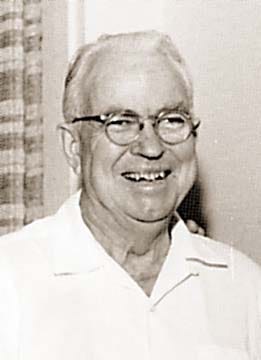
My grandfather, Roy Cecil Kelley, (source: Honolulu Star Bulletin)
Gifted Article: Hotel History is a section of The Upgrade, a publication about the world of hospitality and travel, by Anne Marie Brown. Hotel History is typically for paid subscribers. This week’s article is complimentary.
My grandfather, Roy Kelley, arrived in Hawaiʻi on September 13, 1929, four days before Black Thursday collapsed the American economy. He came with a USC architecture degree, a new wife named Estelle, and no particular plan to go into the hotel business. What he built over the next fifty years became the foundation of what is now Outrigger Hotels and Resorts, shaping the landscape of Waikiki profoundly.
I remember him as the guy who used to scoop me up for a giant hug and help me feed the koi fish in his pond. He once told me I talked too much. My dad was always full of stories about my grandfather, and I was never sure how much was family lore and how much was true. Turns out, some of the craziest tales actually took place.
This is the story of how a kid born in a shack in a California orange grove turned a $5,335 corner lot into the largest hotel operation in Waikiki. Some of it comes from the documented record, and a lot of it comes from the stories told in our family, passed down the way family stories are: repeated at dinner tables, with minor variations, until they become the version everyone agrees on.
The Boy Who Raised Rabbits
Roy Cecil Kelley was born on August 31, 1905, in Highlands, California. His father was a masonry and construction worker who had moved the family from Arkansas to California in search of work. They were poor by any measure. “We had no money,” Roy said. “My father just worked by the day and gradually kept something to eat on the table. You couldn’t be any poorer than that.”
He raised rabbits as a kid, selling them to butcher shops to earn spending money. He put himself through USC by working full-time for the Pacific Electric Railway while carrying a full class load. When he graduated in 1927 with a degree in architecture, he earned $15 a week as a draftsman. The background wasn’t glamorous, but it gave him an understanding of what things cost and what people actually needed.
In the years between USC and Hawaiʻi, he picked up architectural work around Southern California, including a project that the family has always connected to Hearst Castle. The story as we have it: Roy designed the pool railings at San Simeon, both the exterior Neptune Pool and the indoor Roman Pool. I have not been able to verify this against the documented record, but it fits the timeline and the work he was doing in those years, and it is the version of the story my family has told for as long as I can remember.
Murder at Greystone
The job offer that brought Roy to Honolulu came from an unexpected direction. Before that happened, though, he had a ringside seat to one of the most sensational crimes in California history.
After graduating from USC and working through a few drafting jobs in Los Angeles, Roy landed work at a real estate development called Capistrano Beach, a subdivision on the coast halfway between Los Angeles and San Diego. The project was owned by Edward L. Doheny Sr., one of the wealthiest oil men in America and a central figure in the Teapot Dome scandal that had rocked the Harding administration. Doheny had turned the Capistrano Beach project over to his son, Edward “Ned” Doheny Jr., to run.
On the night of February 16, 1929, only five months after moving into their newly built Beverly Hills estate, Ned Doheny was found shot to death inside the 55-room Greystone Mansion at age 35. His longtime friend and personal secretary, Hugh Plunkett, was found dead steps away, still gripping the murder weapon. The official account pointed to a murder-suicide, though the actual circumstances have never been fully resolved, and various theories remain debated nearly a century later. The Doheny family was already mired in scandal, Ned’s father was facing consequences from the Teapot Dome affair, and the whole episode was quickly hushed by the family’s considerable power.
My grandfather’s account of it, told fifty years later in a 1986 oral history interview, was characteristically dry. “My boss, Mr. Doheny Jr., went home one day to Beverly Hills to his lovely home, sat down in his office there, and in behind him came his butler with a revolver and shot him dead. So that was the end of my architecture. Mr. Doheny closed the tract down right away and we were all let go.”
Roy moved back to Los Angeles, picked up a month’s work finishing a university dormitory, and was having lunch with friends when one of them mentioned almost offhandedly that an architecture firm in Hawaiʻi was hiring.
Aloha - Coming to Hawaii
Roy had never thought seriously about Hawaiʻi. “I didn’t even know Hawaiʻi was here instead of being down there in the Philippines,” he said. “I had no idea at all.” He was hired sight unseen based on a friend’s recommendation to C.W. Dickey, one of Honolulu’s most prominent architects, and sailed for Hawaiʻi just weeks before the stock market crashed.
He and Estelle moved into the Marigold Apartments on Dewey Way in Waikiki, two blocks from where the Hilton Hawaiian Village stands today. Waikiki in 1929 was barely a resort. “Just a bunch of cottages,” Roy recalled. The only real hotels were the Moana, the Halekulani, and the newly opened Royal Hawaiian, which Roy remembered as having exactly three guests when he first noticed it. The Royal nearly went bankrupt and was sold to Matson Navigation for almost nothing. Tourists arrived entirely by ship, a few thousand a year, spending a few days and sailing home.
Roy joined the Dickey firm and threw himself into work. Over the following years, he contributed to some of Honolulu’s most significant buildings of the era, including the Immigration Station on Ala Moana, Montague Hall at Punahou School, the main building of the original Halekulani Hotel, and the Waikiki Theater. Even as the Depression hollowed out architectural work across the mainland, Honolulu stayed busy enough to keep Roy employed. When Dickey eventually let almost his entire staff go, Roy was the one person he kept.
The $5,335 Lot
Roy saved carefully. Estelle took a secretary job in the same building as his firm, and together they lived on her salary while banking his. By 1932, he had enough to buy a 55-by-100-foot corner lot at Seaside and Kuhio Avenues for $5,335, paying cash.
He built a six-unit apartment building on it, living in one unit and renting the others. His approach was practical to the point of being funny: he would rent out his own unit, move into a cheaper room nearby, and pocket the difference. “I made about forty dollars a month and kept repeating that process,” he said. “We became capitalists.” (My grandfather and my father taught me frugality in ways that still show up oddly in my life today. While I’ll happily drop money on travel, I will drive around for far too much time so I don’t have to pay for a parking spot, I freeze leftovers like the apocalypse is impending, and I absolutely refuse to pay for business class seats unless I use points).
Roy had no grand vision at that point. He wasn’t planning a hotel empire. He just liked the corner, liked Waikiki, and liked the idea of making money from property. That instinct, repeated over and over across the next fifty years, is what built Outrigger.
As the portfolio grew, so did the methods. The family story about how Roy acquired at least one of his properties involves a trench coat:
He walked down Kalakaua Avenue with the purchase price in cash tucked under his coat. Paid for the hotel on the spot. No wire transfer, no escrow drama. Just Roy, a trench coat, and enough bills to buy a building.
The Islander Hotel Changes Everything
In 1947, after the war had put construction on hold for years, Roy built the Islander Hotel on Seaside Avenue. At five stories and 50 rooms, it was the first new hotel built in Waikiki since the Royal Hawaiian opened twenty years earlier. Rooms started at $7.50 a night, deliberately pitched at middle-income families at a time when Waikiki’s existing hotels catered almost exclusively to wealthy travelers.
The Edgewater Hotel followed in the early 1950s, and it introduced something Waikiki had never seen before: a swimming pool. The decision to put a large pool at the Edgewater was initially seen as questionable, since the ocean was only a block away. It turned out to be one of Roy’s shrewdest calls. The Edgewater was also the first hotel in Waikiki to have an automatic elevator. Growing up, we heard these two facts together so often they became a single sentence: Grandpa put in the first pool and the first hotel elevator in Hawaii.
The Reef Hotel opened in 1955, and by the time the Reef Towers Hotel opened in 1959, Roy had fundamentally changed the shape of Hawaiʻi’s tourism industry by putting the destination within reach of the average traveler.
Roy understood the following: stay close to the front desk, stay close to your guests, and keep prices at a level that keeps rooms full. “I built lots of rooms at reasonable prices and nobody else has done that,” he said. “That’s my claim to fame.” I can still hear his refrain, “Heads in beds, heads in beds.”
When he briefly sold the Edgewater and Reef Hotels to a theater chain in 1969, his buyer went from 100 percent occupancy to 40 percent in less than two years. Roy took the properties back when the buyer died and went on about his business.
My grandmother, Estelle ran reservations from a lanai desk, managing a stack of paper slips and making decisions on who could book by looking at the pile. There were no computers, no yield management software, no systems.
Roy intended to keep it that way. When my father sat down with a computer salesman to discuss moving reservations onto a system, a note arrived mid-meeting. It was from Roy. It said two words:
“NO COMPUTERS.”
My dad proceeded anyway, eventually. He was always the first to adapt new technology, and I remember the giant backpack he carried around with one of the first satellite cell phone models.
“Be Kind to Everybody”
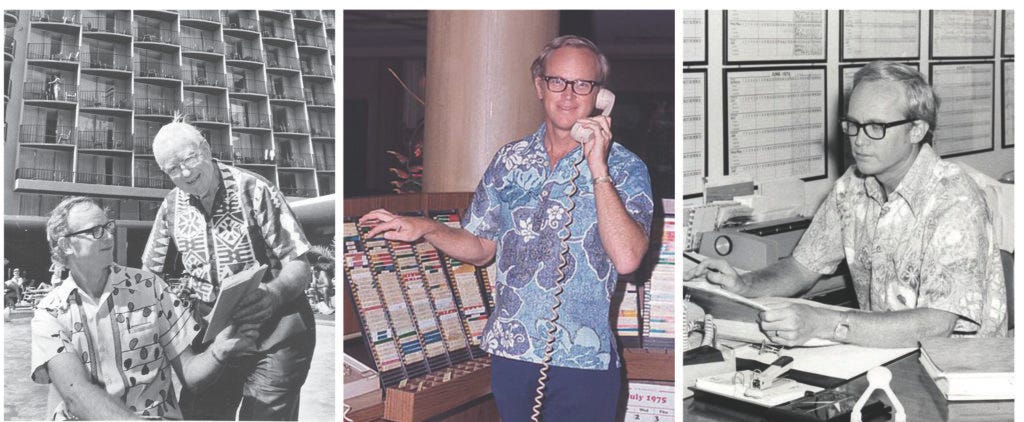
My dad and my grandfather
Roy’s son, my father Dr. Richard Kelley, started as a bellboy at the Islander Hotel. Richard eventually shelved a Harvard medical degree to take over the family business full-time when my grandfather had a stroke and my grandmother wanted to take a long cruise.
In 1963, Roy obtained the leasing rights to the former Outrigger Canoe Club site on prime Waikiki beachfront, owned by the Queen Emma Foundation. When the Foundation’s negotiations with Sheraton broke down over a price dispute, they called Roy. The Outrigger Canoe Club relocated to a new site at the base of Diamond Head, and Roy developed what became the flagship Outrigger Waikiki on the leased property. It opened in 1967 on the exact stretch of beach where legendary waterman Duke Kahanamoku had grown up swimming, surfing, and paddling.
Under my father’s leadership, the portfolio grew far beyond Waikiki. Outrigger expanded to Maui, Kauaʻi, and the Big Island, then beyond Hawaiʻi entirely. The company opened its first property outside the United States in 1996 with the Outrigger Marshall Islands Resort. By 2015, Outrigger Enterprises Group operated 40 properties across Hawaiʻi, Asia-Pacific, and the Indian Ocean. The 50-room walkup on Seaside Avenue had become one of the most recognized hotel brands in the Pacific.
When the University of Hawaiʻi interviewers thanked Roy at the end of his oral history session in 1986, he left them with this:
“Just remember, be kind on everybody. Because that’s what I try to be. I try to take care of my business and they take care of theirs, and it’s been very successful.”
This man, who started with nothing, dealt with the fallout of his boss’ scandalous murder, stumbled into Hawaiʻi by accident, and bought a weed lot on a street that didn’t exist yet, built something that became a nearly billion dollar company over three generations. He never counted his money, he said. He just built rooms people could afford, hired people who cared, and stayed at the front desk.
Anne Marie (Kelley) Brown
SOURCES
1. Roy C. Kelley Oral History Interview, April 22 & 25, 1986. Waikiki, 1900-1985: Oral Histories, Volume I. Social Science Research Institute, University of Hawaiʻi-Manoa, June 1985.
2. History of Greystone. City of Beverly Hills. https://www.beverlyhills.org/426/History-of-Greystone
3. Blood and Oil: Murder at Greystone Mansion. Medium, H. Wayne Smith, Ph.D., June 2024. https://medium.com/@h.wayne.smith/blood-and-oil-74b9b65885f1
4. Charles W. Dickey. Wikipedia. https://en.wikipedia.org/wiki/Charles_W._Dickey
5. Outrigger Hotels & Resorts. Wikipedia. https://en.wikipedia.org/wiki/Outrigger_Hotels_%26_Resorts
6. History of Outrigger Enterprises, Inc. FundingUniverse. https://www.fundinguniverse.com/company-histories/outrigger-enterprises-inc-history/
7. Kelley Family and Outrigger Timeline. Hawaii Business Magazine. https://www.hawaiibusiness.com/kelley-family-and-outrigger-timeline/
8. History of Waikiki Hotels, 1893 to Present. Hawaii Living, March 2023. https://www.hawaiiliving.com/blog/history-waikiki-hotels/
9. Outrigger Hotels and Resorts Celebrates 70 Years of Aloha. TravelAge West, June 2017.
10. Outrigger Fiji Beach Resort First to Celebrate Founders Day. Outrigger Resorts & Hotels Newsroom, September 2015.
I love hearing about how success was built step by step, as growth and expansion made sense. It's probably good your dad won the computer battle, but it does sound like your grandfather's values anchored everything. The other thing that is striking to me is how your grandfather served exactly the people that are increasingly left out in our "K" shaped economy. Surely there are still opportunities in that middle space? Anyways, thanks for sharing such a fascinating and personal story!
I loved this, Anne Marie. To read a story that is so wonderfully human in my feed of forgettable trends and immaculate hospitality imagery. A reminder of finding simplicity in a world that has become too beholden to data, systems and specialists.