


Egypt: What a Luxury Trip Actually Looks Like
The pyramids, a Dahabiya cruise down the Nile, Abu Simbel, and why this is the moment to go
🗝️ This post marks the first of the Master Key series - comprised of actual itineraries I’ve built for luxury clients, my own travel guides, and in-depth brand history lessons from the hospitality industry. These posts are for paid subscribers.
Egypt can feel intimating for travelers, yet is on most people’s bucket list. It was certainly on mine. Prior to my own trip three years ago, I didn’t feel comfortable building trips for clients in Egypt.
As a luxury travel advisor, I pride myself on my network of providers that I’ve built around the world, as well as bringing personal travel experience to my itineraries. In some areas, those connections have to be made in person. I wanted to make sure that I had traveled to Egypt in person - and this is the trip that I’ve now built for several clients with the connections I made there.
This is the right time to travel to Egypt. The Middle Eastern war has made many travelers wary of visiting the region, but Egypt remains a safe place to travel with the same travel advisories it had prior to the conflict. What the slowdown in arrivals has meant is smaller crowds, lower rates, and probably the best time to go to the country I’ve seen in years.
Additionally, The Grand Egyptian Museum finished opening its full collection in 2024. The small luxury dahabiya category on the Nile has matured into an incredible collection of ships. And for the first time in a long time, the crowds are manageable. Europeans who might otherwise go are choosing elsewhere right now, and that’s your opening.
I’ve built out a full sample itinerary, and I want to walk you through how I think about Egypt as a destination, what makes this trip work, and the specific places that make for an amazing first-time visit.
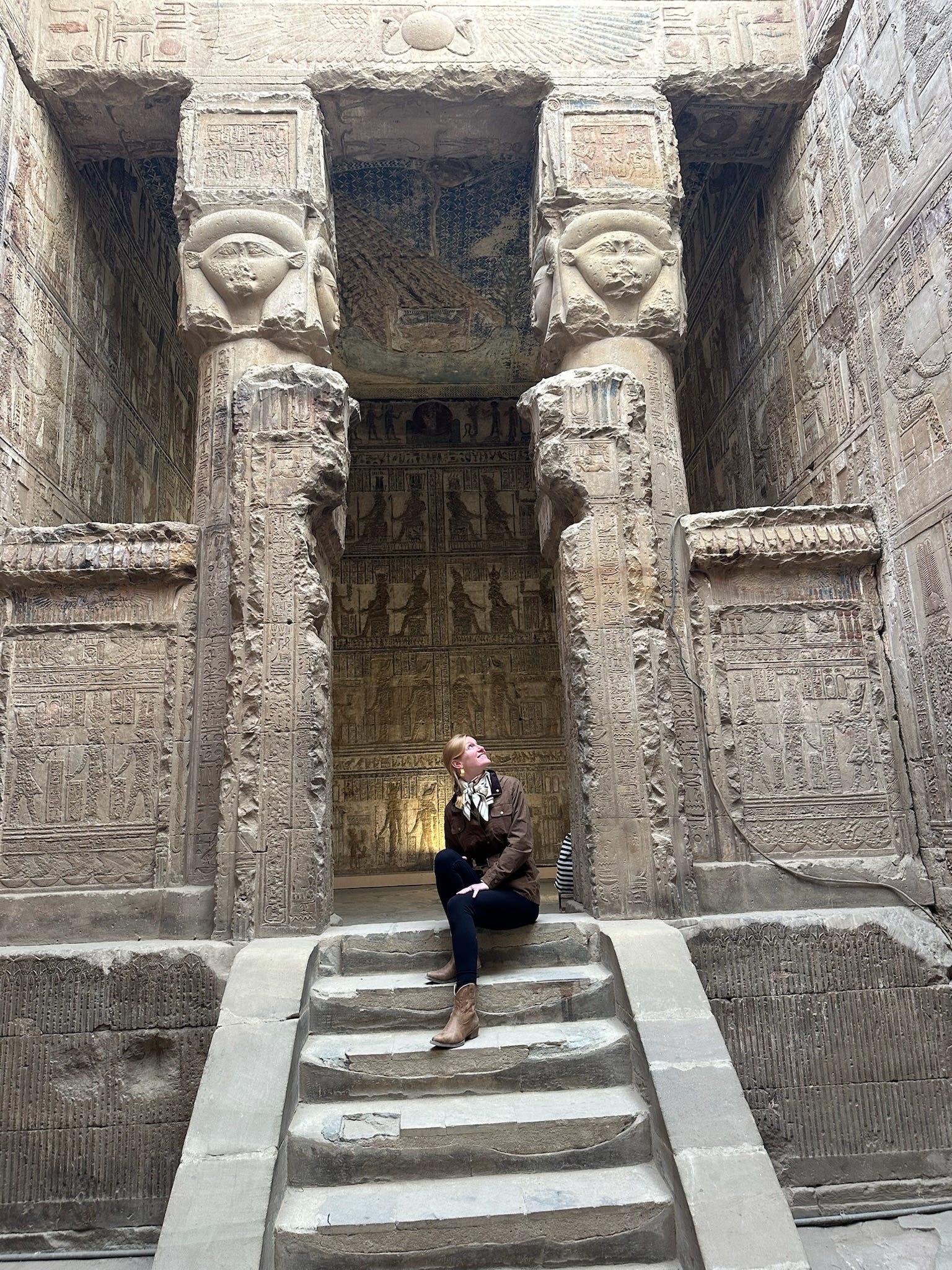
Yours truly in the Hathor Temple
Structural Overview
This is a 10-night trip - Cairo, Luxor, cruise the Nile, Aswan and Abu Simbel, then back to Cairo.
You need 3 nights in Cairo on the front end to see Giza, Saqqara, and the museums without rushing.
Then, you lay to Luxor and spend 5 nights on a private dahabiya sailing from Luxor south to Aswan.
On checkout day from the boat, you fly to Abu Simbel for a few hours, then connect back to Cairo.
Two nights at the Four Seasons Nile Plaza to decompress, visit the Grand Egyptian Museum, and shop the bazaar.
Cairo: The Mena House
Sheerly for the sake of logistics, my choice for the first Cairo portion of this trip is the Marriott Mena House.
Traffic in Cairo is insane, and it’s a good idea to stay near the sights you will see.
The Mena House is a 19th-century palace sitting in 40 acres of gardens at the foot of the Giza Pyramids. You can see the pyramids from certain rooms and from the garden, and most importantly, it’s near the GEM, Saqqara, and the pyramids. You wake up on your first morning in Egypt and the thing you came to see is right there - check.
While it’s not the most luxurious five star hotel experience, it gets the job done with multiple restaurants, the Saray Spa, a pool, 331 rooms. The M Club lounge provides extra perks for guests who book at that tier. But, the reason you stay here is to stand in the garden with a coffee at 6am and have a pyramid tell you good morning.


Note: most flights from the US arrive early in the morning, so it’s a good idea to book the night before so you can check in and shower right away. Spend the first day decompressing.
Days 2 and 3 in Cairo:
Day 2 starts at the National Museum of Egyptian Civilization (NEMC), which is the newer museum that opened in 2021. This is where the royal mummies are now, moved in a ceremony that the Egyptian government did not understate. 22 pharaohs, 18 royal consorts, including Ramesses II. From there, your private guide takes you to Old Coptic Cairo, the car-free section built inside the 6th-century BC Babylon Fortress. The Hanging Church, the Coptic Museum, the Church of St. Sergius where the Holy Family is believed to have sheltered. It’s one of the most peaceful spots in the city.
Day 3 is the Giza Plateau in the morning: you enter the Great Pyramid, you do the camel ride (yes, do it for the photo), you see the Sphinx. Then the afternoon goes to Saqqara, 40km southwest of Cairo. Saqqara is the older, less-visited complex and most tourists skip it, which is a mistake. The Step Pyramid of Djoser, the Serapeum underground galleries, the Imhotep Museum. Your guide earns their fee here. The history spans 3,000 years of burial culture and without context it’s a pile of old bricks. With context, it’s the whole story of how a civilization thought about death and eternity.


The Nile: A Dahabiya, Not a Cruise Ship
Day 4 you fly to Luxor (7:15am, about an hour).
On arrival, you head straight to Karnak Temple. The ancient Egyptians called it Ipet-Sut, which translates roughly as “The Most Select of Places.” It’s a complex of temples, chapels, and sanctuaries built and added to over 2,000 years. Nearly every pharaoh of the New Kingdom left something here.
Then you board your dahabiya.
A dahabiya is a private traditional Nile sailing boat. The ones I work with carry 9-18 guests maximum and they are nothing like a cruise ship. You’re moored at temples. You eat on deck. You sail at your own pace. The cabins have proper bedding made from Egyptian cotton and real Nile views. It’s the way wealthy Egyptians traveled for centuries and the format has been brought back at the luxury end of the market with genuinely excellent results.
I recommend two options depending on your group size and preference:
Dahabiya Nayera is a 9-suite boat with a strong culinary program, a sun pool deck, and indoor/outdoor dining. Intimate, elegant, well-run.
Nour El Nil operates a fleet of dahabiyas with a strong reputation for service and food quality, and more flexibility on vessel size. If you’re traveling solo, as a couple, or with a larger group, there’s usually a configuration that works.
Both are excellent. The choice usually comes down to availability and how many people you’re traveling with.


What you see on the Nile:
Valley of the Kings and Hatshepsut Temple (Day 5). You enter Tutankhamun’s tomb. Still painted, still extraordinary even though it’s one of the smaller royal tombs. Hatshepsut’s mortuary temple sits across the Nile from Karnak: three terraced levels, painted reliefs, and the story of a queen who declared herself pharaoh and pulled it off for two decades.
Edfu Temple (Day 6). The best-preserved temple in Egypt. Dedicated to Horus, buried under centuries of sand until the French archaeologist Auguste Mariette dug it out in 1860. The paint is still there. Two enormous granite falcon statues flank the entrance. It’s extraordinary.
Kom Ombo (Day 7). The only temple in Egypt dedicated to two gods simultaneously. The wall carvings include what appear to be surgical instruments, which tells you something about the sophistication of ancient Egyptian medicine. The mummified crocodiles in the adjacent museum are a bonus my kids would have absolutely lost their minds over.


Aswan and a felucca ride (Day 8). Aswan is where the granite quarries were. The unfinished obelisk is still lying in the quarry, cracked before completion. The afternoon felucca sail around Elephantine Island is an hour of just being on the Nile, watching the desert light change on the cliffs.


Abu Simbel: Worth Every Bit of the Logistics
Day 9 is the logistically complicated day. Some people may choose to spend the night in Aswan and stay at the Old Cataract Hotel, where Agatha Christie wrote “Death on the Nile.”
You check out of the boat at 7:30am, transfer to Aswan airport, fly 45 minutes to Abu Simbel, have about two hours at the temples, then fly back to Cairo via Aswan and arrive around 5pm.
Abu Simbel is Ramesses II’s masterpiece: two temples carved directly into a sandstone cliff in Nubia around 1264 BC. The four 65-foot seated colossi of Ramesses on the main facade are among the most recognizable images in the ancient world. The interior sanctuary was built with such precision that the sun illuminates the innermost statues on exactly two days a year: February 22nd and October 22nd. The smaller temple next door, dedicated to his wife Nefertari, has her statues the same size as his, which was essentially unheard of.
The other thing worth knowing about Abu Simbel: both temples were moved in 1968, cut into 20-ton blocks and reassembled 65 meters higher and 200 meters back from the original site, to save them from the rising waters of Lake Nasser after the Aswan High Dam was built. UNESCO coordinated a four-year international effort to do it. They’re a World Heritage Site.
The fact that humans moved entire ancient temples up a cliff and then put them back together so that the sun still hits the statues on the right two days a year is, to me, almost as impressive as building them in the first place.
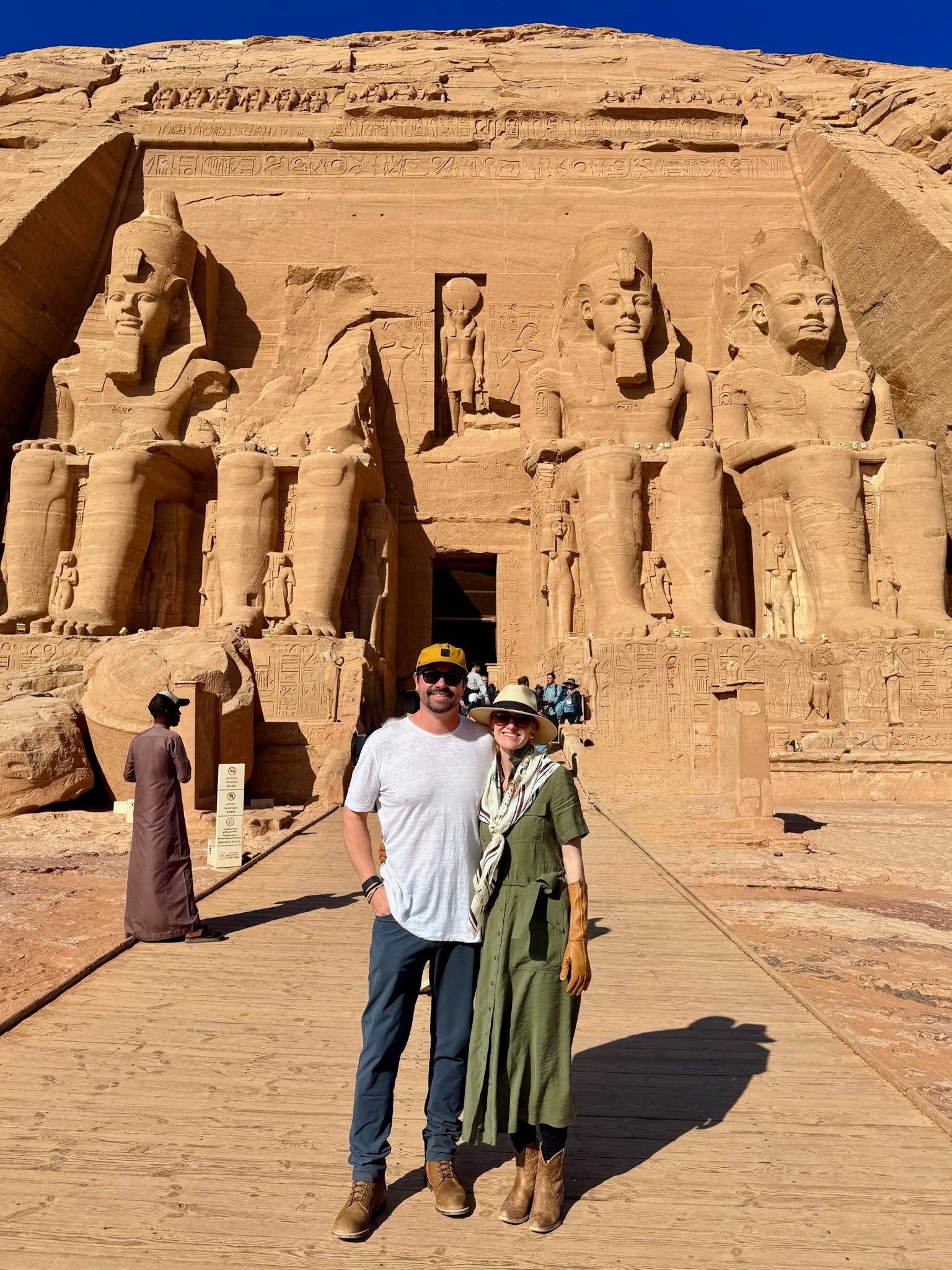
Cairo, Part Two: The Four Seasons Nile Plaza
The Four Seasons Nile Plaza is in the Garden City neighborhood on the east bank of the Nile. Different feel from the Mena House: urban, contemporary, Nile views, multiple restaurants, excellent spa and pool. After eight days of 5am wake-ups and desert heat, this is where you recover.
Day 10 is the Grand Egyptian Museum. The GEM opened its full collection in 2024 and is the largest archaeological museum in the world by exhibition space. The complete Tutankhamun collection alone covers 5,000 objects across multiple galleries. The gold mask is here. Plan the full morning and pace yourself.
The afternoon goes to Khan el-Khalili, the historic bazaar in Islamic Cairo. Narrow lanes, spice vendors, textile sellers, goldsmiths, coffee houses. This is where you buy things. Budget time and some flexibility.
One More Option I Want to Mention: Al Moudira
If you want a land-based alternative in Luxor, or want to extend your time on the west bank, Al Moudira is the property I’d put you in.
It’s a boutique hotel, 25 rooms, owner-designed over several years using traditional Nubian and Syrian craftsmen. There are hand-painted ceilings, mosaic fountains, arched courtyards, bougainvillea everywhere. It sits on the west bank close to the Valley of the Kings and Hatshepsut Temple.
Al Moudira is great for a honeymoon, an anniversary, or anyone who prioritizes atmosphere over scale.
The Practical Stuff
Heat: Travel in January and February can be chilly, but still sunny. By July, Luxor and Aswan regularly hit 105-110F. No matter when you go, each day should follow the pattern of an early start - hit the temples before 10am, back on the air-conditioned boat by midday, afternoon nap, temples again in late afternoon.
Private guide: I always book a private guide to escort each of my client groups for the entire duration of their trip, and the guides I work with are Egyptologists. Navigating Egypt on your own can be stressful, and having a guide can make a huge difference.
Visas: US citizens can get a single-entry tourist visa on arrival ($25 USD cash) or in advance via the Egyptian e-visa portal. Get it in advance. It removes a line.
Pricing: The dahabiya, private guide, transfers, and tours start from $5,000 per person in low season. Cairo hotels are dynamic and priced per room category. Everything is quoted per party once I know your dates, group size, and preferences.
Gratuities:
Egypt is a tipping culture and your guides, drivers, and boat crew depend on it as a significant part of their income. Budget accordingly so you’re not doing math at every stop and pull out money before you go. USD small bills are fine. Bring some envelopes to make it easier.
Private Egyptologist guide: $20-25 USD per day, per travel party. This person is with you 10+ hours a day and is the reason the trip makes sense. Don’t be stingy here.
Driver/transfer vehicle: $5-10 USD per transfer.
Boat crew (dahabiya): $10-15 USD per person per day, distributed at the end of the cruise. For a 5-night cruise with 2 people, budget $100-150 total to split among the crew. The captain and head steward typically receive a slightly larger share.
Hotel housekeeping: 20-30 Egyptian pounds (roughly $1 USD) per day, left on the pillow. Both Cairo hotels will have staff expecting this.
Site attendants: You will be approached by site attendants who open gates, turn on lights in tombs, and offer to take photos. 10-20 Egyptian pounds ($0.50-1 USD) per interaction is standard. Bring a stash of small Egyptian pound notes for this. Your guide will help you know when tipping is expected versus when you can politely decline.
Felucca captain: 50-100 Egyptian pounds for the ride.
Restaurants: 10-15% if service isn’t included. Check the bill first.
One practical note: Get Egyptian pounds at the airport on arrival and keep a pocket of small bills specifically for tipping throughout the day. Attempting to tip in USD works in a pinch but pounds are always preferred and more useful to the recipient.
This trip was one of my all-time favorite bucket list experiences, and each group that I’ve sent to Egypt since has had an incredible time. The sheer scale of the history is staggering. The Nile is as beautiful as you imagine. And right now, the timing is good.
If you want to talk through what this would look like for your specific travel party, reach out: AnneMarie@alpenglowtravel.com