

Travelers -
The Upgrade Weekly has three publications for paid subscribers:
Hotel History - where I publish my father’s archives of articles from his Saturday Briefing that he wrote over 40 years as he led our family company, Outrigger Hotels.
Travel Dispatch - my own personal travels and itineraries
Master Key - deep dive pieces behind the business of travel
This week’s Master Key is a gift to all my subscribers, not just paid ones.
The travel industry is comprised of incredible people, and one of the aspects of my job I love the most is getting to meet so many of these experts around the world. I credit the woman I interviewed for this week’s Master Key with my discovery of Substack, and I love reading her articles on this platform.
Whitney Haldeman spent almost a decade in advertising before a layoff sent her on what she calls her adult study abroad. She started blogging about where she went, friends started asking her to plan their trips, and a friend in the industry pushed her to join an agency. Today, she owns Blonde Atlas and Atlas Adventures, runs a team of more than 15, and does it from London, where she moved in 2020.
I had the chance to meet Whitney in person this summer when my family was in London for a few days. I wanted to pick her brain about being an agency owner of a luxury agency similar to our own, because it’s a tough job to navigate at our stage in life.
Read my article in this week’s The Upgrade Weekly on the Paradox of Being a Female Leader in Travel for my thoughts on why there are so few women at the upper levels in our industry.

I think Whitney has me beat for trips taken on an annual basis. In 2025 she took more than 50 flights and spent 110 nights in more than 45 hotels.
I’ve always believed that we should support each other in this industry, and learn from one another. I hope you enjoy reading this interview with one of my favorite fellow Substackers and an incredible agency owner.
-Anne Marie Brown, Co-Founder of Alpenglow Travel
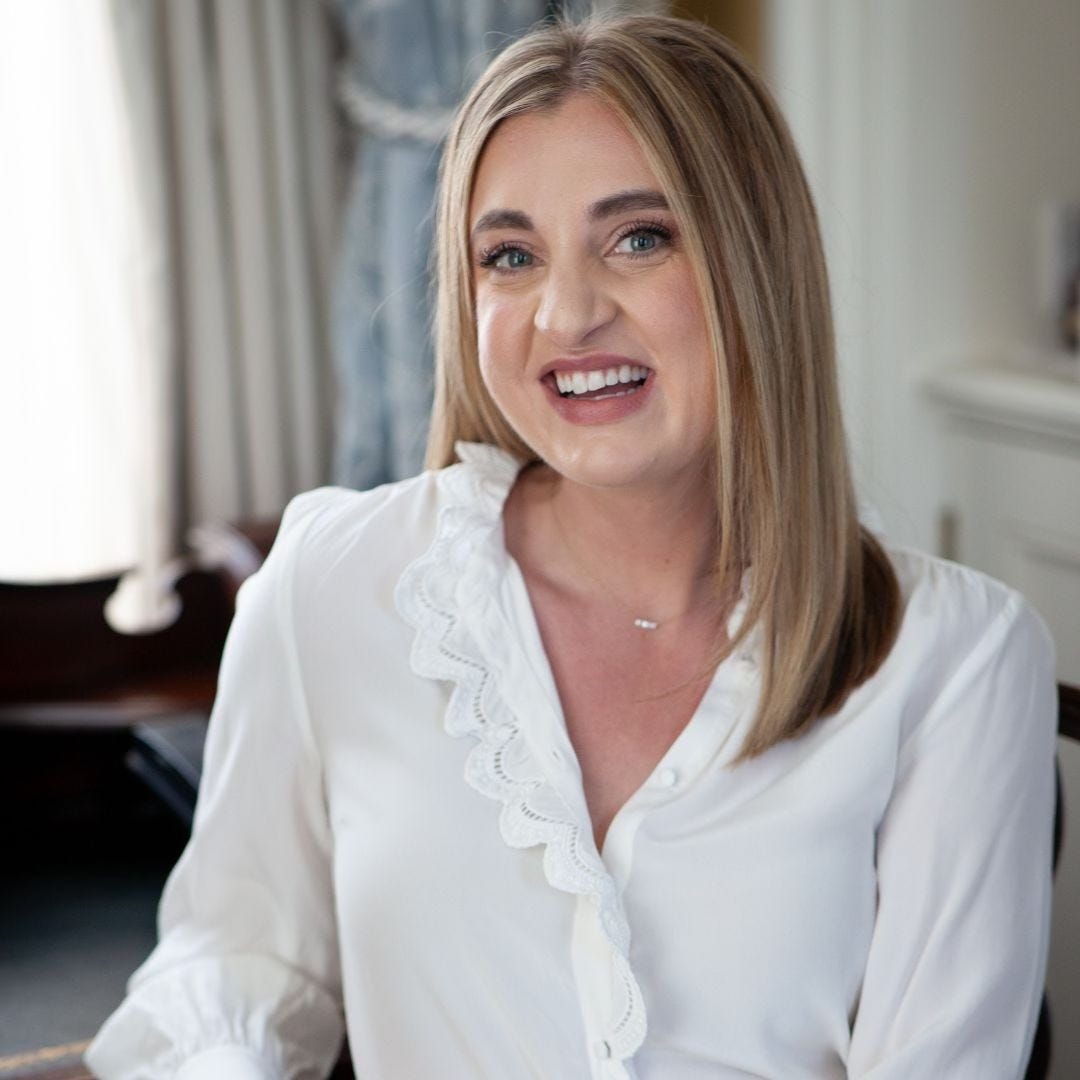
Whitney Haldeman on London, Letting Go, and Women-Only Travel
The founder of Blonde Atlas and Atlas Adventures on building a 15-person agency from London, and the hotels she can’t stop talking about.
1. Tell me about your background. What led you to luxury travel? How did you decide to create your own agency? Who are you hosted under?
I actually came to luxury travel in a fairly roundabout way. I spent almost a decade in advertising after university, working across both tourism and destination accounts and, later, in the luxury space as the social media lead for Infiniti. So I had experience in both worlds, but it really never occurred to me that they could become a career together. At the time, I still thought of travel agents as something slightly antiquated.
The turning point came when I was laid off at the advertising agency where I was working. I took my severance and decided to do something I had always regretted not doing at university: study abroad. I jokingly called it my “adult study abroad.” I started traveling extensively and blogging about the places I was discovering, mostly because I loved sharing them. Friends and acquaintances began coming to me for recommendations, and eventually those recommendations started turning into itineraries and early travel-planning work.
My friend Chelsea Martin had already entered the travel industry and kept telling me, “You need to do this properly. You need to join an agency.” She was really the person who helped me understand that there was this entire modern luxury travel-advisor world that I hadn’t known existed.
Through Chelsea, I eventually met Jack Ezon while we were scouting hotels in Greece. I was immediately drawn to the way he operated: incredibly knowledgeable and direct, but also warm, generous and magnetic. I had a very instinctive sense that these were people I wanted to build alongside.
That ultimately led me to Embark Beyond, which is based in New York and has been my host agency ever since. They’ve given me the infrastructure, relationships and support to build my own businesses while still allowing me the independence to create something that’s mine. Looking back, it makes perfect sense that I ended up here: the advertising background, the luxury experience, and most importantly…my obsession with travel. All were pieces of the puzzle… I just couldn’t see the picture yet.
2. Tell me about your move to London. What drove you to make the move, and what has surprised you most about the experience of living there vs the US?
The funny thing is, I started talking about moving to London before I had even visited. I was going through a period of enormous personal and professional change, and I had a growing feeling that I wanted to spend more time abroad. Even before some of those changes happened, I remember looking into maternity-leave cover roles in Europe or anything that might let me try living somewhere else for a few months without completely uprooting my life.
Then, when a few of the things that had been keeping me rooted started to fall away, Europe suddenly felt much more possible. London seemed like a natural place to start: it was international, incredibly well-connected and, most importantly for a first move abroad, everyone spoke English.
I actually visited London for the first time already wondering, “Could I live here?” Initially, I thought I might transfer through my advertising agency and get sponsored that way, but a few months later I unexpectedly lost my job. That plan disappeared, and I went off on what I called my “adult study abroad” instead.
But London kept pulling me back. I spent the entire month of September 2016 here, essentially trying on a life in the city, and that was when I really fell in love with it. I came back again for November and December, so by the end of that year I had spent three months here. Without realizing it, I was already planting the seeds of the life I have now…making friends, learning the neighborhoods, building a community and beginning to feel at home.
It still took me another four years to actually move. Brexit was happening, immigration rules kept changing, and I would start down one visa route only to have the goalposts move again. I was also building my travel business, but I was a very early-stage independent advisor, which didn’t exactly make me an obvious candidate for sponsorship.
Then COVID happened. I had always dismissed the idea of coming over as a student because the visa restrictions around running my business made it impractical. Suddenly, no one was traveling anyway. I thought, “If there were ever a moment to do this, this is it.” So I enrolled in a master’s program in International Events, Leisure and Tourism Management and finally moved to London in September 2020. By then, I had spent more than a year here cumulatively, squeezing every possible legal day out of my visits.
Six years later, it’s still my favorite place in the world.
What I love most about London is that it feels like the best of both worlds. There is an incredible energy and ambition here. It’s a city full of interesting, entrepreneurial people doing interesting things…but I find the attitude toward life outside of work much more aligned with how I want to live. People take their holidays. The pubs spill onto the pavements at the end of the workday. There seems to be a greater acceptance that having a full life outside your career isn’t somehow at odds with being ambitious.
And as someone whose entire life revolves around travel, London is extraordinary. It feels as though the world is at your fingertips. But you also don’t necessarily have to leave London to experience it: the city is such a collision of cultures, nationalities, food, art and ideas that you can feel transported simply by crossing town.
There have also been plenty of smaller cultural adjustments. I arrived assuming it would rain constantly; I’ve learned that London is much more likely to give you four seasons before lunch. I am considerably more conscious of the volume of my American voice than I used to be. I wear far less athleisure. And I’ve become very good at appreciating the sun the second it appears. I could probably write an entire essay on the tiny differences between American and British life, but I think that’s part of what I love about living abroad. Six years later, I’m still noticing them.
3. How do you structure your team? What do you handle personally vs what do you delegate?
The team has hugely evolved over the years. I started as a team of one, and today there are over 15 of us across two distinct sides of the business: our bespoke travel-advisory business, where we plan individual trips for private clients, and our group-travel company, which creates and operates hosted trips around the world.
We currently have four dedicated travel designers, a team of planners who develop and lead our group trips, and several people across operations and administration (plus outsourced teams for taxes, finance, etc). As we’ve grown, my own role has naturally shifted from executing every detail myself to setting the creative direction, nurturing our industry relationships and making sure we’re continually raising the bar on what we’re recommending and creating.
A significant part of my job now is being the tastemaker for the business. I travel extensively, attend industry conferences and trade shows, meet with hoteliers and representation companies, and do as many site inspections as I can. I spend a lot of time maintaining relationships with everyone from hotel sales teams and GMs to owners. Luxury travel is an incredibly relationship-driven business, but it’s also one where firsthand knowledge really matters. I want us to know not simply that a hotel is good, but exactly who it is good for.
We’ve built an extensive internal knowledge-management system so that what I learn doesn’t stay in my head. I’m constantly sending the team voice notes, contacts, photos and observations from the road: which room category I’d book, who the GM is, what has changed since our last visit, which client immediately came to mind when I saw a particular property.
On the client side, my travel designers increasingly project-manage the relationship: the onboarding, communication, research and itinerary development…while I work closely with them on the creative direction. I’m often involved at the inception of a trip: understanding what the client is really asking for, helping shape the itinerary and making sure we’re matching the right person with the right places. Then my team can take that vision and bring all of the details to life.
Our group trips work similarly. I tend to start with the big picture: Where should we go? Which hotel feels right? What would make this trip distinctive? What experiences are worth building around? What price point are we trying to achieve? From there, the team takes that framework and develops it into an actual trip, with me continuing to weigh in at key points along the way.
I’ve had to learn that delegation doesn’t have to mean completely removing yourself from something. For me, it’s much more collaborative. My job now is to stay close enough to protect the taste level, relationships and point of view that built the business in the first place, while giving an incredibly capable team the ownership to actually run with it. That’s probably been one of the biggest evolutions for me as a founder: realizing that my highest-value contribution isn’t doing more of the work myself, but creating the direction, standards and knowledge that allow everyone else to do their best work.
4. What kind of boundaries do you enforce to protect personal time from work spillover?
I think anyone in this industry who tells you they have perfect boundaries is probably lying! I’m still figuring this one out.
I’ve become much more intentional about protecting my attention, rather than simply protecting certain hours. I use an app called Opal to block particular apps at different points in the day. Social media, for example, is an important part of our business, but I’ve largely delegated the day-to-day management of it. If I open Instagram to do one specific thing, it’s incredibly easy to look up 15 minutes later and wonder why I went on there in the first place. So during much of my workday, I actually block it.
I’m experimenting with doing the same thing with my inbox where I create periods when email simply isn’t available to me. With a team spread across different time zones, calls can inevitably creep later into the evening, and sometimes the most difficult boundary is simply forcing myself to close the laptop.
Having a very capable team has made a huge difference. I’m no longer the person who needs to personally respond to every client email or keep every deadline moving. But I’ve also had to accept that there is simply more incoming communication than I could ever respond to: partnership requests, people asking if we’re hiring, people wanting advice about getting into the industry, requests for recommendations, invitations, introductions. I’ve had to learn that someone having access to my inbox doesn’t automatically mean they have access to my time. I truly want to be generous and helpful, but I also have to accept that I can’t respond to everyone and still have the kind of life I want outside of work.
Ironically, though, one of my biggest challenges with boundaries isn’t that I resent the work…it’s that I love it! I love my team, I love coming up with ideas, and I find the industry so fascinating. It’s very easy for one idea to turn into another and suddenly we’re still going hours later.
Travel blurs that line even further. Even when I’m traveling personally with my husband, I might want to see a hotel while we’re there, meet the GM or send my team a voice note because I’ve just discovered something I know a client would love. But I’ve stopped thinking that a perfect boundary means work and life can never touch. This career is inevitably woven into my life, and for the most part, I really enjoy that.
So for me, the goal isn’t perfect separation. It’s making sure work is integrated into my life without being allowed to consume it. Some weeks I’m better at that than others.
5. If you could go back and tell yourself anything about what your life would look like now, what would you say to your younger self?
I think if you told me ten years ago what my life would look like today, there are parts of it I definitely wouldn’t have believed. I never imagined I would build a business of this scale, live in London, have the financial independence I have now, or spend my life traveling to and staying in some of the most extraordinary places in the world. On paper, so much of my life looks beyond what my younger self would have known to dream for.
But I also think she’d be surprised by some of the things that haven’t happened yet. I’m approaching 40 and I don’t have children yet. We’re only just now in the process of buying our first home. There are milestones I probably assumed, without ever really questioning it, would have happened by a certain age.
My friend Annie once said to me that by 40, almost every woman could write a book called Not Exactly How I Thought Things Would Turn Out. That stuck with me, because I think it can be true in both directions. Some things don’t happen when or how you thought they would, and that can be painful. And then other parts of your life become bigger, richer or more interesting than you ever had the imagination to plan for.
So I think what I’d tell my younger self is actually something I’m still trying to tell myself now: hold the vision for what you want, but hold the timeline and the exact picture of it a bit more loosely.
I’ve always been someone who works incredibly hard and has a very clear idea of where I’m trying to go. That has served me very well. But life isn’t a checklist, and I’ve learned (and am still learning) that you can do all the “right” things and still arrive somewhere different from where you expected. But that doesn’t necessarily mean you’ve arrived in the wrong place.
I’d tell her to keep showing up, keep working hard, keep being curious and keep building a life that feels meaningful. You don’t have to know exactly what it’s going to look like. There will be things you desperately want that take longer than you hoped, and things you never thought to ask for that turn out better than your wildest dreams.
And I suppose I’d tell her that you can be incredibly grateful for the life you have built while still deeply wanting the things that haven’t arrived yet. Those two things are allowed to be true at the same time.
6. Why do you think there’s such a gap in our industry between male and female leaders? What pushes women away from leadership in travel and hospitality?
I don’t pretend to have a definitive answer to this, but it’s something I’ve thought about a lot because travel is an interesting industry when you look at where women are represented versus where they’re still underrepresented.
On the travel-advisor side, women are an absolute force. In the U.S., eight in ten travel agencies are women-owned (ASTA 2025 Fact Sheet) and I’ve watched the profession grow tremendously in recent years. Anecdotally, many of the newer advisors I meet are women, and one of the things that attracts them to the profession is the ability to build a career with some degree of autonomy and flexibility. You may be answering an email at 9 p.m., but perhaps that means you could do school pickup at 3 p.m. There is an ability (particularly as an independent advisor or agency owner) to design your working life in a way that more traditional corporate structures don’t always allow.
Where I still notice a disparity is as you move into some of the more traditional power structures within hospitality. There are incredible female GMs, owners and executives whom I admire, and I absolutely see that landscape changing. But senior hotel leadership, ownership, investment and certain executive roles have historically been much more male-dominated.
Part of the challenge, I suspect, is the structure of some of those careers. Hospitality can require huge personal flexibility. It can ask you to relocate for the next opportunity, to be responsible for a hotel 24/7, or to spend a significant amount of time traveling. Those demands can become complicated during the same years when people are building families. And in a society where women still frequently carry more of the responsibility at home, I don’t think we can talk about the leadership gap without acknowledging that context.
What’s fascinating is that women already power so much of this industry. Travel and hospitality are fundamentally about relationships, communication, attention to detail, problem-solving and understanding people. We all know there are extraordinary women doing that work at every level.
So perhaps the question isn’t whether women have the skills or ambition to lead…they obviously clearly do. It’s whether we’re continuing to create structures that allow talented women to progress into leadership without requiring them to choose between professional ambition and the rest of their lives.
I’m optimistic because I do see it changing. I encounter more female founders, owners, GMs and senior executives now, and I think visibility matters. The more women see other women building companies and occupying those positions, the less exceptional it feels—and the more it simply becomes another version of what leadership in this industry looks like.
7. Tell me about your travel schedule. How frequently do you travel for work and personally?
It really ebbs and flows. On average, I’m probably taking one or two trips a month, but the reality is much less evenly distributed than that. I’ll have stretches when I’m barely home and then deliberately carve out longer periods when I’m not traveling at all.
To put it into perspective, in 2025 I took more than 50 flights, flew approximately 72,000 miles, spent 110 nights in more than 45 hotels and traveled across 13 countries. I’m on track for a fairly similar year in 2026.
The flow tends to be somewhat seasonal. I often travel less during peak summer because that’s when everyone else is traveling, destinations are more crowded, and London is amazing at that time of year anyway. Then I’ll have periods like March through May was this year, when I’m barely home. September onward can be busy again, then I usually slow down around the holidays. But it truly depends on the year.
I’m also increasingly trying to stack trips together. I’d sometimes rather do trips back-to-back, accept that I’ll be exhausted by the end of them, and then come home for a longer stretch rather than constantly doing three days away, four days home, three days away again. I’ve realized I really value having enough time at home to actually settle back into my life.
A lot of my schedule is dictated by what the business needs. I’m already thinking about destinations we may want to use for Atlas Adventures in 2028, which means working backwards: Where do I need to scout? When do I need to experience it? How can I see it outside peak season while still understanding what it feels like at its best?
Then there are trade shows and industry events. I don’t necessarily attend the same ones every year. I might do ILTM one year and PURE, DUCO, Experience Africa or something else. I’ll also travel for hotel openings, hosted trips, site inspections and occasionally to join one of our own Atlas Adventures trips.
And then sometimes an extraordinary invitation lands in my inbox two weeks beforehand and completely destroys whatever sensible travel schedule I thought I’d created! So there’s definitely no neat formula. I’m trying to be increasingly intentional about why I’m getting on a plane, but one of the privileges of this career is that sometimes the answer is simply: this is an opportunity I really shouldn’t miss.
8. What are your top 3-5 favorite hotels?
AN IMPOSSIBLE QUESTION! (I really do struggle with absolutes… it depends on the day you ask me and my mood! I was also just debating the World’s 50 Best Hotels list with some friends and asking: what exactly makes something “the best”? Some of my favorite hotels in the world weren’t even on it! I also think there’s an important distinction between a hotel I can objectively recognize as exceptional and one that I personally feel deeply connected to. The latter is usually what makes my favorites list.
Passalacqua, Lake Como is probably number one for me. Valentina De Santis has become a friend, and she’s also someone I admire greatly (especially as a female hotel owner.) There is such warmth to the entire experience, and the attention to detail is extraordinary. Nothing feels generic or overly manufactured. It has personality, soul and a real sense of generosity. The more closely you look, the more you notice amazing details (where often, that’s where you’d start to see the cracks).
Singita is technically cheating because I’m choosing an entire collection rather than one hotel, but I’ve never been to a Singita property that didn’t feel incredibly special. Their commitment to conservation and the communities surrounding their properties is fundamental to what they do. And then somehow they pair that sense of purpose with spectacular locations, incredible teams, beautiful design and exceptional food. I find what they’ve built incredibly inspiring and I will always be evangelical for the brand!
I’m going to cheat again and say Belmond. I have such an affinity for the way they approach hospitality. So many of their properties are intertwined with the history and identity of a destination, and I love the balance they strike between preserving the sense of place and making it feel relevant and luxurious today. There’s an old-world romance to Belmond that really speaks to me. Asking me to choose a single Belmond might be a step too far!
FORESTIS in the Dolomites has one of my favorite hotel views anywhere in the world. There’s something about being there that immediately grounds me. The food is extraordinary, but what I particularly love is that the luxury doesn’t feel “try hard”. It’s simple and connected to its surroundings. Everything feels thoughtful but without feeling overdone.
Apparently my criteria for a favorite hotel are becoming clear as I answer this: a strong sense of place (even if it’s an overused phrase in the industry), exceptional people, beautiful design, wonderful food and, above all, soul. The hotels I remember aren’t necessarily the ones with the most marble or the longest list of amenities. They’re the ones that make me feel something.
9. Tell me about your retreats. Why are they female-only? How do you structure them for the right pacing, select the right hotels, and choose your locations?
Our group trips are called Atlas Adventures, and they really came out of something I personally wanted and couldn’t find.
I was newly single at the time and really craving both travel and community. I wanted to see the world, but I didn’t necessarily have someone who could (or wanted to) go everywhere I wanted to go. When I looked at organized travel, I felt caught in this strange gap: I was too old for the Contiki-style party trip and far too young for the traditional retirees-on-a-coach model. I actually ended up going on a yoga retreat largely because it was the closest thing I could find to the kind of group travel I was looking for. But I didn’t necessarily want a yoga retreat. I wanted a really great trip, with lots of exploration and interesting people.
That’s ultimately what became Atlas Adventures. I made them female-only because I loved the idea of creating the kind of girls’ trip I was craving myself. I’m a huge believer in prioritizing female friendships and girls’ trips at every stage of life. There are so many reasons someone might not have a built-in travel companion at a particular moment: perhaps you’re single, your friends are having children, your friends have different holiday budgets, or you simply have different ideas about how you want to travel than your partner/friends. I never wanted someone to miss out on seeing the world because they were waiting for the right person to go with them.
We describe the trips as “by women, for women.” My team is female, and all of our trips are women-only. We have made the occasional exception though… we did run a New Zealand trip where women could bring their partners, which felt appropriate because my husband is a Kiwi and helped me lead it. But the heart of Atlas Adventures is still the girls’ trip.
And importantly, they’re not built around one particular hobby. You don’t have to be a yogi or a foodie or an art obsessive. They’re for curious women who want to experience the best of a destination and feel really alive while they’re doing it. That might mean an architecture tour in the morning, a cooking class in the afternoon and rosé by the pool afterwards. We want there to be substance, but we also want it to be fun.
The flow is something we’re incredibly thoughtful about, and it changes with every destination. One of our rules is that we only operate trips in places we’ve experienced firsthand. When I’m scouting, I’m constantly thinking about the eventual rhythm of the group: Where do we need to slow down? Is this somewhere people will want an afternoon by the pool? Is this experience actually worth getting up at 6 a.m. for? How much can we realistically fit into a day before it stops being enjoyable?
We’ve also learned a lot simply from operating these trips over the years. The first 24 hours have a completely different energy from day five, when everyone knows one another and friendships have formed. We generally find that around seven days is the maximum (you want everyone to leave while they’re still wishing they had another day together, rather than after they’ve had time to get sick of each other!) We can always offer an optional extension for those who aren’t ready to go home.
Hotels are a huge part of the equation. Obviously there are practical considerations like if rooms twin properly for women sharing… but I’m equally interested in how a hotel facilitates the social experience. Is there somewhere lovely to gather for a drink before dinner? A pool where everyone will naturally congregate? Can you walk out the door and explore? Does it have enough personality that staying there actually contributes something to the trip? My relationships within the hotel industry are hugely helpful because we can really understand a property before committing to bringing a group there.
Destination selection is probably equal parts strategy and instinct. I’m constantly discovering places through my own travels, trade shows and relationships with suppliers, and I’m paying attention to destinations that are evolving or particularly interesting at that moment. But I’m also asking: Would I actually be excited to take a group of women here?
And increasingly, our alumni help answer that question. We have a very strong repeat community (typically more than 30% of the women on a trip have traveled with us before) so we survey them about where they want to go next, and those responses often influence where I scout.
That’s probably the thing I’m proudest of. I started Atlas Adventures because I personally wanted community, and somewhere along the way, the community became the product as much as the travel itself. The destination may be what gets someone to book the first trip, but very often it’s the women they meet who bring them back for the second.
10. How do you balance being available to clients and being present when you travel?
Honestly, the way my team is structured today is what makes that possible.
Most clients initially find me through Instagram, referrals or email, but I’ve been very intentional about communicating that planning a trip “with me” really means planning a trip with my team. I’m still very much behind the experience sharing my knowledge, directing the creative, making recommendations and meeting one-on-one with my travel designers. But we’ve built systems that allow that expertise to flow through the company without requiring me to personally be the conduit for every email or decision.
I actually think that makes us better at what we do. If I were trying to be every client’s sole point of contact while traveling extensively, I’d inevitably have to choose between being responsive to the person at home and being fully present in the destination I’m supposed to be learning about.
Instead, there’s strength in numbers. We have people managing the client relationship, others building the scaffolding of the itinerary and an operations team keeping everything moving behind the scenes. That frees me (and increasingly other members of my team) to be properly present when we’re on the road.
Because being present is really the point. If I’m inspecting a hotel, I want to notice which rooms I would actually book, how the breakfast experience is at 9 a.m., whether the pool gets sun in the afternoon, who on the team is exceptional, what the neighborhood feels like when you walk outside. I want to have dinner with the GM, meet our partners and ask the questions that aren’t answered on a fact sheet. Those are often the tiny pieces of information that eventually make a client’s trip better.
There is absolutely a place for great DMCs and local partners (we work with some wonderful ones) but we’ve also invested hugely in building our own collective knowledge. Between my travels and those of my team, we can bring a tremendous amount of firsthand experience to the planning process. So I’ve stopped thinking of my travel as time away from my clients. It’s part of the work I’m doing for them. The challenge is making sure the company is structured so that I can put my phone away long enough to actually absorb where I am, knowing that someone excellent is taking care of things at home.
Ultimately, every time one of us travels, the entire team should come back knowing more.
If you enjoyed this week’s Master Key, please upgrade to a paid subscription to continue receiving the best of my brain, more interviews like this one, and articles such as the following.
