

The Upgrade Weekly
🗝️ The Upgrade | Weekly by Anne Marie Brown
Issue 15 · Why is everyone becoming a travel agent? My take on Fora.
In The Upgrade this week:
Pre-Departure – My take on controversial tech company/travel agency Fora
The Room Report – The newly opened Delano Miami
The Lobby Bar – This week’s Lobby Bar covers a LOT this week. Ennismore is heading toward a U.S. IPO at €3.2 billion with an Airbnb partnership as the potential demand story; Aspen Hospitality launched Nell Hotels with The Nell New York opening fall 2027, and The Little Nell closes April 2027 for a full renovation; and sooooo much more
Travelers,
This week’s The Upgrade is a spicy one. If you’ve chatted with me in the last year, you know I have strong opinions about Fora – the latest disrupter in our little corner of the luxury travel industry. I’ve been part of controversial companies in the past, so I’m equally fascinated by and concerned about this one. I also sit on the board of a VC company, so spend a lot of time hearing pitches from tech startups, and so put on my investor hat to look at the SWOT analysis of this one.
This weekend, I also went to the WORLD CUP third place game in Miami, because YOLO. I stayed at the Delano, so the Room Report is my take on this very swanky, very beige and white, newly renovated hotel.
Happy travels,
Anne Marie
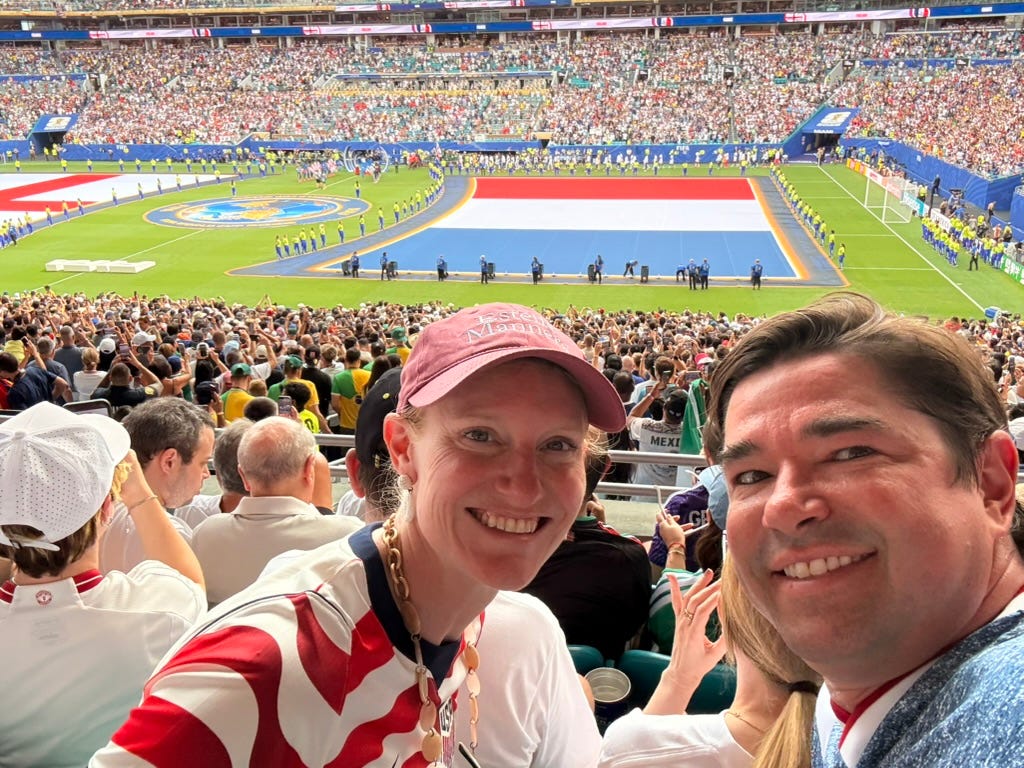
Yours truly at the World Cup Game in Miami this weekend
🗝️ Pre-Departure — Hospitality Hot Takes
Why is everyone becoming a travel agent? My take on Fora.
I ran into an old colleague last week. We’ve known each other for 18 years, and worked together at Exclusive Resorts, Inspirato, and Coastline, dovetailing each other at the latter two. When I asked what he was doing, he said, “I’m with Fora.” At a recent industry lunch with a sales rep for a new luxury hotel, a fellow attendee said, “This may be controversial, but I’m with Fora.” I received two emails from acquaintances yesterday who are thinking about becoming travel advisors, who both asked, “Should I just sign up with Fora first?”
If it seems like many of your acquaintances or people you follow on Instagram are announcing that they are becoming travel agents, Fora is likely the engine behind it.
I’m a luxury travel advisor, (not hosted under Fora), and have built my career first through growing up in a family that owned a hotel company, Outrigger Hotels, and then through helping create the Once in a Lifetime program at Exclusive Resorts and the Journeys and Bespoke programs at Inspirato. I’ve consulted for Airbnb and Under Canvas Adventures (preparing them for sale to KSL), and sit on the board of several hospitality companies. I live and breathe the travel industry.
If you are thinking about becoming an agent, or have recently joined the ranks of Fora, here’s my travel advising 101 guide: Everything You Want To Know About the Travel Advising Industry
Fora has made it possible for almost anyone to become a travel advisor
Fora is a host agency, meaning it acts as an umbrella organization under which independent travel advisors build their businesses. For those of you wondering how one becomes a travel advisor, there is no official test you must take. An IATA number – a travel company’s registration with the International Air Transport Association – serves as a form of licensing. It is the way that hotels track and pay commission via systems like Onyx.
Getting access to an IATA number used to require letters of recommendation, demonstrated sales volume, and executive background checks. Now it’s as simple as joining a host agency, which handles your commission tracking and payments in exchange for a cut of your commission.
For $299 a year and no sales minimums, anyone can join, complete training, access Fora’s supplier relationships, and start booking travel for commissions.
According to Fora’s statements to Fortune and Forbes (July 2026), and their “About Us” page, 97% of their 15,000 advisors had never sold travel before joining. 86% are women. Co-founder Henley Vazquez, a former Virtuoso agency owner and Travel + Leisure A-Lister, has publicly described the opportunity as “the new real estate” for women looking for a career change or additional income.
Can you make money by joining Fora?
The short answer is “yes,” with a caveat. Travel advising is typically an “eat what you kill” job, and for most advisors new to the industry, building a book of business takes time and financial investment.
Commission splits start at 70/30 with Fora taking 30, moving to 80/20 once an advisor hits $300,000 in annual bookings, and 90/10 at $2 million. The $299 annual fee covers access to the platform, training, Fora’s IATA number, and supplier partnerships including Virtuoso, Four Seasons, and Rosewood Elite.
These Preferred Partner programs, as well as Virtuoso, provide clients who book through agency members with benefits, such as upgrades, late check outs, breakfast, and resort credits. Every major host agency has access to these programs. Fora calls them “perks”, Coastline calls them “benefits.” It’s a major selling point of working with one of these agents.
These commission splits mirror those of other major host agencies such as SmartFlyer, TravelEdge, and Coastline. The difference is that you are on your own. You have access to Fora’s training docs and their tech, which is arguably the best I’ve seen in the business, but you don’t have a mentor or senior advisor giving you leads or helping you create relationships with suppliers.
When your commission from a hotel is 10%, and your host agency is taking 30% of that commission, you are making $7,000 annually if you book $100,000 in travel. That’s decent ancillary income to subsidize a travel budget for your average family, but it certainly doesn’t replace a full-time job.
Travel Weekly’s data notes that among advisors who have been in the business two years or less, 74% earn under $25,000 annually. At three to five years, that drops to only 47%.
I remind new sub-ICs (i.e., agents in training) that the learning curve is steep regardless of where you start. I spend most of my year traveling personally, meeting with hotels and destination management companies, and attending industry conferences for training and connections. The advisors who excel at this job, whether they’re at Fora or anywhere else, tend to have put in real time learning, traveling, and researching.
Why is Fora so popular?
The first group attracted to Fora appears to be social media influencers
Frankly, I should have realized something like Fora was coming. A few years ago, I said that influencers were the next set of travel advisors as they looked to monetize their platforms.
One of the hardest things to solve for in the luxury travel space is the top of the sales funnel, and social media influencers who post about travel already have that piece in place. Being able to earn commission from their content is a logical next step, which is why we see Tik Tok’s new partnership with Booking.com or platforms like Stay22 becoming popular with influencers.
However, a great content creator does not necessarily make a stellar travel advisor – they are distinct skillsets.
The second group is women looking for additional household income
The pandemic shifted work habits, and as companies are now calling people back to the office, many women are saying “Hell no, I won’t go.” Everyone has friends who travel. What if they booked with you and you made some money off that side hustle? Many of these moms are the ones who handle their own family’s travel plans, so planning travel for others looks like a natural outgrowth of that experience.
What is controversial about Fora?
We are approached weekly by people wanting to work on our team at Alpenglow Travel, and we turn many of them away. To join us, we require a new advisor to have an established network, experience booking travel or experience in a travel or another hospitality role, and the drive to book more than $100,000 annually, which is our breakeven point for carrying the cost of hosting a sub-IC.
Several of the people who approached us about being sub-ICs were already Fora agents. Naturally, I asked about their experience with Fora. The resounding response was that they loved the technology, but with some caveats.
These agents expressed that they felt like they were on their own under Fora. They had access to all this information, but no one to help them navigate it. They also seemed to feel slightly less respected as a Fora agent among other industry professionals.
On the industry side, hotel sales directors I have known for years expressed frustration to me at the flood of Fora advisors requesting FAM trips (familiarization trips that suppliers and hotels put on to show off their services or property to a group of agents), or agent rates, which are discounted rates that hotels offer to travel agents.
I do think they are actively trying to address the issues mentioned above.
With a $1B valuation and 15,000 advisors on its platform, Fora has become hard to ignore. They seemed to have taken the “move fast and break stuff” approach, much like Uber and Airbnb did in their early days, to gain enough volume to strong arm their way into the industry.
Why the Industry Has Mixed Feelings
The traditional path to becoming a travel advisor is slow by design and is usually something of an apprenticeship model. You come up under a senior agent, spend years learning supplier relationships, build a book of business gradually, and earn your independence over time.
Fora compresses that training timeline significantly, and does not pair new agents with an established travel professional. I am not trying to gatekeep here and if it sounds like I’m a snob about new agents creating their own companies, that’s not my intention. My concern comes from the feeling between Ai platforms and Fora, the agency world is becoming the Wild West of booking.
An experienced advisor’s skill set takes time to develop, and even then, mistakes happen. I made one last week that cost me $3,000. Newer agents just don’t have that kind of financial backing to make it right if they mess up. One point I do find interesting – all Fora advisors are covered under the company’s errors and omissions policy, underwritten by Berkshire Hathaway, with a $10,000 deductible and a $3 million overall limit. The coverage applies to claims brought against Fora in the United States, and advisors must maintain clear Fora affiliation in their marketing to remain eligible. So, if something goes wrong, the claim runs through Fora, not the advisor directly.
However, the policy is explicitly designed not for routine mistakes, but for significant errors or liability exposure. So, my $3,000 error would likely not have been covered. As an affiliate agency hosted under Coastline, we are required to hold our own E&O policy that covers all our sub-ICs.
The proliferation of inexperienced advisors means more errors, more escalations, and more strain on hotel sales teams that are already managing high volume. Henley Vazquez, one of Fora’s co-founders, has addressed this directly. Her counterargument is that suppliers want bookings, and Fora is delivering net new demand that wasn’t previously coming through the trade channel. This sounds suspiciously like the OTAs (online travel agencies, e.g Expedia and Booking.com) argument. I don’t think this approach works in the luxury sector, where higher dollar amounts require higher attention to detail and more experience.
However, Vazquez is correct that the model is working at scale.
For a small boutique hotel, the argument of scale is attractive. Rather than forking over 25% to an OTA like Expedia, a small, independent hotel can have access to a large network of agents via Fora’s plaform for just 10% commission.
The question I have for travelers is: What does it mean to book a $30,000 trip with someone who joined Fora six months ago because they loved planning their own vacations? Do you trust your friend enough to hand over that kind of money to someone with close to zero training or licensing?
They are getting better
In talking with my friend yesterday, it seems that Fora is now trying to take a step back and address some of the original issues I noted above. Are all 15,000 advisors on their platform full-time advisors looking to make a career out of being a travel agent? Hardly likely.
Fora has not publicly released how their sales volume is distributed across their 15,000 advisors. They have disclosed that their top 100 advisors and agencies generated more than $200 million in 2025, with approximately 40 of them booking more than $2 million each (https://www.foratravel.com/newsroom/fora-announces-centum-2026-honorees).
That’s 0.26% doing meaningful booking volume.
In contrast, Coastline, the host agency that we are under, hosts around 450 advisors, and 50 are booking more than $2M annually, which is 11%.
My friend posits there are probably a few hundred Fora agents booking more than $1M annually, which is typically the baseline benchmark in our industry of a decently successful advisor.
However, there are likely thousands booking $100,000 or less in gross sales.
Fora has instituted a tiered system for advisors, defining the tiers as Classic, Pro, and Fora X. This was introduced at some point after Fora’s 2021 founding, likely as a response to industry criticism about inexperienced advisors accessing supplier perks without production requirements.
FAM trips, travel agent rates, individual Virtuoso login, IATA card, and CLIA membership (Cruise Lines International Association) are now all gated behind Fora Pro status, which requires $100,000 in annual commissionable bookings, 10 unique clients, and five client reviews. New advisors do not have access to any of those benefits from day one. Pro tier advisors can only access 3-5 agent rates a year, and no property they haven’t booked before.
The predatory players
The problem with the gap in training and mentorship is that external, predatory players are trying to fill that role. Every day, there are courses and coaches popping up like mushrooms promising to train these new agents in aggressive sales tactics. Some of them are straightforwardly predatory, structured more like MLMs than professional development programs. When you see a proliferation of courses promising passive income through travel, that’s usually a sign that someone has figured out how to monetize aspiration. Just try posting on a Reddit travel forum and you will be flooded with direct message requests asking if you’d like to work with a travel advisor.
Fora is not in that category. The founders have industry credentials, the supplier relationships are legitimate, and the technology is better than most of what exists in this space. Their AI assistant, Via, handles destination research, itinerary drafting, and proposal generation, which frees up advisors to spend time on the relationship side of the work.
I’m hoping to meet some of the Fora folk at Virtuoso travel week because I’m fascinated by their disruption in the industry.
There’s no denying that Fora has become a major player
Putting on my investor hat, here’s my take. They just raised a $60M series D yesterday and, as noted earlier, have a $1B post-money valuation. To put that in perspective, Outrigger sold for roughly the same number after our family spent close to 100 years building the company.
Total funding is now at $138M, backed by Thrive Capital, Insight Partners, Forerunner Ventures, Heartcore Capital, Tactile Ventures, and (oddly) Amy Schumer. Their advisors have collectively booked $3 billion in travel since launching in 2021. It took three years to reach the first billion. The third billion took five months.
I’m an investor in a handful of VC funds in the travel space and I sit on the board of Denver Ventures. Am I just slightly jealous that I didn’t think of this concept or invest in it early? Absolutely. Amy Schumer bested me there.
However, I think their business is likely more vulnerable to being replaced by Ai platforms than the traditional host agencies, at least at the lower levels.
As AI becomes more sophisticated, a newbie agent without much experience becomes relatively interchangeable for one of these platforms that a client can self-service, with less risk involved. As an investor and a board member of a VC fund, that would give me pause.
However, Fora is a tech company that operates a travel agency, not a travel agency that happens to have developed good technology. One obvious pivot is for Fora to offer AI-assisted planning directly to the consumer, or to license their tech to other agencies. I think these potential opportunities is what is driving their valuation.
The $1 billion valuation is also partially built on advisor volume and platform growth, which creates pressure to keep the top of the top of the funnel wide, welcoming as many new agents as possible.
The result is an industry with more advisors than ever, significant variance in quality, and travelers who may not know the difference until something goes wrong.
My takeaways and what to know before you book
Just like working with an Edward Jones advisor for your investing, it’s hard to go wrong with a straightforward hotel booking. Hotel platforms are relatively ubiquitous across Virtuoso agencies that have developed these skins sitting on top of GDS (global distribution systems) that tie into hotel reservations.
If you’re booking a relatively easy trip, a Fora advisor who specializes in your destination and has a track record of bookings can absolutely deliver. Ask how long they’ve been booking travel, what their volume looks like, and whether they have specific experience with the properties or region you’re considering. A good advisor, at any agency, will have direct answers to those questions.
For complex, high-value itineraries, treat finding your travel advisor the same as you would interviewing financial advisors. Look for someone with years of experience, direct experience traveling at the level you travel at, and supplier relationships they’ve built over time. Interview past clients who aren’t their friends and family.
If you are thinking about joining Fora as an advisor…
Are you just booking for yourself and friends and family? If yes, then absolutely join Fora. It’s low cost and their tech is great.
Are you willing to do a lot of your own research for training? Join Fora and sign up for all the trade publications, like Travel Weekly. Become an ASTA (American Society of Travel Advisors) member and take their training courses. Listen to Tique Talks and sign up for their Niche program. Don’t fall for other training courses -- most are a scam and will spew word salad at you without any real understanding of the industry.
If you want to make a serious career out of this, find a host agency and ask them what affiliate agencies are taking on new Sub ICs. Smartflyer and Coastline are probably the largest ones with the newest tech and younger millennial agents who are adapting to the world of AI the fastest.
The Regulation Question
The industry will eventually respond to the volume of new entrants with some form of standardization or credential requirements. It will take a few years of consumers reporting agents to the Consumer Financial Protection Bureau (CFPB), or a handful of lawsuits.
I was asked in an industry publication interview yesterday whether I am anti-Fora.
The answer is no, I do think they have a role that needs to be filled. There is clearly a market for people who want to book travel at the hobbyist level, but don’t want to make a career out of it. Fora is the perfect entrance into that market, letting people get their feet wet before they decide if they want to be a serious advisor. (Yes, I am aware there are some Fora advisors who take the job very seriously and do quite well in their own right, just not the same percentage as you see at other host agencies).
My problem is more with their market positioning, their broad stroke approach to giving people access to book travel for others without much training, and what seems like a lack of support for newer advisors.
🗝️ Room Report — The Delano, Miami Beach


This weekend, my husband and I YOLO’d our way to the World Cup third place game in Miami to watch England and France more goals than I thought possible in a soccer game. When deciding where to stay, naturally I chose the newly-opened Delano, Miami. After watching Nadine @the Stanza’s interview with Jonathan Goldstein of Cain Capital, I wanted to go check out this renovation project myself.
The Delano opened in 1947 on Collins Avenue, designed by Robert Swartburg as an exercise in post-war optimism. For decades it sat alongside the rest of the Art Deco district, which by the 1970s and ‘80s had seen most of its sophisticated clientele migrate to Europe and the Caribbean.
Ian Schrager bought the building in 1995, hired Philippe Starck, and reopened it as something Miami had never seen. Starck designed the interiors as a series of “living rooms” assembled from the furniture and objects of a specific childhood memory, mismatched on purpose and scaled for comfort rather than formality. The billowing white curtains at the entrance became a signature of the hotel, and could be why the entire place is white today. Madonna celebrated her birthday at the Blue Door restaurant, which she co-owned.
The property closed in March 2020. Eldridge Industries acquired it and brought in Ennismore (the hotel collective owned jointly by founder Sharan Pasricha and Accor) to reopen it. Because it’s a Sharan property, there’s a membership club aspect, like Estelle Manor.
The reopened property has 171 rooms across standard categories, poolside Bungalow Suites, and Penthouse Suites. The renovation outlay was roughly $100 million in capex. Elastic Architects restored the original terrazzo floors, hexagonal lobby columns, and the vertical paint banding on the facade.
My take:
I almost never send clients to a hotel in its first year of operation because there are bound to be hiccups. As a hotelier, I fully expected to encounter some during my stay, and I definitely did.
I stayed in an Ocean View King room for $755 per night, and it felt like a bargain for South Beach standards. However, the room did feel small. The first night, our AC wasn’t fully functioning, but they had it fixed the next day. The service elevator was….not in service for the entire weekend. This meant that not only were housekeepers and other staff using the elevators, which meant it took forever to get anywhere, but they also were moving furniture in to the higher level suites and penthouse units over the weekend, so moving crews were hauling boxes through those same elevators. I would probably have rescheduled that move if I were the GM.
I did spot Sharan walking around with other executives – they were there for the World Cup. That was an exciting moment for me as I wore my Estelle Manor cap all weekend.
The pool and restaurant spaces are lovely and feel more like a Pasricha property than the rest of the hotel. The all-white décor in the penthouse units I found felt a little soulless, (and I’m working on an article about the beige-ification of hotels as suppliers source all their FF&E from the same companies), but it could just not be my vibe. I’m more maximalist British mansion than “Clean Girl” aesthetic any day.
I will take a moment to acknowledge the staff, who were exceptionally warm and every single person went out of their way to ask how our stay was. We befriended the French bartender and met up with him at the World Cup Game. The concierge, Jelena, was a delight and took time to show me the penthouse and the rest of the property on one of her busiest days.
Ennismore is actively expanding the brand globally, with Delano Dubai open since October 2024 and Maison Delano Paris since April 2023.
🗝️ The Lobby Bar — Hospitality updates, promotions, and the occasional pun
Ennismore is heading toward a U.S. IPO at a valuation of roughly €3.2 billion, the floor of the analyst range, because investors are pricing it as a hotel collection rather than a demand platform; Rafat Ali argues in Skift that a distribution deal with Airbnb is the move that closes the gap, and if it happens, it changes how properties like The Hoxton, Mondrian, and 25hours reach travelers.
Aspen Hospitality has launched Nell Hotels as a standalone brand, with The Nell New York opening fall 2027 inside Rockefeller Center as a Relais & Châteaux property; more immediately, The Little Nell closes April 2027 for a full renovation and will not reopen until the 2027/28 ski season, per the Aspen Times.
Aman and OKO Group are in permit review for an 81-room hotel at the base of Aspen Mountain, part of a 320,000-square-foot Lift One corridor redevelopment that city officials call potentially the most complex build in Aspen history, with no groundbreaking date confirmed, per Aspen Journalism.
Kygo’s Palm Tree Crew acquired River Valley Ranch Golf Course in Carbondale in partnership with Major Food Group and 8K Capital, with plans to add MFG dining and cultural programming to the 187-acre course roughly 30 miles down-valley from Aspen, per the Aspen Times.
W South Beach closes August 20 and reopens late 2027 as Waldorf Astoria Miami Beach, with Reuben Brothers converting all 348 suites, the pool deck, spa, and food and beverage program after paying over $400 million for the property in 2024, per Hotel Dive.
Aman appointed Victor Clavell as Chief Operating Officer, a scale hire with a resume spanning Ritz-Carlton, Bulgari, EDITION, W, and Rosewood, timed to Amanvari opening in East Cape Mexico next spring and Aman Dubai targeting 2027, per Hospitality Net.
Delta’s premium cabin out-earned economy for the first time, with first class and premium tickets generating $6.92 billion against the main cabin’s $6.85 billion in Q2 2026, part of a record $17.67 billion quarter, per CNBC.
The World Cup did not lift international arrivals to the U.S. in June, with overseas visitors down 1.8% year-over-year despite match-driven surges from the UK, Ecuador, and Colombia, while Germany, Argentina, South Korea, and Canada all fell by double digits, per Skift.
The DOT officially restored the 2011 standard on airline fee disclosure, rolling back the 2024 rule that required upfront transparency on baggage and seat fees after the Fifth Circuit vacated it earlier this year, per ASTA.
Patina Osaka scored a rare 100/100 to take the top spot in this year’s Travel + Leisure World’s Best Awards, with Castiglion del Bosco winning best hotel in Italy and The Fifth Avenue Hotel taking best in New York City, per SmartFlyer.
Super interesting read on Fora. My impression of Fora agents is much like what you and this comments section reflect: a lot of hobbyists but not best for agents who want to build a serious travel advisory business. I'd be interested to know how you select the right host agency, and on the flip side, how do hotel sales teams view these various host agencies (beyond what business they bring)?
This was a thoughtful and fair dissection, Anne Marie, and I agree with many of your concerns about what scale has done to the brand. I joined Fora early, when there were only a few hundred advisors globally, because it positioned itself as a modern agency and genuinely delivered on that promise. The technology was and remains excellent, the training was included rather than sold as another layer, and the accessible entry point allowed me to begin while I was still working full-time and hustling in hotels. For someone with decades of hospitality experience but a new travel-advisor business, that mattered.
The issue is what happened next. At 15,000++ advisors now, many with limited personal travel or industry experience, the Fora name no longer signals the same level of expertise it once did. In my view, that growth has diluted the brand and made the individual advisor’s niche, experience and judgment far more important than the host affiliation. Included training is valuable, but doesn't replace being an experienced traveler or hospitality professional.
From the hotel side, however, I still understand the commercial logic. Paying a 10% commission to an advisor who knows the client and can generate well-matched, repeat business is generally more attractive than paying 20% to 25% to an OTA with little relationship or context. The industry created those distribution economics; Fora simply made the game more accessible. Standards and education matter enormously, but perhaps this is still a case of don’t hate the player, hate the game 😉