


🗝️ The Upgrade | Weekly by Anne Marie Brown
20. The Upgrade | Weekly – How Do You Evaluate Risk in Travel?
Travelers,
I’ve been in the luxury travel industry professionally for 18 years. My colleagues used to joke that I had the worst luck, as the small group trips I was assigned to run at two luxury destination clubs would invariably be the trips that encountered emergencies. While stressful, these early experiences in my 20’s managing evacuations, extreme weather, lost passports, etc taught me how to stay calm in just about every situation abroad, and gave me an interesting perspective on evaluating travel risk.
Today, as an agency owner and advisor, I am still the person handling those emergency calls. Every few months, I open my news feed and know my day is about to be highjacked by hurricanes or other news.
That is the nature of travel - we leave our safety zones and venture out into a world where we don’t have as much control over our environment.
In today’s The Upgrade Weekly, I evaluate various risks we take in luxury travel voluntarily, and the ones out of our control.
Happy travels!
Anne Marie
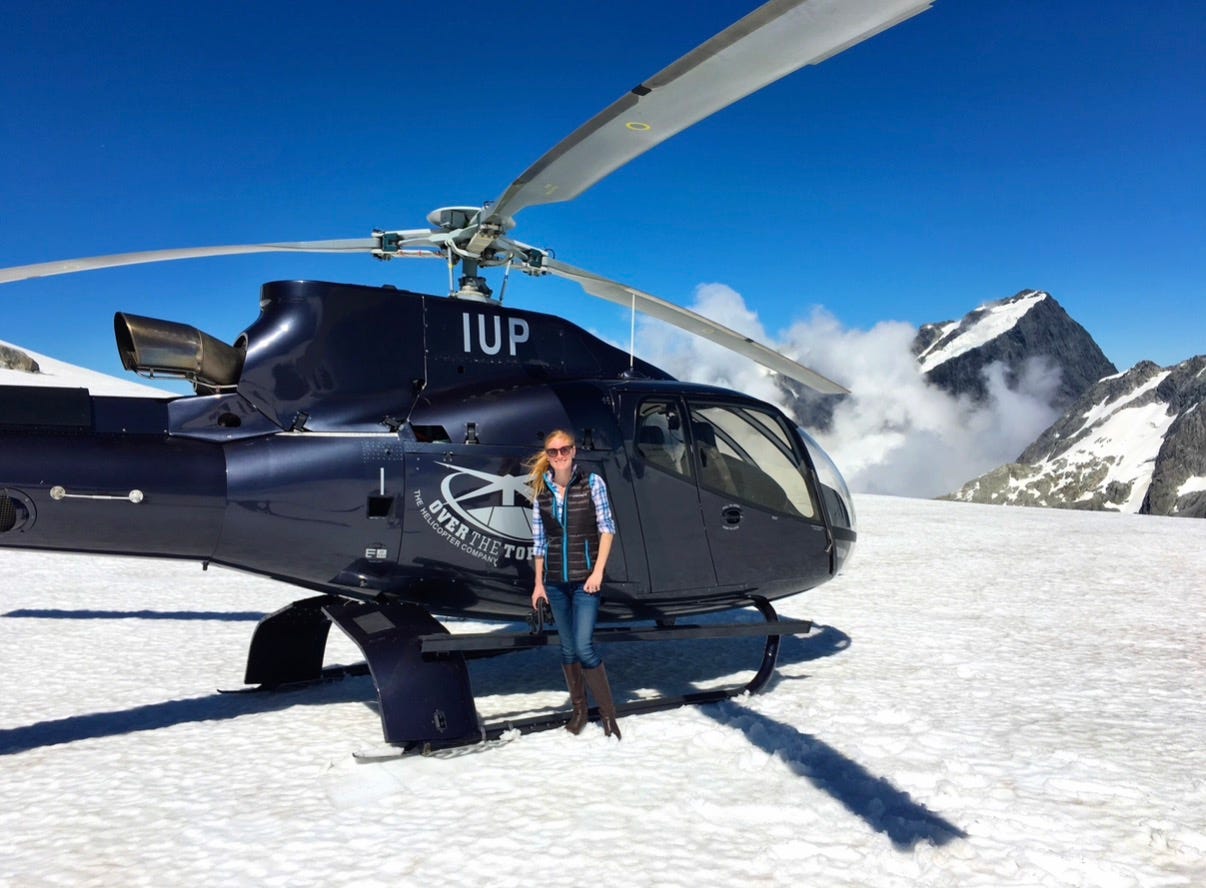
Yours truly, taking a helicopter to land on a glacier in New Zealand
🗝️ Pre-Departure — Hospitality Hot Takes
Helicopters, Bush Planes, and Hurricanes
Two helicopters carrying travelers went down within about 48 hours of each other this week, leading me to ruminate on risk in travel.
On August 17 a Bell 206 JetRanger crashed near the Greek island of Sifnos, killing Marie Ebert, 30, and Alexander Cromie, 31, a British couple on their honeymoon, along with their pilot, Giorgos Raikos, 53, a former air force officer everyone described as highly experienced. Greek investigators are examining a possible tail rotor failure, and the civil aviation authority pulled Bell 206s from service pending review.¹ ²
Two days later, a Eurocopter EC130 B4 operated by Lady Lori Helicopters went down in the foothills of Mount Ololokwe in Samburu County, northern Kenya. It was carrying six guests of luxury safari company &Beyond from Loisaba Conservancy toward the Ewaso Nyiro area.³ Seven people (including the pilot) died, five of them Americans.⁴
Evaluating risk and creating a game plan in the form of a “worst case scenario handbook” was part of my job at Exclusive Resorts and Inspirato. Over my career in the luxury travel industry, I’ve had to deal with just about every sort of disaster. I’ve evacuated a chartered cruise of 400 clients in the middle of Greek austerity riots, found an emergency dental surgeon on an island when a client knocked his teeth out, rescheduled chartered flights in the Galapagos when volcanic ash clogged the air, and repatriated the body of a client who suffered a stroke in Antarctica.
Let’s talk about how to assess risk, the likelihood of encountering an emergency, and how to cover your bases so you are as prepared as possible should you experience one while traveling.
What pilots say about single-engine helicopters
There are risks outside of your control, like weather or political violence, and then there are risks you choose, such as your mode of transportation.
I want to like helicopters – they seem like an adventurous choice and often, the easiest route to get from point A to point B. But, for as many times as I’ve flown on them, I’ve never felt comfortable.
From a business standpoint, I’ve always been concerned when a client books one, and in my previous two companies, we were not allowed to include them as part of any client itinerary. As I’ve gotten older and had children, I’ve started evaluating the risks I take differently. I’ve flown in four helicopters in my life, and I think the one we flew on in Kenya last January was the last one I will take.
Many of my clients are fearful of the small bush planes used to get from safari camp to safari camp. Are they riskier than helicopters, or about the same?
Both the EC130 and the Bell 206, the helicopters involved in last week’s crashes, have one engine. The working pilots who weighed in after the Kenya crash in a Reddit thread on ChubbyTravel kept noting that fact, along with the following information.
An airplane that loses power still has wings and becomes a glider, buying the pilot some time to seek a potentially safe landing spot. A helicopter that loses power enters autorotation, using airflow through the falling rotor to keep the blades turning and somewhat soften the landing. Autorotation is helpful, though it is a demanding maneuver with a very short window, and its success in saving lives depends on altitude and terrain.
One commercial pilot in the Reddit thread said he can lose both engines on a jet and still land safely, but that he does not want anyone he loves in a helicopter for any reason. Another kept returning to the number of moving parts in a rotor system, and said what he trusts least is maintenance he cannot verify in a country whose oversight he does not know.
What the numbers say about helicopters vs fixed wing aircraft
In a typical year, the US records 95-130 civil helicopter accidents, with between 17 and 30 of them causing fatalities.⁵
Non-commercial fixed-wing airplane accidents came in at 5.67 per 100,000 hours in the most recent full AOPA (Aircraft Owners & Pilots Association) analysis, with 0.87 fatal.⁶
NTSB data, via AOPA’s Air Safety Institute (formerly the Nall Report), shows helicopters have a higher accident rate than fixed-wing GA.
Here’s the apples-to-apples comparison between helicopter accidents and small, fixed wing airplane accidents for 2023, the most recent complete year, non-commercial category for both:⁷
Non-commercial fixed-wing: 3.86 accidents per 100,000 flight hours (0.65 fatal)
Non-commercial helicopter: 4.86 accidents per 100,000 flight hours (0.69 fatal)
That’s about 26% higher for helicopters on total accidents. In 2022 it was 4.30 (fixed-wing) vs 6.48 (helicopter). In 2021, 4.28 vs 6.75.⁷ Separately, NTSB data cited by TorkLaw puts general aircraft at 7.28 crashes per 100,000 hours vs 9.84 for helicopters, a 35% higher rate.⁸
How about Hawaii?
In the US, one of the most dangerous places to take a helicopter is Hawaii, where I was born and raised. Thousands of tourists a year take helicopter rides in Hawaii, and every year as I grew up, we would see a crash make the news.
The Islands have recorded 38 tour helicopter accidents since 2000 and 45 deaths, 25 of them on Kauai, while tour flight volume climbed roughly 67 percent since 2010.¹² This past March, a Hughes 369D built in 1979 went down off Kauai’s Na Pali Coast, killing three people.¹³
Now, let’s compare that to the odds of dying in a car crash.
The National Safety Council puts lifetime odds of dying in a motor vehicle crash at 1 in 101.
Lifetime odds of dying in an air or space accident, general aviation included, are around 1 in 5,051.⁹
Death by lightning odds are roughly 1 in 79,746.
Being killed by a shark: about 1 in 4.3 million.¹⁰
Comparing Africa to the US
It’s hard to find much clean data for bush flight crashes in Africa, so treat this with a grain of salty skepticism, but it gives us a place to start.
Between 2015 and this month, I count five fatal accidents on light fixed-wing aircraft carrying tourists in sub-Saharan Africa, killing 33 people¹¹.
Over the same period, I count two fatal accidents on helicopters carrying tourists, killing 12.
OK, how does this compare with the volume of flights?
Wilson Airport in Nairobi handles about 120,000 aircraft movements a year. Maun logged 46,747 in 2023, Kasane another 11,042, and Arusha 27,050 in 2024. Those four hubs alone generate over 200,000 light fixed-wing sectors annually, even before counting any camp airstrip-to-airstrip legs.
There are far fewer helicopter flights. Kenya’s entire civil helicopter register held about 67 aircraft as of 2020, most privately owned, with just a handful flying tourists.
Therefore, based on the volume, helicopter accidents are somewhere between three and eight times more likely than small fixed-wing aircraft per flight in this setting.
Bush fixed-wing flights are flown daily by commercial pilots with many hours in the cockpit on routes they know well. In comparison, safari helicopter flying is typically charter based, single-pilot, low and slow over unimproved terrain.
The accident databases typically undercount, excluding aircraft under six seats and leaving helicopters out almost entirely, and crashes that kill only local nationals draw a fraction of the coverage of Western tourist deaths.
The role of bias in travel risk assessment
Now that we’ve covered helicopters and bush planes, let’s zoom out and talk about general risk. In my masters program at Darden (UVA), we discussed the role of biases in decision making. I see two biases play out as my clients evaluate risk around their travel plans.
Recency bias weighs whatever just happened far more heavily than everything before it. When my clients have just read about a helicopter crash in the African bush, they are more likely to believe this will happen to them should they go on a safari.
Vividness bias (aka availability heuristic) judges likelihood by how fast an example springs to mind. Vivid, recent, emotional examples arrive instantly. For example, if you just read an article about a horrific shark attack, you’re more likely to think sharks are a greater danger than getting struck by lightning.
What about other travel risks?
Flight disruption
It’s completely reasonable to be worried about your flight being cancelled or delayed, and missing part of your trip. This is probably the likeliest travel risk of all.
In a normal month, about 1% of scheduled US flights are canceled and roughly 76% arrive on time.¹⁴ This year has not been normal.
The Iran conflict that began in late February and the subsequent disruption to the Strait of Hormuz interrupted the global oil supply, raising the cost of jet fuel by 31% in a single month. US airlines spent $2B more on fuel this March than in March 2025.¹⁵
Faced with rising costs, airlines shrank their routes and in May alone pulled 2 million seats out of global schedules to conserve fuel.¹⁶
What happens when your flight is cancelled? Fewer flights reduce rescheduling options. Travelers who used to get rebooked within hours now wait a day or two because the empty seats that absorbed them last year have evaporated.
Hurricanes, Hawaii vs the Caribbean
How likely are storms to interrupt your trip?
The Atlantic and Central Pacific hurricane seasons both run June 1 through November 30.
The Atlantic season peaks around September 10, with the highest likelihood falling mid-August to mid-October.
Looking specifically at Mexico, a major hurricane makes direct landfall on the Yucatán Peninsula roughly once every four to five seasons, and Cancún has taken only two major direct hits in the history of modern tourism.
In April, the Colorado State University forecast for 2026 predicted 13 named storms, six hurricanes, and two majors (Category 3 and higher) that might affect the Cancún area, below the 30-year averages.¹⁷
This summer, Hawaii got hit hard by back-to-back Kona Low storms in the spring and, less than two weeks ago, a hurricane (Lala). As I write this, another tropical storm (Moke) is expected to affect the Islands.
In more than 70 years of reliable records, only three hurricanes have made direct landfall on the Islands, all on Kauai: Hiki in 1950, Dot in 1959, and Iniki in 1992. Iniki arrived as a Category 4, killed six people and damaged or destroyed about 14,000 homes.¹⁸ I was 7 when Iniki blew in. I remember leaning into the wind on our seawall (on Oahu, which got off lightly) and being held as if in suspension.
Three landfalls in seven decades is a very different exposure from one every four or five years. Hawaii’s realistic weather risk is heavy rain and high surf, but rarely an entirely spoiled trip.
Fires
With rising temperatures across Europe, fire danger has become a true summer travel risk.
So far this year, France has experienced widespread fires. Spain has seen more than 350,000 hectares burn. Portugal evacuated three districts, and a single Coimbra fire disrupted over 2,000 kilometers of road. France also experienced massive wildfires, and over on this side of the Atlantic, Canada counted 1,747 wildfires by June 10.¹⁹
Political unrest
On February 23, Mexican authorities killed the leader of the Jalisco New Generation Cartel. The cartel’s retaliation shut down parts of western Mexico. The US embassy told Americans in Jalisco to shelter in place, roads to the Puerto Vallarta and Guadalajara airports were blocked, four major carriers suspended flights, and cruise lines canceled port calls.²⁰
I had a lot of clients in Puerto Vallarta or heading there for spring break. I fielded multiple requests for cancellations, rebooked people for Hawaii or San Diego, and stopped taking any new bookings for other clients the entire week. People worried about putting their children in harm’s way for a vacation by traveling to an area they saw as suddenly unsafe.
When they asked my opinion about whether they should still go, I told them that I’m not the best barometer for risk. Because I’ve worked in this industry for so long and seen (and dealt with) so many emergencies abroad, I just have a much higher risk tolerance for certain things than others. I also have a flexible job that I can do from anywhere, so flight disruption doesn’t bother me much. I still took my family to Punta Mita for spring break.
As much as my client would like to believe I have a crystal ball, I can only provide information and context.
Let’s examine the actual risk profile.
No violence was reported at major Mexican resorts. While taxis stopped and the military patrolled the beaches, guests stayed on property with amenities running. Cancún, Tulum and Los Cabos were untouched, and within days airlines were flying again. The worst my clients experienced while there was an extra day – comped by their hotels.
Events like this tend to be local, short, and experienced as a logistics problem.
The largest risk here was flight disruption, not violence affecting tourists. However, that means little coming from me when my client is worried about their children getting hurt on vacation – that’s the vividness bias rearing its incandescent head again. No one can tell you to spend your money on a vacation to a place you are going to feel uncomfortable in.
How to reduce the damage
You cannot lower the odds of a hurricane, a fire, or political unrest. The fact is, that you can experience travel emergencies just about anywhere in the world. People often overestimate how close incidents are to the areas they will be traveling, and the news thrives on sensationalizing such events. If there’s a shooting in New York, does that mean you won’t travel to New Jersey?
I’ll bet the people planning to travel to Minnesota this spring hardly imagined that clashes with police and ICE might interrupt their trips when they were booking their flights.
However, there are ways to protect against the costs of disruption when you do experience it.
Cancel For Any Reason Travel Insurance (CFAR)
I will not book travel insurance for my own travels without this policy coverage. CFAR raises a policy’s cost by 40 to 50 percent and reimburses 50 to 75 percent of prepaid, non-refundable trip cost. You must purchase it within 14 to 21 days of your initial deposit (depending on the plan), insure 100 percent of your prepaid cost, and cancel at least two to three days before departure.²¹
I recommend this for any trip whose cost is larger than a client is comfortable losing, especially when the trip hinges on one nonrefundable element like a villa or a mobile camp, or when we book hurricane season. For a $3,000 trip on flexible rates, it’s not worth it. $15K? Absolutely.
Storms
Standard policies cover weather, with one catch: once a storm has been named, it becomes a known event, and coverage for it can no longer be purchased. Good Caribbean and Mexican resorts publish storm policies covering closure or evacuation during your dates. Ask for one before you plunk down your deposit.
Buffer days
Book one night in the departure city ahead of anything you cannot miss, like a cruise departure. It’s the cheapest protection money can buy.
Evacuation coverage, especially for Antarctica and Africa
In East Africa, AMREF Flying Doctors membership covers air evacuation to Nairobi, and I encourage clients to carry Global Rescue or Medjet on top of it. Standard travel insurance often will not pay for a helicopter lift out of the bush.
On whether you should still go
I tell my clients that if they are going to be stressed out about the level of risk they imagine they are taking during their trip, it’s not a vacation. However unlikely a small plane crash, cartel event, or natural disaster is to affect your trip, it matters little if you aren’t going to enjoy the experience because you’re terrified the entire time.
Even if you are aware of cognitive biases and know there is little likelihood of an event impacting your trip, you should still recognize that perceptions of risk can feel powerful.
However, if you can be calmed by data, be aware that major disruptions are extremely rare and with good planning your experience will be fairly smooth.
Personally, I do not mind risk. Travel carries risk. But so does driving to the grocery store.
What I will not do is put clients on a helicopter. That is a choice they have to make themselves.
🗝️ The Lobby Bar
Hospitality updates, promotions, gossip, and the occasional pun
United is adding Denver to Paris. Daily 787-9 service to Charles de Gaulle starts March 27, 2027, which makes Paris the fifth nonstop European city out of DIA behind London, Munich, Frankfurt, and Rome. (9NEWS) I’m forever a United girl, so this makes me unreasonably excited.
Black Tomato’s founders sold 75% of the company to their own staff. Altruistic move or liquidity play? The deal closed in early July and employees found out August 24, with Tom Marchant and his co-founders holding 25% through a new share class that keeps decision-making with them, so an operator that posted £3.09 million in operating profit in 2024 stays out of private equity hands. (Tasmin Lockwood, Skift)
Investors are buying tired hotels and fixing them. US hotel sales rose 28% in the first half of the year as owners who will not fund renovations sell to buyers who will. (The Wall Street Journal)
Rosewood strung four of its Mexico properties into one eight-day trip. Guided by Rosewood Mexico moves you through Mayakoba, Mandarina, San Miguel de Allende, and Las Ventanas al Paraíso with cenote swims, artisan workshops, and desert dinners, and there is no published rate, so every itinerary gets priced on request. (Paula Conway, Forbes)
The resort behind “Dirty Dancing” is coming back. Don’t put Baby in a corner. PPG Development, a Florida firm that paid $14.75 million for the overgrown Grossinger’s site in Sullivan County in June 2025, wants a year-round luxury resort and residential community on the old Borscht Belt property. Family summer camp? Sign me up! (Times Union)
Travel Substacks are pulling readers away from the glossies. Colin Nagy argues a newsletter with 10,000 subscribers who book trips is worth more than a feature seen by millions, with the catch that the writing only holds up when the person has stayed in the room. (Colin Nagy, Skift) As a bonus, Colin Nagy listed The Upgrade in his Substacks to read! My little publication keeps chugging along. Thanks for reading it.
Sources
Mechanical issue suspected in Greek helicopter crash that killed honeymooners, pilot, UPI, August 18, 2026
Sifnos Helicopter Crash Kills British Honeymooners; Tail Rotor Failure Probed Amid Greek Safety Gaps, Tech Times, August 18, 2026
Seven killed in EC130 helicopter crash during Kenya safari flight, AeroTime, August 2026
Seven people, mostly foreign tourists, killed in helicopter crash in Kenya, Al Jazeera, August 19, 2026
FAA Rotorcraft Accident Dashboard, U.S. Helicopter Safety Team, FY2025
Nall Report, Non-Commercial Fixed-Wing, AOPA Air Safety Institute
McSpadden Report figure view, AOPA Air Safety Institute, https://www.aopa.org/training-and-safety/air-safety-institute/accident-analysis/richard-g-mcspadden-report/mcspadden-report-figure-view
TorkLaw
Odds of Dying, National Safety Council Injury Facts, 2024 data
Annual Risk of Death During One’s Lifetime, Florida Museum, International Shark Attack File
No survivors in Mombasa Air Safari Grand Caravan crash in Kenya, AeroTime, October 2025
Tour Helicopter Crashes, And Flights, Have Escalated In Recent Years, Honolulu Civil Beat
NTSB releases preliminary report on Kauaʻi helicopter crash, Maui Now, April 19, 2026
Air Travel Consumer Report, U.S. Department of Transportation
Jet Fuel Shortage 2026: Flight Cancellations, Surcharges and Your Passenger Rights, AirHelp
Airlines Cut 2 Million Seats Worldwide in May Alone, IBTimes UK
Cancún Hurricane Season 2026: Forecast, Risk and Smart Travel Tips
Hawaii Hurricane Season 2026
Wildfires 2026 and Travel Disruptions, Riskline
U.S. Embassy Issues Shelter-in-Place Order for Travelers in Puerto Vallarta Amid Cartel Violence, Travel Market Report
Cancel For Any Reason Insurance Is Having a Moment In 2026, Squaremouth via PR Newswire, March 2026
I appreciate your fact based approach to this. Last week, I tried to logic my mom into a zipline activity by telling her that driving down the tollway in Dallas is objectively way more dangerous, but I didn't have any luck :)
I've sold a lot of travel in Latin America, and so I especially appreciated your section about political unrest, because it's exactly like you said - the pattern has always been that big protests flare up quickly, settle down equally quickly, and the places involved often aren't anywhere near our itineraries. I usually could convince clients that was the case, but it helps a lot to have contacts on the ground who can send accurate and rational updates.
I agree about the helicopter risk, I’m glad I have taken a helicopter to see the Napoli coast before I had children, but now don’t think I will be booking any more helicopter tours. Same goes for skydiving, glad I did it pre kids, but it is in the past.