

The Upgrade Weekly has three publications for paid subscribers:
Master Key - deep dive, MBA level pieces behind the business of travel, including interviews with industry members.
Hotel History - where I publish my father’s archives of articles from his Saturday Briefing that he wrote over 40 years as he led our family company, Outrigger Hotels.
Travel Dispatch - my own personal travels and itineraries.
All articles are written by yours truly, Anne Marie Brown, luxury travel professional, co-founder of Alpenglow Travel, hotel investor, Darden MBA, and hotel obsessive.
Design and taste tend to be cyclical. Sanchita wrote about this pattern in an excellent article noting the overlap between Laver’s Law and the hotel renovation cycle, linked here. Laver’s Law is “a timeline of how we view a style as it ages. A look is smart in its moment, dowdy a year later, hideous at 10 years, and ridivulous at 20…at 30 its amusing, 50 quaint, at 70 charming, at 100 romantic.”
Hotels are places that tend to mirror the cultural moment, as we seek third spaces that reflect ourselves. The business traveler may choose a hotel for loyalty status or ease of location, but the luxury traveler selects a property that transports them to the version of their destination they envision.
For about ten years, luxury meant restraint. Aman and The Row became the shorthand for minimalist luxury. Millennial white and modern organic filled our homes, and everyone talked about “quiet luxury.” Hotels sported oatmeal palettes, linen, light woods, and amorphous, rock-hard sofas. We paid up for brand-free clothing pieces that were supposed to build a capsule wardrobe.
In The Upgrade issue 18, I wrote about the great beige-ification of hotels, and why they all look the same. This largely stems from the collapse of furniture supply chains, vertical integration, and the cost of capital compressing development timelines. However, it also requested a desire for stability and calm during the pandemic years.
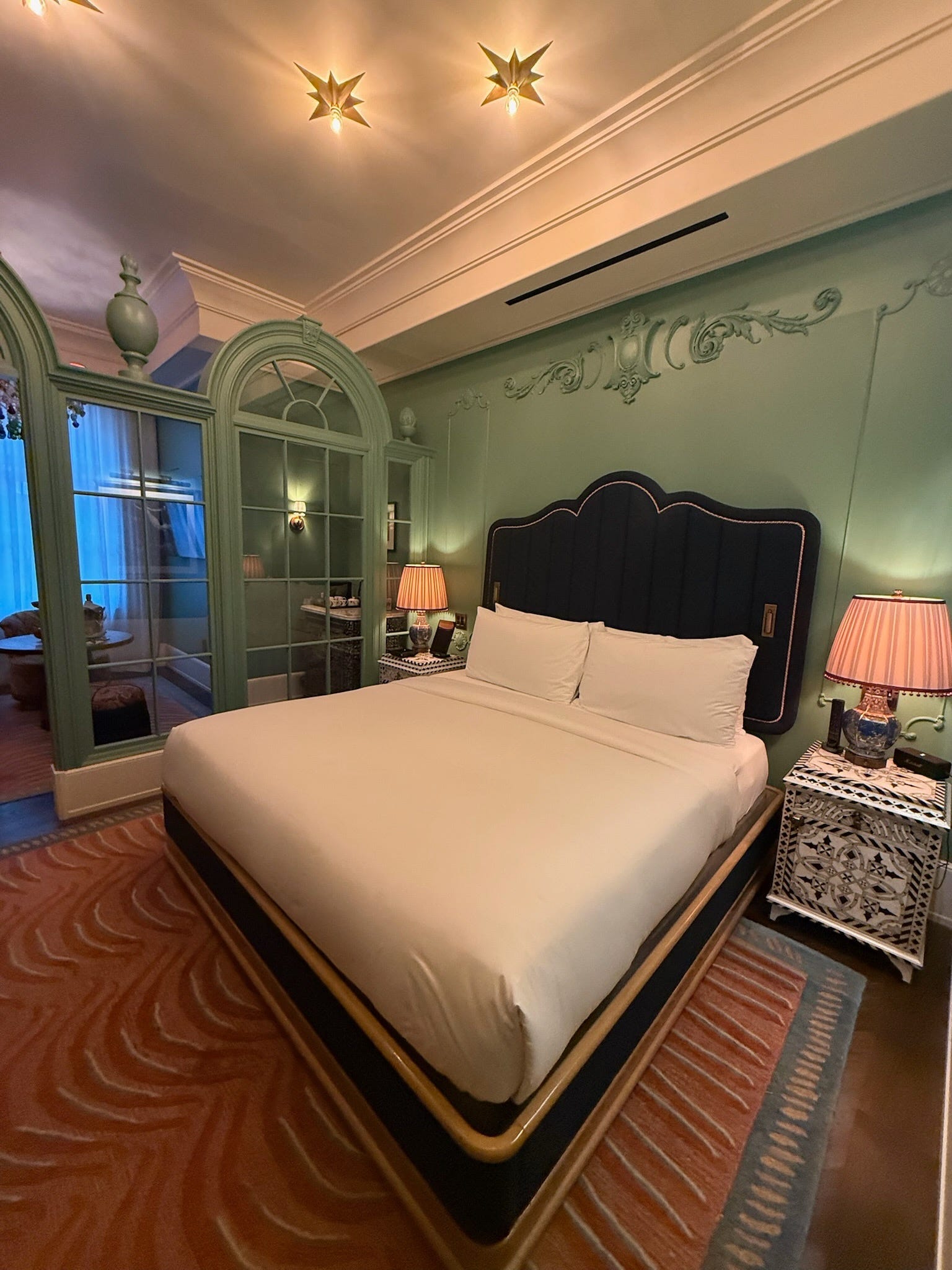
This year, we are seeing a seismic shift. In hotel briefs, hospitality designers are specifying brass, leather and velvet banquettes, mother-of-pearl inlay cabinets for the mini bar, tapestries, and vintage mirrors.
On the runway and in street style, we are seeing silk opera coats with fur trim, brocade and jacquard, beaded pouches, tassels, feathers, brooches, and jeweled headpieces. Pinterest named Neo Deco a defining interior trend for 2026, and British Vogue’s Alice Cary calls the opera coat this season’s answer to understated luxury. Even The Row changed course, with its Paris show for summer 2026 adding feathers and sequins to the runway.
My Christmas list includes a gloriously over-the-top opera coat from Rixo, a tasseled silk handbag, and all the feathered things. My grandmother’s brooches have come out of the safe.
I find this a fascinating convergence between fashion and hotel design mostly because those timelines rarely overlap.
While fashion tends to be quick and responsive, hotel décor specs take years to develop and execute.
Recently, I stayed at The Fifth Avenue Hotel in New York, a jewel box of a property filled with high design, bright colors, rich fabrics, and unique art. I absolutely loved it and wrote about it in the Room Report.
The hotel displays maximalist interiors by Martin Brudnizki, who told Elle Decor he built the hotel’s penthouse suite around a flâneur who has traveled the world and brought it all home. Travel + Leisure readers named it the best hotel in New York. Properties like this, Royal Malawane, and Firmdale hotels are scooping up awards left and right in the hospitality world. They are a far cry from the white, ubiquitous interiors of a Four Seasons that could be anywhere.
Here is what I think this shift says about the current cultural moment and our collective psyche. Let’s start with a history lesson.
The Gilded Age, roughly 1870 to 1900, was America’s first era of mass fortunes. Railroad, steel, and oil money built families like the Vanderbilts and Astors, who showed their wealth through accumulation. (Learn about my take on how American Tourists are the new Dollar Princesses here).
